



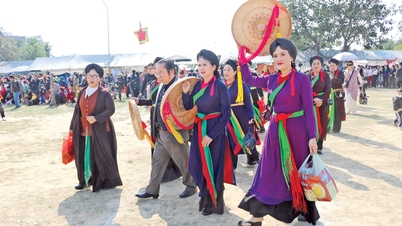
A group of folk singers performs traditional Mường songs to wish families a happy New Year.
In the cultural life of the Muong ethnic group, the traditional New Year is not only felt through the white blossoms of peach and plum trees covering the mountains and forests, or people gathering around a table of five-colored sticky rice and jars of rice wine, but also begins with customs and traditions that have been preserved through many generations. Among these, the "sac bua" singing tradition is particularly noteworthy.
To learn about the art of Sắc Bùa singing, we visited the home of Meritorious Artist Phạm Vũ Vượng in Thuận Hòa village, Thạch Lập commune – considered a leading figure in this art form. At 82 years old, Mr. Vượng still diligently teaches Sắc Bùa singing to the Mường people in the area and to students in schools throughout the province.
Carefully turning each handwritten page, filled with verses and words of the Sắc Bùa folk songs, Mr. Vuong recounted: “For the Muong people, Sắc Bùa folk songs are a beautiful cultural tradition that has existed for a very long time and has been passed down from generation to generation. From childhood, we grew up listening to the Sắc Bùa songs of our parents and the people in our village, so these folk songs have been deeply ingrained in our minds and blood. Even though time has flowed by with countless changes and there have been times when it seemed this melody had faded into oblivion, with love and passion, we Muong people have strived to preserve and bring Sắc Bùa folk songs to life in our community. And so, every time Tet (Lunar New Year) comes around, the Sắc Bùa folk songs resound along with the lively sounds of gongs and drums throughout the villages and hamlets as a greeting and a wish for peace and good fortune for everyone in every home in the new year.”
According to Mr. Vuong, those who sing the "sac bua" songs are called "phuong chuc" (blessing groups). Previously, each "phuong chuc" group consisted of 12 people, corresponding to a set of 12 Muong gongs. Now, there is no longer a limit on the number of participants. Anyone of Muong ethnicity, regardless of age or gender, can join the "phuong chuc" group to wish everyone a happy New Year.
Each group of celebratory singers will have a leader, who must possess a good singing voice, a talent for leading the singing to support the entire group, and the ability to react quickly to situations and improvise lyrics. The songs in these celebratory songs are easy to sing, easy to remember, and close to everyday life, reflecting rituals and customs of greeting and wishing the host a happy New Year, and have a lively and cheerful artistic and cultural atmosphere.
Then, Mr. Vuong began humming a verse of a traditional New Year's greeting: "Today, the first day of the new spring, we have come to wish your family a happy new year. May your family have many buffaloes and cows. May you have a prosperous and successful new year..."
In Ngoc Lac commune, Ms. Pham Thi Hau from Van Hoa village, a knowledgeable person about the "sac bua" singing tradition, said: "Sac bua singing is a cultural activity and custom that creates a beautiful cultural aspect during the traditional Tet holiday of the Muong people. According to the Muong people's belief, at the beginning of each new year, families who are visited by the village's singing troupe to perform the 'sac bua' songs are considered extremely lucky to hear them being sung, praying for prosperity, good fortune, and a peaceful and happy life."
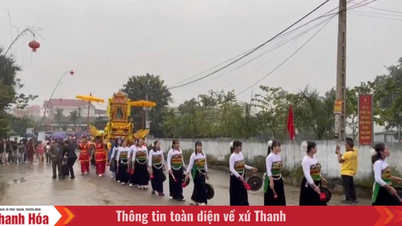
The beauty of the "sac bua" singing lies in the combination of lyrics, singing, and the resonant sounds of gongs and drums. While on their way to offer New Year greetings, the group of people performing the rituals would both play gongs and sing. The songs could be improvised and adapted flexibly to the family circumstances or the audience.
Today, despite many changes in life, the unique lifestyle, customs, and cultural characteristics of the Sắc Bùa singing tradition are still preserved and promoted by the Muong people in various communes. To further spread the beauty of Sắc Bùa singing within the community, the communes of Ngoc Lac, Thach Lap, and Minh Son have devoted considerable attention to the preservation and development of this folk art form. Accordingly, this form of folk culture is not only performed during the New Year celebrations but is also increasingly featured in local cultural events. Furthermore, the artisans and those knowledgeable in Sắc Bùa singing are given support and opportunities to practice, perform, and pass on Sắc Bùa singing to the younger generation. As a result, every time Tet (Lunar New Year) arrives, the melodies of Sắc Bùa songs resound joyfully, expressing the Muong people's aspirations for a happy and peaceful new year.
Text and photos: Nguyen Dat
Source: https://baothanhhoa.vn/sac-bua-ron-rang-vao-xuan-276355.htm
![[Photo] Head of the Central Propaganda and Mass Mobilization Department visits and congratulates the Ministry of Health and the Military Traditional Medicine Institute.](https://vphoto.vietnam.vn/thumb/1200x675/vietnam/resource/IMAGE/2026/02/24/1771938483290_img-2682-3562-jpg.webp)

![[Image] A dreamy "livable city" under pink clouds](https://vphoto.vietnam.vn/thumb/1200x675/vietnam/resource/IMAGE/2026/02/24/1771930060937_tp4-jpg.webp)
![[Photo] White pear blossoms bloom across the border of Pho Bang](https://vphoto.vietnam.vn/thumb/1200x675/vietnam/resource/IMAGE/2026/02/24/1771927665653_a8-8280-jpg.webp)
















































Comment (0)