

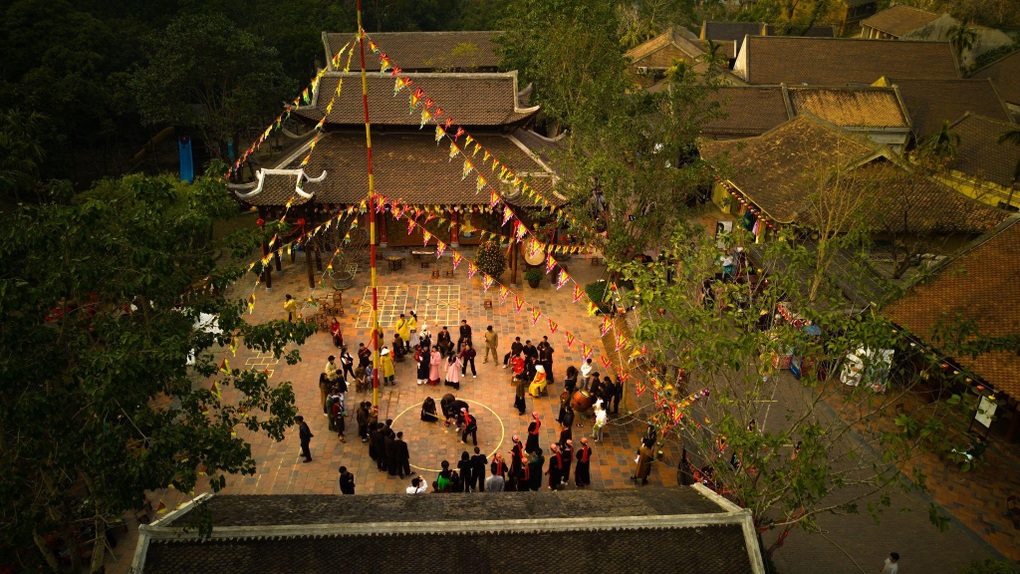
 The communal house of Nuong Yen Tu village at the foot of the mountain during the spring festival (Photo: Tung Lam).
In the early days of the new year, Yen Tu is filled with the joyful laughter and chatter of those returning from afar. Everywhere you look, the atmosphere is imbued with the vibrant colors of Tet (Vietnamese New Year). Trees and leaves bend to welcome the morning dew, mountains embrace the pilgrims, and even ancient houses affectionately welcome the peace of the new year.
Yen Tu is a sacred land, considered the Buddhist capital of Dai Viet (ancient Vietnam), as it is closely associated with the ascetic life and enlightenment of Emperor Tran Nhan Tong, the founder of the Truc Lam Zen sect. Today, Yen Tu still retains the essence of its ancestors, but has become a multi-experience tourist destination. Every year, tourists of all ages do not miss Yen Tu in their spring travel itineraries.
In spring, Yen Tu is filled with the vibrant colors of its festivals. Notable examples include the Yen Tu Village Festival at the foot of the mountain, featuring many folk games such as stick pushing, pulling palm leaf fronds, playing firecrackers, weaving brocade, making incense, wearing traditional Vietnamese costumes, and the annual Yen Tu Spring Festival opening ceremony on the 10th day of the first lunar month, with characteristic rituals such as drumming, bell ringing, palanquin procession, and other spiritual ceremonies.
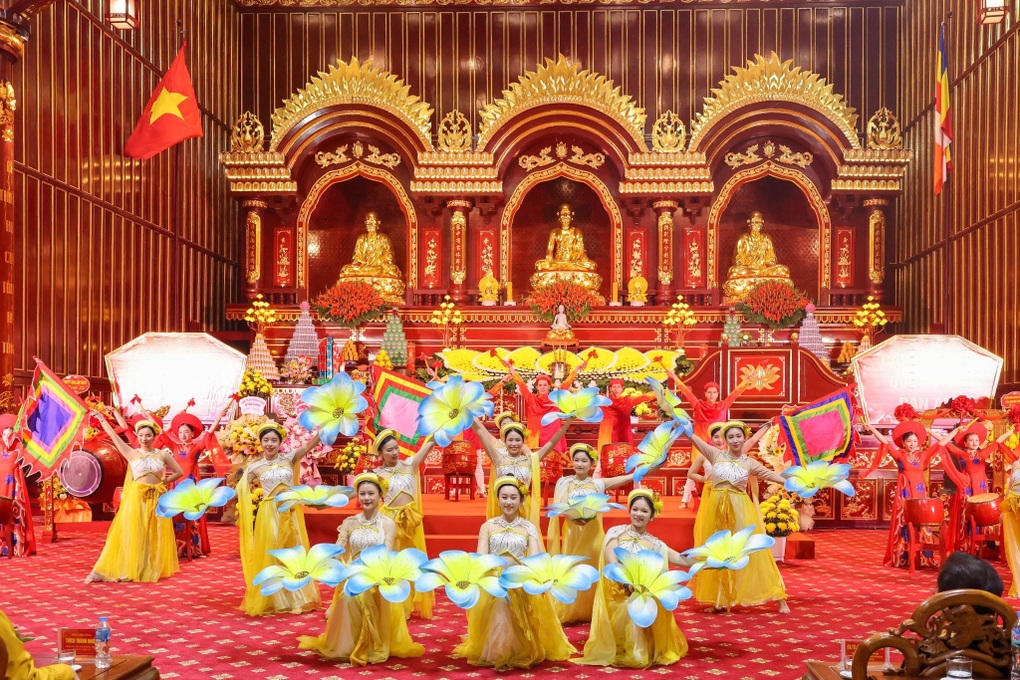 The opening ceremony of the Yen Tu Spring Festival - an event that attracts thousands of Buddhists and people from all over the country to attend (Photo: Tung Lam).
Besides praying for peace at the famous temples in Yen Tu, take some time to explore the interesting folk activities. Dressed in traditional Vietnamese attire, you can ride a horse and enjoy the ancient atmosphere, start the new year with a calligraphy piece you wrote yourself, or immerse yourself in many folk games that you may have forgotten, such as tug-of-war, chess, O An Quan (a traditional board game), and making firecrackers.
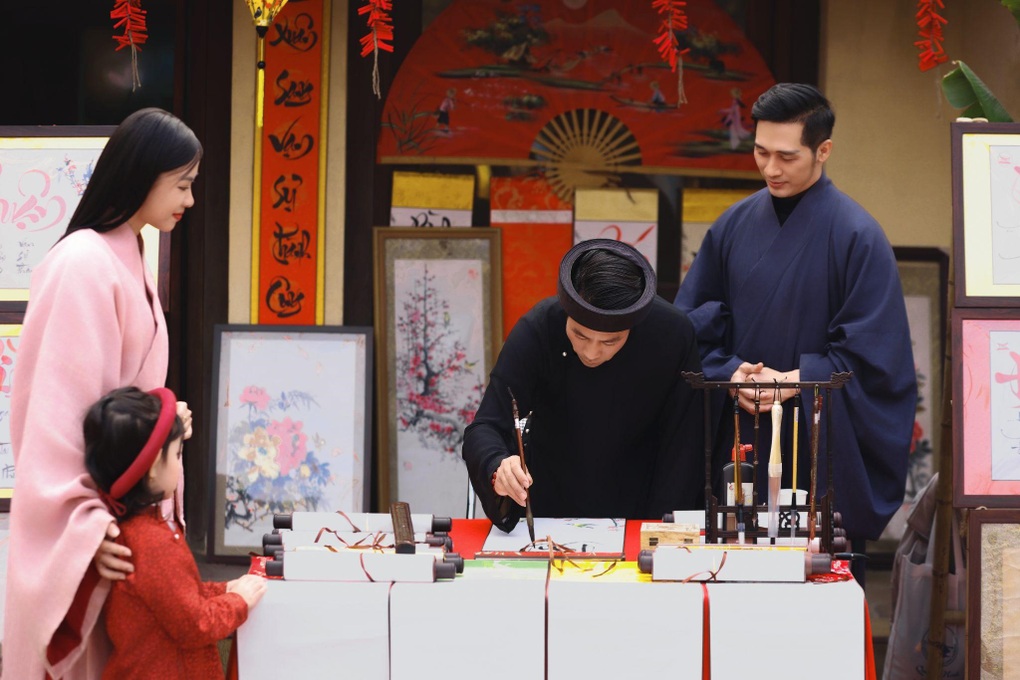 Tourists experience asking for calligraphy from a traditional calligrapher, receiving good luck at the beginning of the year (Photo: Tung Lam).
Adding flavor to the spring excursion to Yen Tu, a chain of traditional restaurants makes the Tet holiday even more memorable. The Tet feast at Yen Tu is not elaborately presented, but each dish embodies the chef's heartfelt dedication. Whether it's royal cuisine or traditional Vietnamese village dishes, they are the result of a process filled with emotion, using locally grown ingredients.
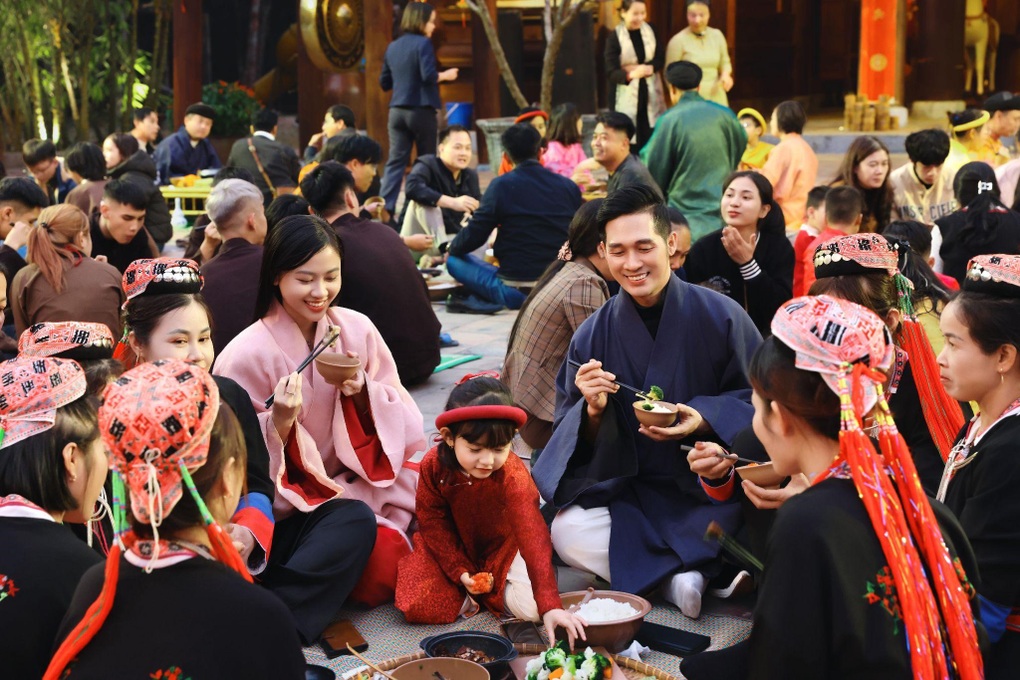 Enjoying traditional cuisine with the locals (Photo: Tung Lam).
Besides the rich cultural experiences, a visit to Yen Tu also allows you to appreciate the beauty of life of the Dao Thanh Y ethnic minority people living at the foot of the mountain. The people here are hospitable; after a year of hard work, everyone is delighted to see visitors return. As if they have the opportunity to welcome honored guests, the locals are open and enthusiastic, treating them like long-lost relatives.
Besides the bustling atmosphere of spring, Yen Tu also has moments of surprising tranquility. The inherent gentleness of the place allows you to relax, making it ideal for those yearning for rest after a year of hard work. Surrounded by Yen Tu National Forest, the Yen Tu historical site possesses a pristine atmosphere, the sound of birds singing in the early morning, the babbling of streams, and the rustling of spring leaves—all possessing a wonderful healing power.
Legacy Yen Tu Retreat and Lang Nuong Yen Tu Resort are ideal destinations for a perfect spring getaway. With architecture deeply rooted in Vietnamese culture, reflecting the Tran Dynasty and the spirit of Truc Lam Zen Buddhism, these places deserve to be considered among the most unique cultural retreats.
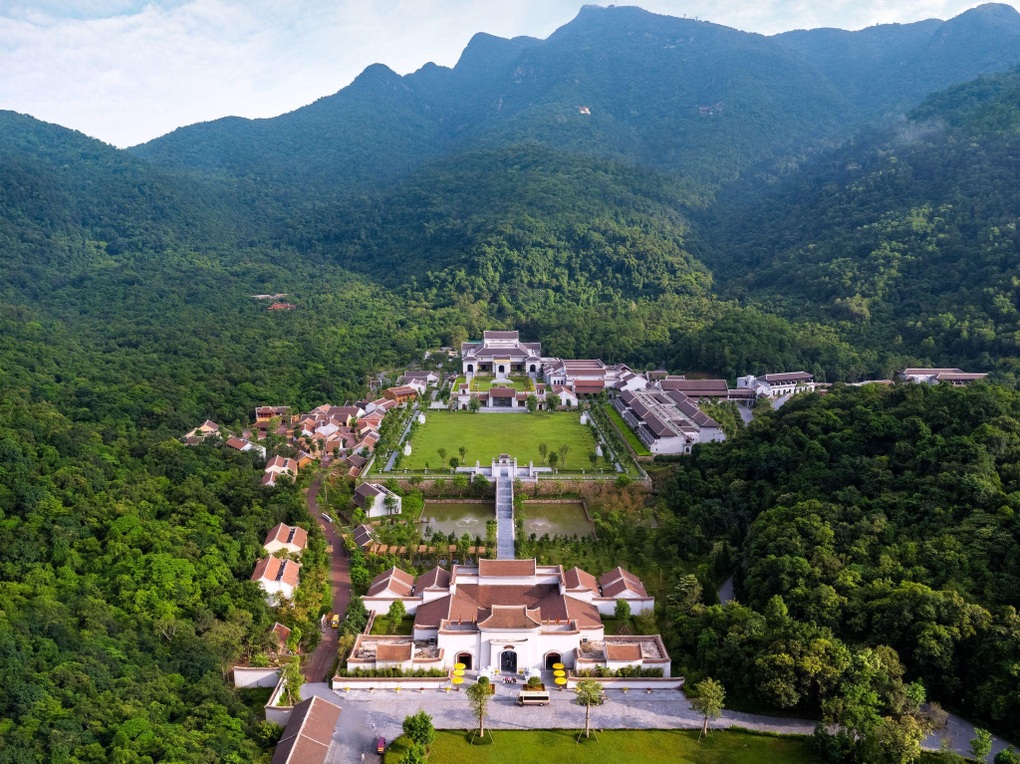 The Truc Lam Cultural Center complex with the central axis (central area), Legacy Yen Tu - MGallery retreat (right area), and Lang Nuong Yen Tu resort (left area) (Photo: Tung Lam).
![[Photo] My Son at night: A thousand-year-old heritage site amidst the Milky Way](https://vphoto.vietnam.vn/thumb/1200x675/vietnam/resource/IMAGE/2026/04/15/1776261039184_ndo_br_chon6-jpg.webp)
![[Photo] The General Secretary, President and his wife meet with Vietnamese-Chinese friendship leaders.](https://vphoto.vietnam.vn/thumb/1200x675/vietnam/resource/IMAGE/2026/04/15/1776264829725_vna-potal-tong-bi-thu-chu-tich-nuoc-to-lam-gap-mat-nhan-sy-huu-nghi-viet-nam-trung-quoc-8703641-3130-jpg.webp)
![[Photo] Mrs. Ngo Phuong Ly meets and exchanges views with Mrs. Peng Li Yuan](https://vphoto.vietnam.vn/thumb/1200x675/vietnam/resource/IMAGE/2026/04/16/1776277858080_phu-nhan-1-jpg.webp)
![[Photo] National Assembly Chairman Tran Thanh Man arrives in Türkiye to attend IPU-152](https://vphoto.vietnam.vn/thumb/1200x675/vietnam/resource/IMAGE/2026/04/15/1776261003665_tnk10-jpg.webp)
![[Photo] National Assembly Chairman Tran Thanh Man attends the opening session of IPU-152](https://vphoto.vietnam.vn/thumb/1200x675/vietnam/resource/IMAGE/2026/04/16/1776277863731_ctqh5-jpg.webp)








































Comment (0)