


Editor's note: The Politburo and the Secretariat have basically agreed on the principle of rearranging and reorganizing administrative units at all levels and building a two-tiered local government model; merging some provinces, abolishing the district level, and continuing to merge the commune level.
This content is currently being reviewed by Party committees, sectors, and localities to finalize the proposal. The Politburo will submit it to the 11th Central Committee meeting, tentatively scheduled for mid-April.
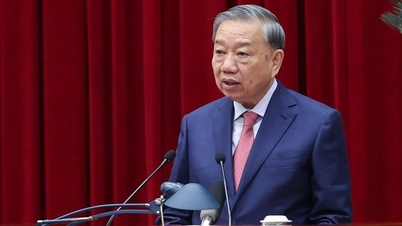
This policy of reorganizing administrative units at all levels aims at a grand goal, with a strategic vision for the next hundred years. General Secretary To Lam emphasized: This reorganization of administrative units at all levels "is not simply a matter of adjusting administrative boundaries, but also an adjustment of economic space; an adjustment in the assignment and decentralization of responsibilities; and an adjustment in the allocation and combination of economic resources."
Recognizing the importance of this policy in the process of leading the country into an era of national progress, VietNamNet is organizing a series of articles titled "The Historic Reorganization of Administrative Units with a Centenary Vision," featuring analysis and evaluation from many reputable experts.

One of the major directions and goals of this reorganization of administrative units at all levels, as clearly stated by General Secretary To Lam, is: "It is not simply about adjusting administrative boundaries, but also about adjusting the economic development space; adjusting the division of responsibilities, decentralization, allocation, and combination of economic resources."
Mergers aimed at streamlining and saving costs are only part of the solution; the real challenge lies in creating momentum for new development.
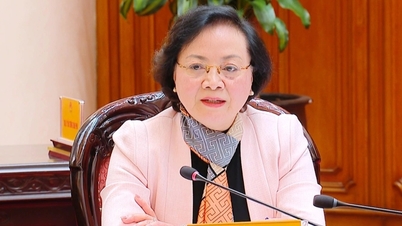
Minister of Home Affairs Pham Thi Thanh Tra has repeatedly emphasized the objectives of this administrative unit reorganization. These objectives are to expand development space, create a foundation and impetus for the country in the new era, while simultaneously ensuring the long-term stability of the system and organization with a strategic vision for the next hundred years.

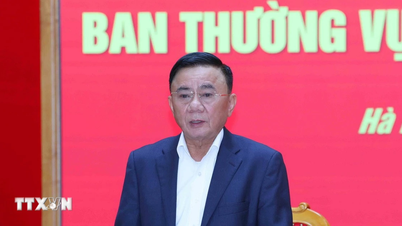
Speaking to VietNamNet, National Assembly representative Vu Trong Kim, former Secretary of the Quang Tri Provincial Party Committee, said that the merger of provinces is to create more resources for breakthroughs.
"A small province is like a tight shirt; even a slight movement will cause the seams to tear, making everything difficult. Therefore, if we want to expand, develop, and pursue big ambitions, we must buy a new, larger shirt to create space for growth," he said, using an analogy.
Mr. Kim cited the example that merging Ho Chi Minh City with one or two provinces would provide resources in terms of capital and human capital to strongly promote the development of the Southeast region. He also suggested that some provinces in the Central Highlands could merge with some coastal provinces in Central Vietnam to create more favorable conditions for development.
According to him, in the past, when transportation was difficult and information technology was not yet developed, 'small provinces, small districts, small communes' were appropriate.
This merger is taking place against the backdrop of increasingly modern infrastructure and rapid development of information technology. Therefore, the merger has a very clear objective: to create momentum for socio-economic development in the province.

Associate Professor Dr. Vu Van Phuc - Vice Chairman of the Scientific Council of the Central Party Agencies, commented that after mergers and consolidations, each province will be larger, have a wider development space, and will not be fragmented by administrative boundaries as much as it is currently.
Furthermore, with the merger of provinces and the elimination of the district level, the implementation of policies and guidelines at the grassroots level will be much faster, smoother, and more effective because it will not need to go through intermediate levels.
"Not to mention that intermediate levels can also be obstacles, creating many sub-mechanisms and policies," Mr. Phuc pointed out the reality.
Conversely, the grassroots level, being closest to the people, can immediately report any issues or seek advice to the provincial level. This also allows for faster leadership, guidance, supervision, and inspection by the provincial level at the grassroots level.
When mergers and consolidations occur, the organizational structure becomes more streamlined, and the number of officials and civil servants decreases. This means that investment in maintaining the local government apparatus will be significantly reduced.

That portion of the expenditure could be used to increase investment in national development, develop new provinces and communes, and provide social welfare for the people.
He cited recent examples, such as the Politburo's decision to waive tuition fees for students from kindergarten to high school starting next academic year. He also mentioned the General Secretary's question of whether medical examination and treatment fees could be waived by 2030.
"The people wholeheartedly welcome these policies and decisions of the Party. If the funds allocated for organizational structure are used for medical examinations and treatment, I believe the people will be very happy," Mr. Phuc emphasized.

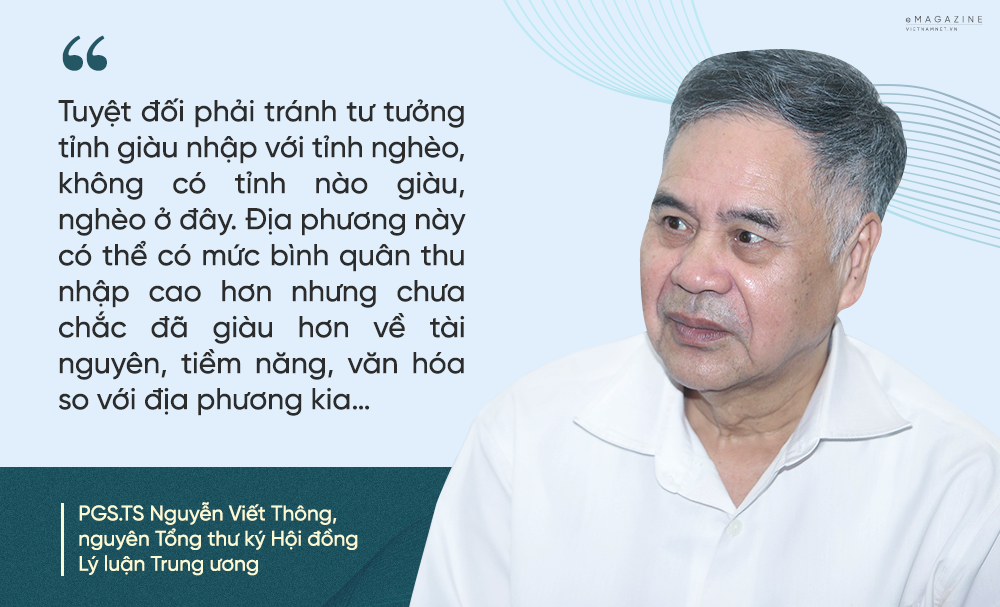
Associate Professor Dr. Nguyen Viet Thong, former Secretary General of the Central Theoretical Council, believes that when arranging and organizing the local administrative apparatus, one should not be rigid but should combine criteria such as area, population, history, culture, and development conditions of each region.
According to him, while previously the arrangement was based on geographical conditions—plains, mountains, coastal areas—this time it is possible to combine these factors to create a holistic approach, linking localities together and creating conditions for mutual development.
"This is for the common good of the country. We must absolutely avoid the idea of merging rich provinces with poor ones. There are no rich or poor provinces here. One locality may have a higher average income, but that doesn't necessarily mean it's richer in resources, potential, or culture compared to another... Therefore, in mergers, we cannot say, 'You are richer than me, I am a burden to you.' This is a mindset that needs to be overcome," Mr. Thong shared.
He cited examples from around the world, showing that to distinguish a happy nation, in addition to the criterion of average per capita income, many other factors are considered, such as political security, public trust, social welfare, health, and life expectancy of the people.
He also acknowledged that the 63 provinces and cities still suffer from a "fiefdom, parochialism, and localism," with one effect following another. Typical examples include periods of the "cement effect," the "sugar cane factory effect," and the "university effect"... In other words, "whatever your province has, my province must have too; we cannot be inferior."
Therefore, this time, the reorganization of provincial-level administrative units, eliminating the district level to create a larger province, aims to create room for development, worthy of investing in projects of appropriate scale.
He cited developed countries like China – a vast country with only around 30 provinces and cities; the United States with 50 states; and Japan with only 47 provinces and cities.
Noting that in 2022, the Politburo for the first time issued six resolutions on socio-economic development and ensuring national defense and security in six regions until 2030, with a vision to 2045, Mr. Thong noted that the merger of provinces also needs to take into account regional linkages to create a development space with a long-term vision.

From a businessman's perspective, Dr. Tran Khac Tam - Chairman of the Soc Trang Provincial Business Association - is very much looking forward to this "revolution" in reorganizing the administrative apparatus.
The merger of provinces and the elimination of district levels will create more favorable conditions for the business community, provide a wider space for regional economic and social development, and reduce administrative procedures.

Localities will have a broader environment to attract development resources. The merger of smaller provinces into larger ones will allow them to fully utilize each other's potential and strengths.
He analyzed that one region has agricultural products, goods, and resources, but lacks sufficient modern processing facilities and technology, as well as seaports for export. The other region, on the other hand, has seaports but lacks the necessary goods for export.
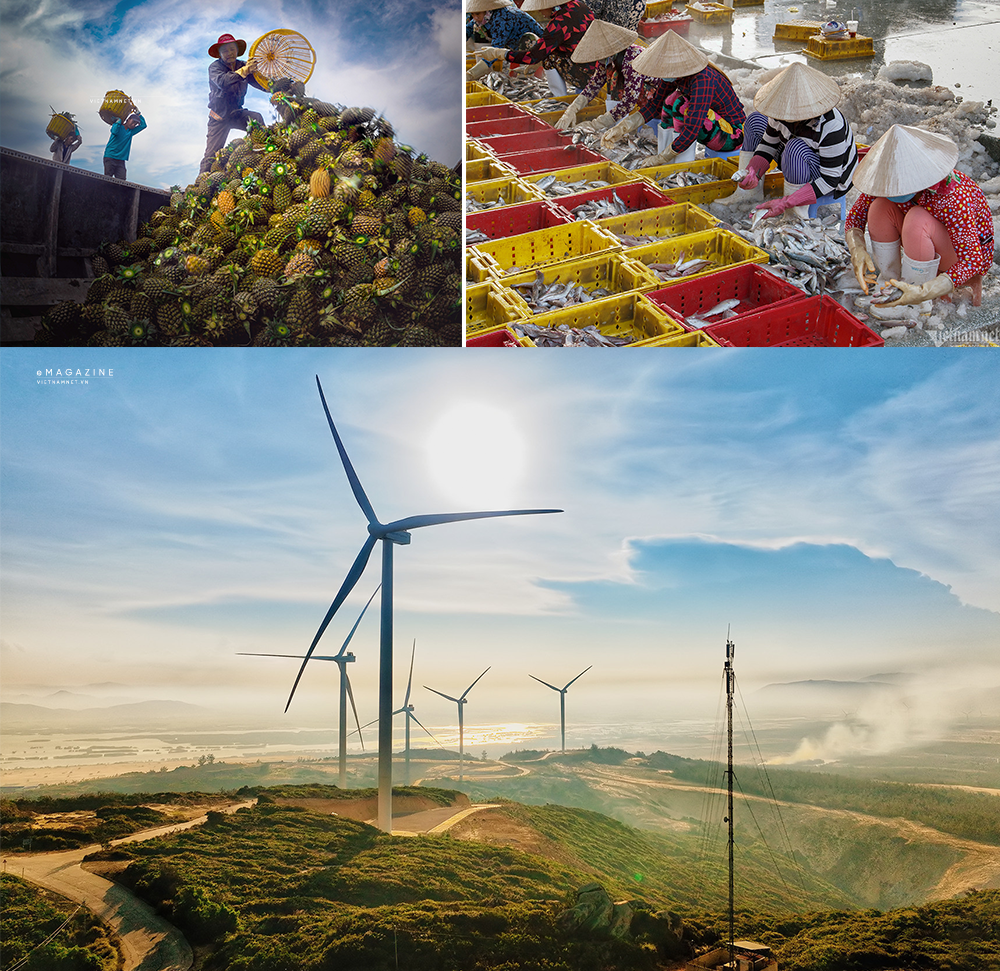
Businesses will certainly benefit greatly. Previously, to implement a project, businesses had to go from the provincial level down to the district level, then down to the commune level to complete various paperwork. Although administrative procedures have been "digitized," there is still a delay due to waiting for approval from different levels.
"If the 'intermediate' level, the district level, is eliminated, businesses will reduce one level of work, saving a lot of time," Mr. Tam said.
According to him, a business investing in another province will certainly face certain obstacles. But with a larger province after the merger, the potential and opportunities for investment are enormous. Businesses can easily invest in other areas without encountering any obstacles.
Vietnamnet.vn
Source: https://vietnamnet.vn/sap-nhap-tinh-khong-the-noi-anh-giau-hon-toi-toi-la-ganh-nang-cho-anh-2382478.html








































































Comment (0)