

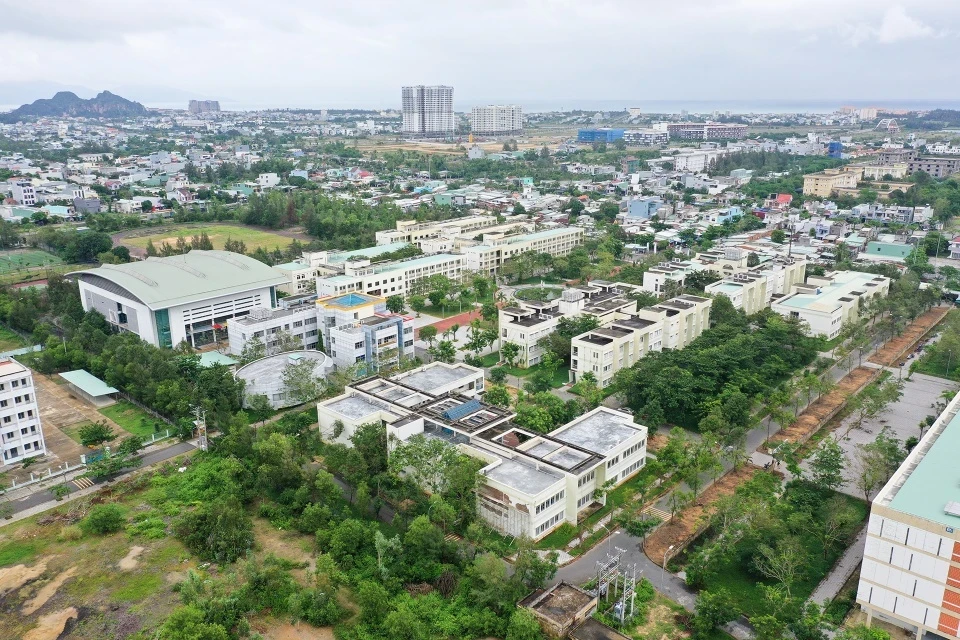
This article does not discuss specific policies or strategies of the city, but rather suggests an approach: organizing universities according to a multi-campus model, integrated into a knowledge-based urban ecosystem, instead of approaching it with a mechanical spatial displacement mindset.
Therefore, if universities are considered simply as physical structures, relocation can be seen as a technical solution to address the land shortage problem.
However, if we approach universities as special socio -economic institutions (places where knowledge, creativity, culture, and economic, cultural, and social relationships converge), then "relocation" is no longer a mechanical operation, but a decision that can transform the structure of an urban ecosystem.
The trend of multi-campus universities
International experience shows a trend: instead of complete relocation, developing cities are opting for a multi-campus university model, that is, organizing university space in a network format, where each campus performs a distinct function but is closely interconnected. This allows for maintaining the "knowledge core" in the urban center while expanding development into new areas flexibly and efficiently.
A prime example is Tongji University (in Shanghai, China). This university doesn't concentrate all its activities in a single campus but has developed into multiple "campuses" such as Ciping, Jiading, Hubei, Huxi, etc., as well as international cooperation centers.
Each campus has its own role: some focus on basic education, some specialize in technical research, and others aim for global collaboration. This organizational structure allows the university to maintain a strong presence in the urban core while also having space to develop fields requiring large areas and modern infrastructure.
Similarly, many universities around the world operate on a multi-campus model. The common thread among these models is that they don't "move" the university in the sense of leaving one location for another, but rather expand the university through a spatial network structure, aligning with the logic of modern urban development.
From an urban studies and urban sociology perspective, the multi-baseline model is not a random choice but the result of many factors.
First, large cities are increasingly facing land constraints in their central areas, while the need for expanding training and research continues to grow. However, urban centers remain hubs for crucial resources such as businesses, research institutions, creative spaces, and cultural activities. Therefore, it is impossible to "abandon" the center; instead, core functions must be retained there, while activities requiring large areas are moved to the periphery.
In addition, students' needs for quality of life and experiences are also an important factor.
Students not only study but also participate in social life, work part-time, network, and create. A multi-campus university system allows for a rational allocation of functions: the center for networking and creativity, and the periphery for learning, research, and social activities. This optimizes both the physical and social spaces of the university.
Universities in the urban ecosystem
Placed in the context of Da Nang, the risks of applying a "total relocation" approach are evident.

First and foremost is the risk of disrupting the knowledge ecosystem that has been developing for many years. Universities are currently closely linked to networks of businesses, research institutes, and socio-economic activities in urban areas. Relocating them entirely to a new area could weaken these connections, thereby affecting the quality of education and research.
Secondly, there is the risk of wasting resources, especially infrastructure that has been invested in using state budget funds and international capital.
Thirdly, it increases social costs for students and faculty, as commuting distances are greater and access to jobs and services decreases.
Finally, if the area where the university village is planned to be built lacks a corresponding socio-economic ecosystem, it is easy to create an "empty university city," where only academic activities exist but lack true urban vitality.
In this context, a more sensible approach is to build a multipolar and integrated university model.
Accordingly, it is necessary to retain the core university in the center of Da Nang with its functions of administration, training in social sciences, economics, and creative fields, along with innovation and entrepreneurship centers. This is the "brain" of the system, where knowledge value is created and social connections are made.
Other areas could be developed into new university hubs, focusing on high-tech research, experimentation, technology transfer, and large-scale dormitory systems. These would act as "extended arms," providing physical space for long-term development.
However, a prerequisite for this model to work effectively is a connected system.
Without high-speed public transportation, integrated digital infrastructure, and strong connections with businesses, campuses will become fragmented and unable to leverage their combined strengths.
Conversely, if well-designed, a multi-campus system can create a dynamic network of knowledge spaces, where each campus is a connecting "node" in the urban development structure. This is also perfectly consistent with the Da Nang city government's decision to invest in an urban railway system connecting Da Nang to Hoi An and Tam Ky (naturally passing through Thang Binh and Nui Thanh...).
Drawing on experiences in many countries, universities located in the periphery are often closely linked to high-tech zones, innovative businesses, and production-service ecosystems. As a result, universities not only serve as training centers but also become drivers of local economic development.
A cycle is being formed: from knowledge to technology, from technology to businesses, and from businesses back to drive urban development. If properly implemented, the southern area of Da Nang could completely become a new knowledge-based growth pole, instead of just a place to receive relocated facilities.
From the above analysis, it can be seen that the issue is not a choice between "relocation" or "not relocating," but rather the selection of a suitable urban development model.
Modern urban planning cannot be based solely on administrative decisions or subjective desires, but must be built on a scientific foundation, with a long-term vision and the integration of functional components. Within this structure, higher education is not just a separate field, but one of the most important drivers of knowledge-based economic development and innovation.
Therefore, all decisions related to university space need to be placed within the overall urban development strategy, regional planning, and innovation ecosystem.
If we only address the immediate land allocation problem while ignoring these factors, it can easily lead to long-term consequences such as wasted resources, declining training quality, and the creation of inefficient urban spaces.
Conversely, by adopting an approach focused on developing multi-campus university spaces, integrating spaces, and learning from international experience, Da Nang can transform its current challenges into opportunities for urban restructuring towards a modern, sustainable, and knowledge-based model.
Source: https://baodanang.vn/tai-cau-truc-khong-gian-dai-hoc-3336900.html






















































































Comment (0)