

To launch a rocket into space, engineers and scientists need to ensure the vehicle has enough thrust and fuel to overcome Earth's gravity. Rockets typically fly along a curved path to take advantage of gravity and use tilting maneuvers to stay on course.
According to Headed for Space, most of the world's large rocket launch complexes are located on or near the equator because the Earth rotates fastest at the equator. Therefore, rockets launched from the equator and traveling eastward can gain instantaneous acceleration (approximately 1,670 km/h) thanks to the Earth's rotation. However, not all spacecraft orbits and flight paths are eastward.
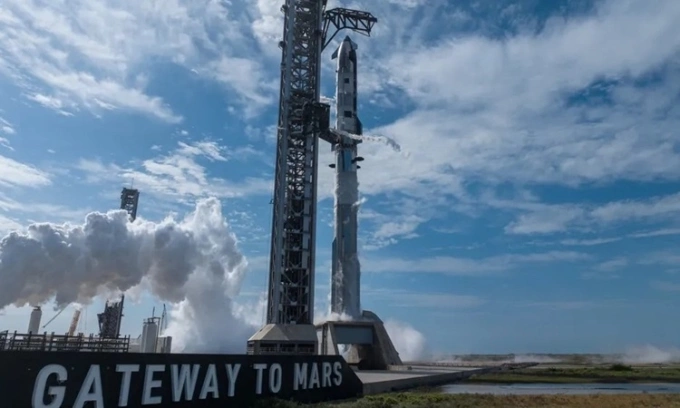
For example, to put a Saturn V rocket into an optimal orbit to the Moon, the vehicle needs an orbital inclination of 18 degrees and a launch angle of 72 degrees. Similarly, the International Space Station (ISS) is at an orbital inclination of 51.6 degrees and requires a launch angle of 38.4 degrees. In both cases, launching the rocket eastward without mid-flight adjustments would prevent the vehicle from reaching its target orbit.
Because the launch complex is fixed in a north-south or east-west direction, the launch vehicle needs to eliminate the difference between the launch angle and the launch pad orientation, or use complex in-flight navigation calculations to adjust its trajectory. Immediately after leaving the vertical launch pad, rockets like SpaceX's Starship will perform a roll and pitch towards their intended trajectory. This rolling and pitching maneuver allows the rocket to utilize Earth's gravity to gradually steer horizontally, maximizing fuel efficiency.
According to BGR, missiles that primarily operate within the Earth's atmosphere often utilize aerodynamic features such as tail fins, taking advantage of air resistance to trigger internal rotation. This is a common feature on ballistic missiles in military defense systems. However, most modern missiles operating in orbit use thrusters to tilt after launch. Because the engine nozzles are adjustable, they can redirect thrust in opposite directions, allowing the missile to rotate.
Not all rockets have multiple nozzles; instead, engineers design smaller auxiliary engines called Vernier thrusters, often mounted on the side of the launch vehicle or offset from the main engine, to initiate the rotation process.
Engineers also came up with several new solutions to help the rocket tilt more easily. For example, the Delta IV rocket has only one engine nozzle, but by directing the two exhaust pipes of the gas generator in opposite directions, the launch vehicle can still rotate.
( According to vnexpress.net )
Source: https://baodongthap.vn/tai-sao-ten-lua-xoay-nghieng-sau-khi-phong-a241234.html
























![[Image] Hanoi's urban life under the challenge of a "scorching hot" environment](https://vphoto.vietnam.vn/thumb/1200x675/vietnam/resource/IMAGE/2026/05/25/1779706979265_nang-nong-t5-2026-minh-duy-7-4636-jpg.webp)
































































Comment (0)