

The Joint Statement establishing the Comprehensive Strategic Partnership for Peace , Cooperation, and Sustainable Development between Vietnam and the United States, signed between General Secretary Nguyen Phu Trong and President Joe Biden, marks a significant step forward in bilateral relations.
Partners based on mutual respect.
That partnership continues to be based on full respect for the fundamental principles that have guided the bilateral relationship over the years, including respect for the United Nations Charter, international law, and each other's political institutions , independence, sovereignty, and territorial integrity.
The upgrade to the Comprehensive Strategic Partnership demonstrates Vietnam's proactive and natural approach to upgrading its relationship with the United States, taking a significant step forward in showcasing its long-standing independent and self-reliant foreign policy.
This is a remarkable achievement of the Comprehensive Partnership established by the leaders of the two countries exactly 10 years ago.
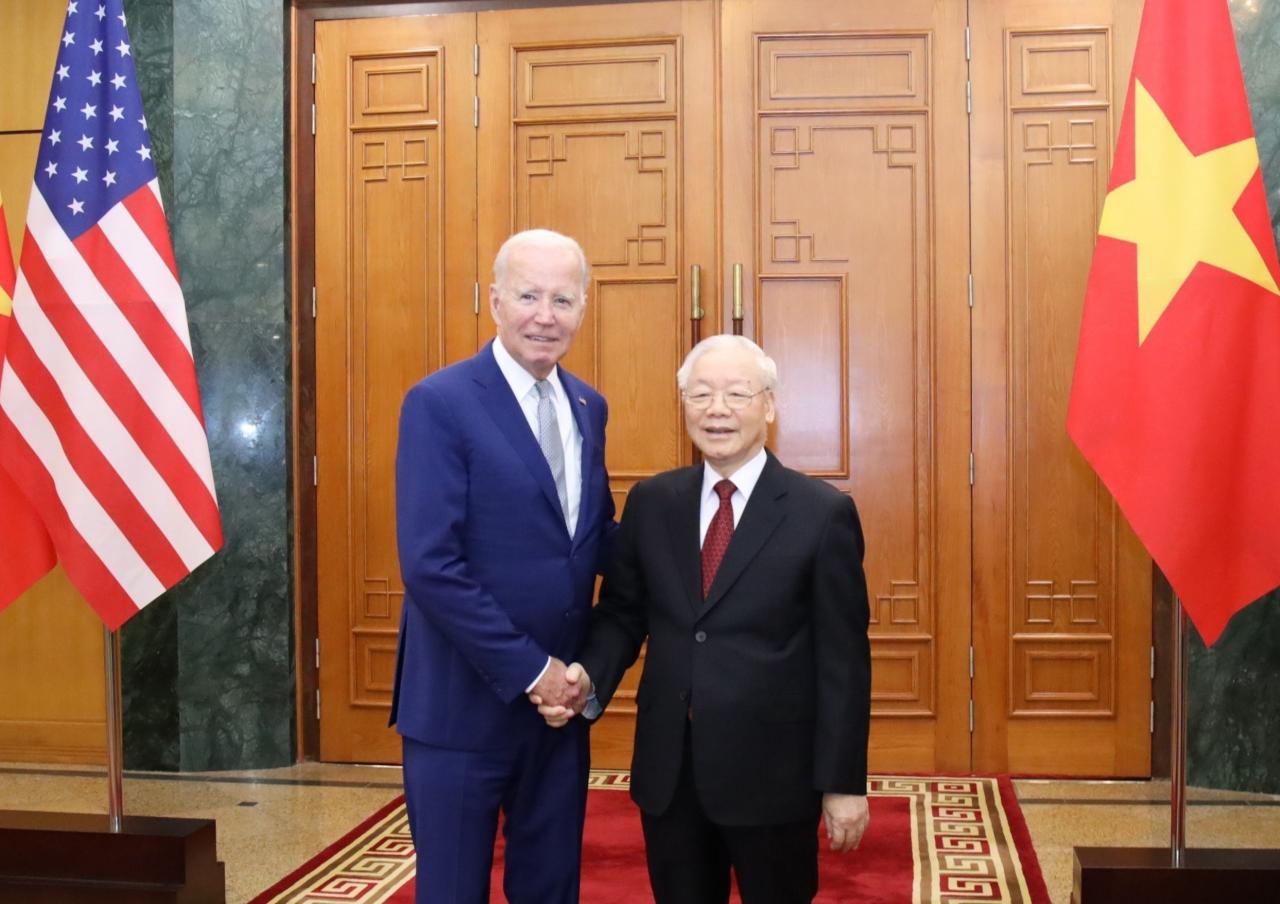
The meeting between two high-ranking leaders from two different political systems is a symbolic event.
Australian Vietnam studies scholar Professor Carl Thayer commented: "Vietnam is pursuing a diplomatic initiative aimed at elevating its relations with key partners to the highest level."
Professor Thayer further commented that economic relations need to be upgraded because the US is Vietnam's largest export market and the US is not a party to any free trade agreement with Vietnam such as the CPTPP.
President Joe Biden's schedule in Vietnam was packed with activities. A solemn welcoming ceremony for President Joe Biden was held at the Presidential Palace with the highest protocol reserved for heads of state. General Secretary Nguyen Phu Trong presided over the ceremony. This was the first time a US President had paid a state visit at the invitation of the General Secretary of the Communist Party of Vietnam.
Ambassador Pham Quang Vinh commented that US President Joe Biden's visit to Vietnam was a state visit, at the invitation of the General Secretary, unlike the usual practice where the President invites the head of state.
"It's clear that the meeting between two high-ranking leaders from two different political systems is a symbolic event. It's not just about bilateral relations, but also a symbol of mutual respect, including respect for each other's political systems," he said.
In July 2015, General Secretary Nguyen Phu Trong made a historic first visit to the United States. President Obama and then-Vice President Joe Biden received him and issued a Vision Statement on bilateral relations. Following the 13th Party Congress, President Biden congratulated the General Secretary on his re-election. This past March, the two leaders held a telephone conversation.
"All of that clearly shows that the two sides have exchanged a great deal at that level. This time is also a continuation of that and demonstrates that, in addition to exchanges between the two leaders, there is also mutual respect for each other's political systems," the ambassador said.
He remarked that there is still much room for development in the relationship between the two countries. The two countries share interests in economic cooperation, scientific and technological cooperation, addressing the consequences of war, and regional and international cooperation… all of which are intertwined interests; without these intertwined interests, cooperation cannot be promoted.

President Vo Van Thuong receives US President Joe Biden.
Promoting economic and technological cooperation will be a key focus.
During a press conference on September 10th, President Joe Biden cited the example of a Vietnamese company that signed a $4 billion agreement to build a factory producing electric vehicles and batteries in North Carolina, creating 7,000 jobs.
World-class Vietnamese technology companies have been and will be listed on the US stock market, and more important trade agreements are expected to be signed during this visit.
Bilateral trade volume has consistently witnessed high growth rates, increasing more than 275 times, from approximately $450 million 30 years ago to $124 billion in 2022.
For many years, the United States has consistently been a leading trading partner and one of Vietnam's largest export markets, accounting for nearly 30% of Vietnam's total global exports. In 2022, Vietnam became the eighth largest trading partner of the United States.
The joint statement said that the United States welcomes Vietnam's significant progress in market-based economic reforms and affirms its enthusiasm and commitment to broad, robust, constructive cooperation and support for Vietnam in its transition to a market economy and toward recognizing Vietnam's market economy status under U.S. law.

President Joe Biden and Prime Minister Pham Minh Chinh attended a roundtable discussion with businesses.
On September 8, 2023, the United States received a formal request from Vietnam asking the U.S. to consider recognizing Vietnam's market economy status. The United States will expeditiously consider this request in accordance with the law.
The joint statement said that, recognizing Vietnam's enormous potential to become a key country in the semiconductor industry, the two leaders supported the rapid development of the semiconductor ecosystem in Vietnam and that both sides would actively cooperate to enhance Vietnam's position in the global semiconductor supply chain.
Vietnam and the United States announced the launch of human resource development initiatives in the semiconductor sector, in which the U.S. government will provide an initial seed grant of $2 million, along with future support from the Vietnamese government and the private sector.
Professor Carl Thayer noted that US investment in Vietnam's semiconductor industry and the establishment of a secure and resilient supply chain are key areas of development between Vietnam and the US. US investment will aim to enhance Vietnam's capabilities in assembling, packaging, and testing computer chips. Other areas of cooperation will focus on green energy transition and decarbonization.
At the Vietnam-US Summit on Investment and Innovation held at the Government Office on September 11th, Minister of Planning and Investment Nguyen Chi Dung proposed that semiconductor corporations such as Intel, Amkor, Marvell, Global Foundries, and the US Semiconductor Association develop a chip and semiconductor ecosystem, coordinating with the National Innovation Center to build a training and research and development center, and ultimately design chip and semiconductor products in Vietnam.

National Assembly Chairman Vuong Dinh Hue met with US President Joe Biden.
The Minister suggested that Boeing develop a component manufacturing ecosystem and build a regional-scale aircraft equipment and machinery maintenance center (Hang-Ga) in Vietnam. Google and other technology companies should promote innovation, AI collaboration, and organize training programs for high-tech human resources in Vietnam.
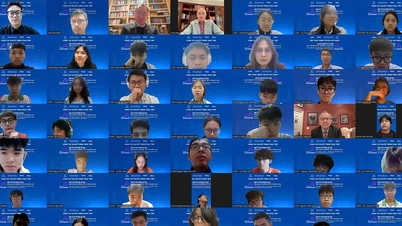
Cooperation in education, training, and healthcare is also a pillar, with approximately 30,000 Vietnamese students currently studying in the United States. Regarding cooperation in medical training, Dr. Lisa Cosimi, head of the Center for Healthcare with International Organizations at Harvard University, stated that Harvard has helped several Vietnamese medical universities develop smart classrooms to innovate teaching, offer courses in general education, modernize laboratories, apply technology, and develop electronic medical databases. She believes that cooperation in medical training, especially at the undergraduate and postgraduate levels, will be strengthened in the future, helping Vietnamese universities achieve international standards.
A series of foreign affairs, economic, and educational activities were announced in the Joint Statement. This clearly demonstrates the role of the Party and General Secretary Nguyen Phu Trong in aiming for a better and more prosperous future in relations with the United States, as well as with the region and the world.
Lan Anh
Vietnamnet.vn


































































Comment (0)