

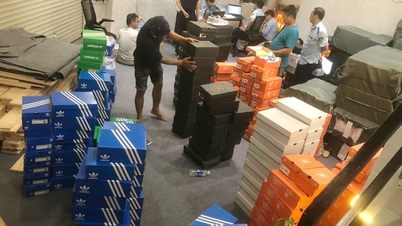
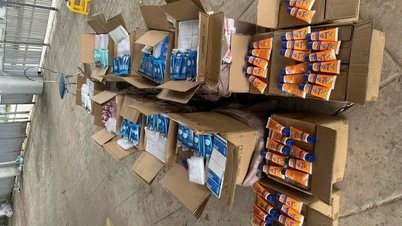
In the first nine months of 2025, authorities detected and handled over 15,500 violations, transferring 133 cases to investigative agencies, indicating that fraud and forgery remain at an alarming level.
On the other hand, cases of Vietnamese trademark infringement abroad further highlight the risk of losing brands due to a lack of registration and legal transparency. From Buon Ma Thuot coffee being exclusively registered in China by a Guangzhou company, Phu Quoc fish sauce having its name misused in Europe, to ST25 rice, Ong Tho milk, Miss Saigon... nearly losing their trademarks in China, the US, and Australia...
The Ministry of Industry and Trade estimates that counterfeit goods and trade fraud cause tens of thousands of billions of dong in budget revenue losses each year, eroding consumer confidence and reducing the competitiveness of legitimate businesses. On e-commerce platforms, fraud accounts for more than 35% of all detected violations, highlighting the new challenges of the digital age.
When consumers place their trust in a product, transparency becomes a vital factor for businesses. A product whose entire journey, from raw materials and production to the consumer, can be traced is proof of brand credibility. This not only acts as a shield protecting businesses from counterfeit goods but also provides a foundation for Vietnamese products to assert their true value in the international market.
In reality, the application of technology in supply chain transparency, such as QR codes, GS1 standards, IoT, and blockchain, helps businesses verify origin, ensure authenticity, and optimize risk management. When data is synchronized, transparency becomes a core competitive advantage, a measure of professionalism and responsibility.
From another perspective, for the "transparency passport" to truly become a tool for integration, Vietnamese businesses need to consider transparency as a long-term strategy, a matter of survival. First and foremost, they must standardize input data and production processes, build a system for recording, verifying, and holding each stage accountable. Simultaneously, they need to form transparent supply chain linkages where businesses use common standards to reduce costs, share data, and build trust throughout the value chain. Furthermore, transparency also begins with early registration and protection of intellectual property rights. Businesses need to proactively register trademarks domestically and internationally through the Madrid System for international trademark registration, or file directly in target markets, including using transliteration and the local language.
Authorities need to quickly complete the national data infrastructure for traceability, standardize internationally compatible standards, especially in areas prone to counterfeiting such as food, cosmetics, consumer goods, and electronic components. Strengthening control over goods on e-commerce platforms, imposing strong penalties for intellectual property violations, and establishing mechanisms to encourage businesses to meet transparency standards will help create a "green corridor" for Vietnamese goods.
In global competition, trust is the greatest asset. When a "transparent passport" becomes the "identity card" of Vietnamese goods, it is not only an affirmation of origin but also a commitment to business ethics and quality. Transparency from production and distribution to brand protection is essential for Vietnamese businesses to maintain their position domestically and enter the world market with genuine value, forming the foundation for Vietnamese goods to reach further.
Source: https://www.sggp.org.vn/tam-ho-chieu-de-hang-viet-vuon-xa-post819241.html
![[Photo] The heat at the fireworks display site on the opening night of the Da Nang International Fireworks Festival 2026](https://vphoto.vietnam.vn/thumb/1200x675/vietnam/resource/IMAGE/2026/05/27/1779889741485_ndo_br_z7872039145157-fecaba5112f39e8352544099d7ef4738-5140-jpg.webp)

![[Photo] The courage of new recruits of Brigade 144 on the training ground.](https://vphoto.vietnam.vn/thumb/1200x675/vietnam/resource/IMAGE/2026/05/27/1779881651341_anh-man-hinh-2026-05-27-luc-18-32-52.png)























































![[Photo] The courage of new recruits of Brigade 144 on the training ground.](https://vphoto.vietnam.vn/thumb/402x226/vietnam/resource/IMAGE/2026/05/27/1779881651341_anh-man-hinh-2026-05-27-luc-18-32-52.png)


























Comment (0)