


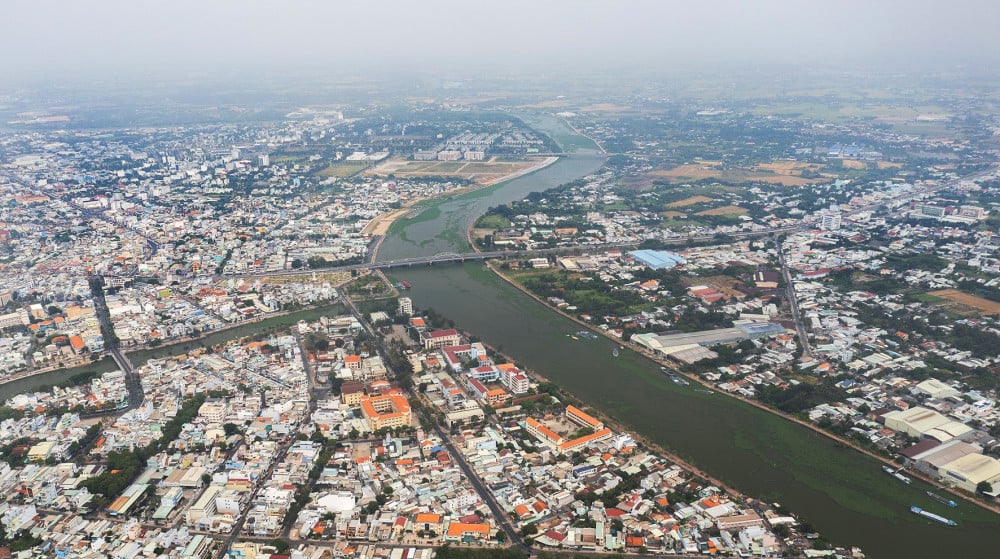
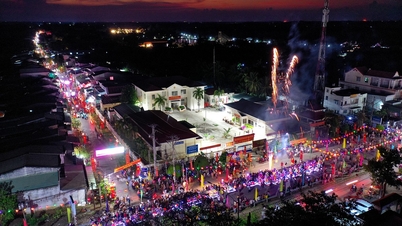
Tan An, while retaining the ancient charm of its early days of settlement, is also a youthful and dynamic city.
(Photo: Photographer Duy Bang)
Located at the gateway to Gia Dinh province (established in 1698 - present-day Ho Chi Minh City), the Dang Trong court had a strategic plan for the western border region from a very early stage, aiming to both protect the border and expand its territory into new, undeveloped lands.
In 1705, immediately after defeating the Siamese attack on the Sam Khe estuary (Rach Gam, Tien Giang today), Chief Commander Nguyen Cuu Van led his troops to encamp at Vung Gu (many believe this name originates from Kompong Ku, meaning cattle landing - Tan An today). Here, he commanded the army to build defensive lines and cultivate fields.
In particular, he had a canal about 9km long dug, connecting the Vung Gu canal, which was later expanded into the Bao Dinh river, linking the Hung Hoa river (also known as the Vam Co Tay river) with the Tien river. Following the principle of "proximity to the market and proximity to the river," the Vietnamese continued to establish villages and settlements along the river, making this area increasingly prosperous and strategically important for the entire Southwestern region of Vietnam. According to cultural researcher Nguyen Tan Quoc, this is an important basis for determining the 320-year history of Tan An City (1705-2025).
Following in the footsteps of Nguyen Cuu Van in expanding the territory, in the first half of the 18th century, Huynh Cong Luong - a military general who had held the position of Captain in the court of the Nguyen lords - came to the Giong Cai En area (now part of Khanh Hau ward, Tan An city ) to establish his livelihood.
It was here that he and his wife gave birth to their son, Huynh Tuong Duc, who later became the renowned general Nguyen Huynh Duc (a royal surname bestowed by the king). From 1781 to 1817, he made significant contributions to helping King Gia Long unify the country and expand the borders of Dai Viet to unprecedented levels. Notably, before his death, he personally built his own tomb.
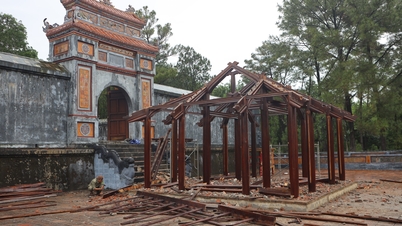
Today, the tomb area, temple, and artifacts associated with the name of the famous general are considered ancient tombs that have been preserved intact, containing very important cultural and spiritual values in Tan An.
Located within a 1,280m2 area, the mausoleum complex includes three gates, the tomb, and the temple. The main construction materials are laterite stone, ceramics, mortar, and precious wood; the main architecture of the complex reflects the style of Hue imperial mausoleums. Particularly noteworthy is the temple, which has preserved intact imperial decrees and artifacts from the time of its construction, such as the imperial robes bestowed upon the Duke during his lifetime, the altar, horizontal plaques and couplets, bronze incense burners, canopies, long benches, wooden planks, etc.
One afternoon, the sunlight shone a golden amber hue. The ancient, over 300-year-old Trôm tree in front of the tomb of Nguyễn Huỳnh Đức cast its shadow over a corner of Tân An. We walked slowly and respectfully beneath the canopy of fragrant frangipani trees. Looking at the ancient calligraphy still standing solemnly against the red background, and the moss-covered, ancient stele, a profound sense of reverence welled up in each of us. We gently closed our eyes, focusing on our breath, and imagined the figure of the ancient general still strolling in this place.
In Tan An, people will marvel at the beauty of the river that has become legendary and is deeply imprinted in poetry and songs. Stretching across the eastern part of the city, the Vam Co Tay River is like a gentle woman. On both banks, nipa palm trees lean gently, casting their shadows onto the cool, refreshing water. Whether in the rainy or dry season, the river in the Tan An section is always clear and sweet. Looking at this peaceful and poetic river, who could imagine that there was a time when its waters were stained red with loss and sacrifice?
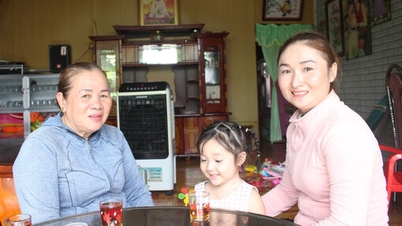
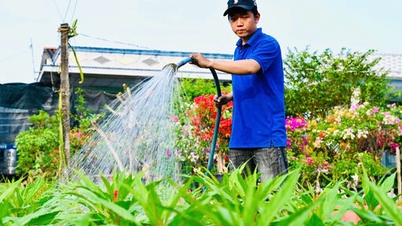
Despite being a young city located at the gateway to the country's major economic , cultural, and social center, Tan An still retains the inherent peace and tranquility characteristic of the Southwestern region of Vietnam. Without many bustling urban, commercial, or industrial areas, social life here is not overly chaotic or noisy. The streets are well-planned and newly constructed, making them wide and spacious.
The houses are close together but not overly tall or imposing. Public playgrounds and parks are spacious and clean. Even the night market offers a full range of essential goods for daily life, from affordable to high-end, and the food court has a variety of dishes to suit all tastes; strolling around here feels very relaxing and comfortable. Shopping in Tan An is free from harassment or price gouging. Whether you're a local or a tourist, you'll have plenty of choices.
I love taking my children to the town square on weekend afternoons, where there's ample space for kites to soar in the wind. My children can let their imaginations run wild, following the clouds in the sky. Afterwards, the whole family can stroll around Hung Vuong Street (in Ward 6), where you'll find a wide variety of food to suit all ages and tastes, from Hanoi's bun cha, chicken rice, pho, buffets, Trang Bang banh canh, Hue beef noodle soup, Western-style banh xeo, or even bun siem lo, which originates from neighboring Cambodia...
Tan An, while retaining the ancient charm of its early days of settlement, is also a youthful and dynamic city, a place that those who leave will always remember and long for.
Nguyen Hoi
Source: https://baolongan.vn/tan-an-thanh-pho-toi-yeu-a193669.html
![[Photo] General Secretary To Lam working with the Central Inspection Committee](https://vphoto.vietnam.vn/thumb/1200x675/vietnam/resource/IMAGE/2026/03/05/1772718314670_a1-bnd-8682-5192-jpg.webp)

![[Photo] Prime Minister Pham Minh Chinh receives the Minister of Emergency Situations of the Russian Federation.](https://vphoto.vietnam.vn/thumb/1200x675/vietnam/resource/IMAGE/2026/03/05/1772712011395_ndo_br_thiet-ke-chua-co-ten-76-png.webp)





























































Comment (0)