

Traditional Vietnamese New Year customs were simple, joyful, harmonious, and deeply rooted in national cultural identity.
Signifying the beginning of a new planting season, a new month, a new season, and a new year, Tet (Vietnamese New Year) holds immense significance in the lives of Vietnamese people.
For every Vietnamese person, Tet is a time for family reunions. Children and grandchildren who work far away, no matter how busy they are, try their best to return home to celebrate Tet with their families. Everyone tries to finish their work and settle all debts before Tet so they can welcome the new year peacefully and happily.
Traditional Vietnamese New Year customs were simple, joyful, harmonious, and deeply rooted in national cultural identity.
For Vietnamese people, Tet (Lunar New Year) is a harmonious blend of dreams and reality. Tet is not just about material things, food, and decorating the house… it is also a beautiful aspect of spiritual culture, a time to remember ancestors, and a time for warmth, sacred family bonds, and community spirit.
For Vietnamese people, the Lunar New Year is celebrated for three days, but preparing for those three days requires almost a whole year of hard work.
First, there was pig farming. Back then, there were no hybrid pig breeds or growth-enhancing feeds; we only raised native pigs fed on bran cooked with banana stalks, sweet potato vines, or duckweed. They only gained 4-6 kg per month. So, to reach a weight of 50-60 kg of meat for Tet (Vietnamese New Year), we had to start raising them from the beginning of the year.
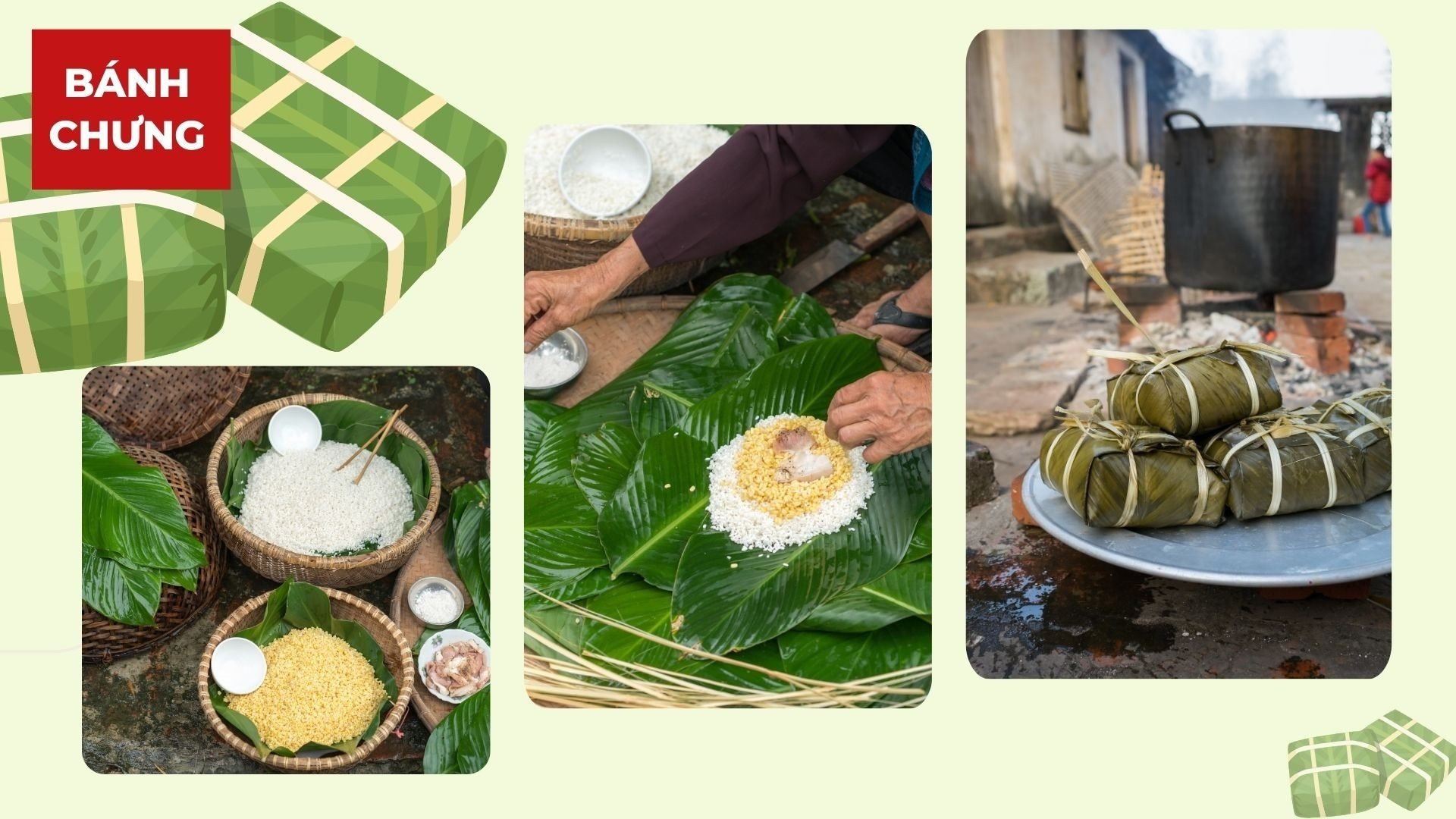 |
| For the vast majority of people living in rural areas who make a living from farming, sticky rice cakes with pork are the basic food for offerings and meals during Tet (Lunar New Year). |
For families who can afford to make banh chung (traditional Vietnamese rice cakes), they start buying glutinous rice, mung beans, etc., as early as the beginning of the twelfth lunar month. Even the leaves used for wrapping, such as dong leaves, and the strings for tying banh chung and banh gio (another type of Vietnamese sausage) must be prepared in advance, not waiting until closer to Tet (Lunar New Year). How do they prepare? Those with gardens gather fallen leaves year-round, cut them, shred them thinly, and wrap them up to use for making gio during Tet.
Every year on the 15th day of the 12th lunar month, every household makes pickled onions. Large, round onions are bought, soaked in wood ash water for 5 days, then peeled, roots cut off, and mixed with salt for two days before the soaking water is drained. It takes another 7-8 days for the onions to lose their spiciness and turn into slightly sour pickles. While not a main dish, it's indispensable on the Tet (Lunar New Year) feast table, so in the past it was considered one of the six characteristic Tet items: "New Year's pole, firecrackers, green sticky rice cake / Fatty pork, pickled onions, red couplets."
The Tet atmosphere begins on the 23rd day of the 12th lunar month, with the offering to the Kitchen Gods before they ascend to Heaven. From the 24th onwards, the atmosphere is already bustling; children buy firecrackers from the market and set them off with loud bangs in the village square. Adults clean the ancestral altars, pay respects to the deities at the graves of their grandparents and great-grandparents; and do a thorough cleaning of their houses and neighborhoods...
From the 27th to the 30th of the twelfth lunar month, every household is busy slaughtering pigs, wrapping banh chung and banh te (traditional Vietnamese rice cakes), making che lam (a type of sweet soup), cooking peanut candy, and making puffed rice.
Except for a few families of officials and city dwellers who celebrated Tet with expensive delicacies, the vast majority of people in rural areas, who lived by farming, relied on sticky rice cakes with pork as the basic food for offerings and meals during Tet.
Usually, each household slaughters one pig; if a family is small or poor, they share one pig between two families; if a family is very small or very poor, they share a leg or half a leg.
Throughout the 28th to 30th of the twelfth lunar month, the squealing of pigs filled the villages, and people bustled along the riverbanks, some scrubbing banana leaves, others preparing pig intestines.
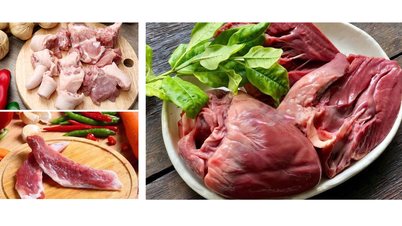
Throughout the year, busy as usual, meals are simple, consisting of just a few dishes: vegetables, pickled onions, fish, shrimp, crab, eel, snails, and frogs. Only during Tet (Lunar New Year) do they slaughter a pig and have the means to prepare elaborate dishes for offerings before eating. The pig's head is often used to make pork sausage called "gio thu," while the tenderloin is pounded and used to make "gio lua," and some families even make "gio mo." Fried pork patties are made from pounded lean meat shaped like discs, while grilled patties are sliced and marinated with onions, fish sauce, and also galangal and fermented rice paste, then skewered on bamboo sticks, each skewer holding 7-8 pieces.
Pork belly or a mixture of lean and fat is boiled until firm, then sliced into strips a few fingers wide and pan-fried. Ribs are chopped into cubes and grilled or boned to make grilled pork patties. Bones are used to stew dried bamboo shoots. Many families also make fermented pork rolls wrapped in guava leaves, as they give the Tet holiday a rich and authentic flavor.
Banh chung (Vietnamese sticky rice cake) is a delicious dish, and the rice grains are self-grown, so there's no need to measure them. However, the problem is that only five or seven wealthy families in the village could afford a copper pot that could cook thirty or forty cakes. Therefore, they had to borrow them from one another, and they had to make arrangements with the owner beforehand. Some families started cooking cakes on the morning of the 27th, while the last family to borrow was on the afternoon of the 30th, carefully calculating how to return the pot before the host lit incense to welcome the New Year, amidst the resounding firecrackers celebrating the arrival of the new year.
Beyond the three days of Tet, feasting continues for many more days. Relatives and friends from afar come to visit and share meals. Children and grandchildren roam around enjoying themselves with games like swinging, playing marbles, tug-of-war, cockfighting, wrestling, and chess, returning home to rummage for food when hungry. The custom is: "January is the month for feasting and revelry." They feast and revel to make up for the long winter spent toiling in the fields under the sun and dew. They feast and revel because all the farm work is done.
The final preparation involves bringing small change to give to children as a New Year's gift. First, on the morning of the first day of the Lunar New Year, money is given to the children and grandchildren in the family, and then any child who comes to visit receives some. If it is a duty to visit elders or superiors to offer New Year's greetings, small change should also be brought along to give to the children.
On the afternoon of the 30th day of the Lunar New Year, every household erects a New Year's pole in the middle of the courtyard. They use small bamboo or reed stalks, with the tips curved like fishing rods, and tie a red and green pennant flag or a bunch of wild pandan leaves to it as a signal to welcome their ancestors home for Tet and to ward off evil spirits. It seems the preparations for Tet are very extensive and arduous. But strangely, no one complains; young and old, men and women alike, are all joyful and excited.
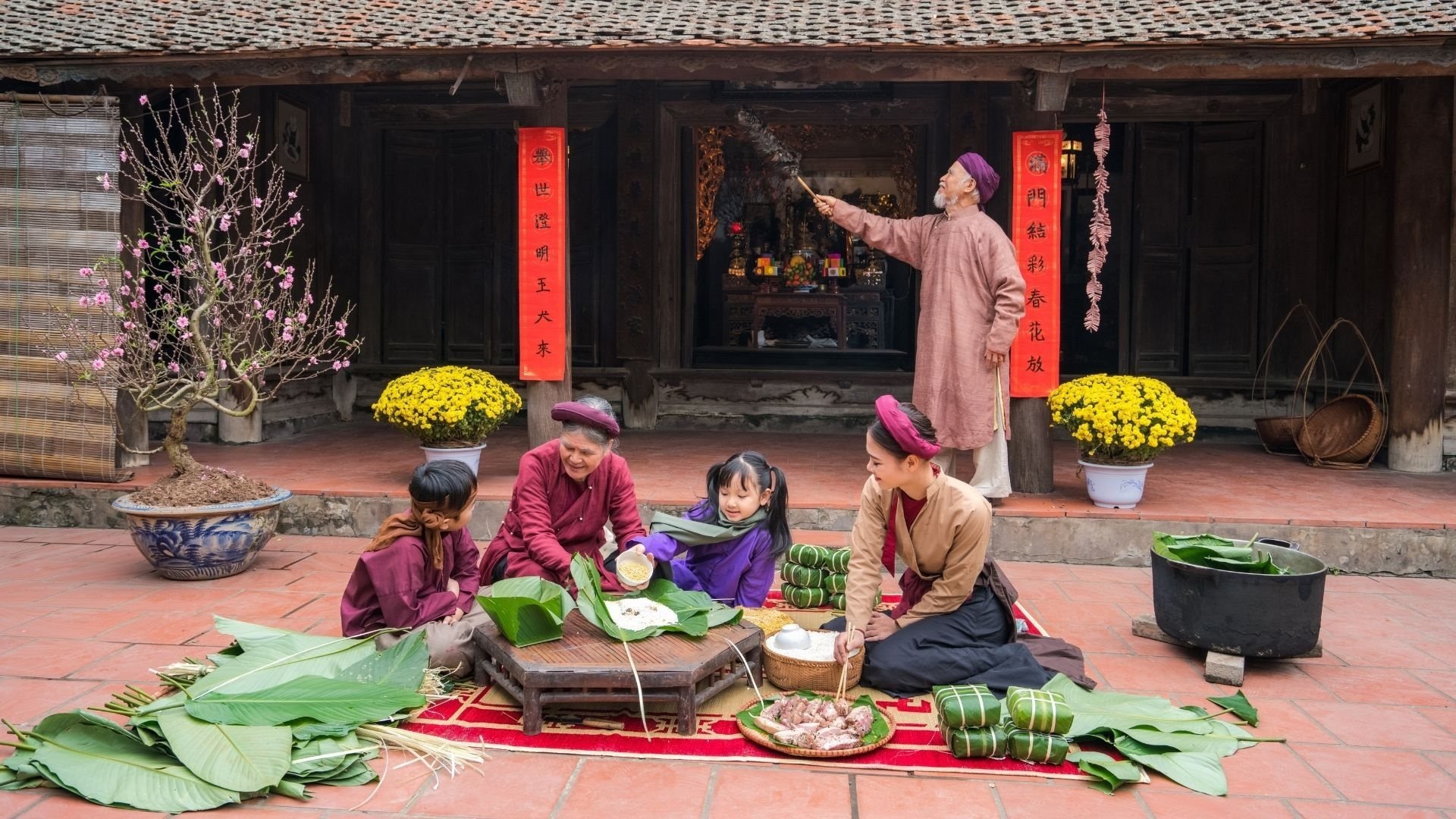 |
| People clean their houses and wrap banh chung (traditional Vietnamese rice cakes) to welcome Tet. |
Preparing for Tet to welcome the New Year is not just about taking care of everyday things, but also about cherishing cherished memories and deep relationships.
At exactly midnight, people light incense and candles to worship their ancestors, deceased relatives, and welcome the arrival of spring.
According to the Vietnamese tradition of "first visitor of the year," if everything goes smoothly on the first day of Tet, then good fortune will last all year. Therefore, the first guest to visit a home in the new year is very important.
At the end of each year, families intentionally seek out cheerful, lively, quick-witted, and morally upright individuals within their family and extended family to be the first visitor of the year. The visitor usually only stays for 5-10 minutes, hoping for a smooth and successful year ahead.
During the three days of Tet, women can visit temples and pagodas, men play card games like "to tom" and chess, and the village organizes traditional folk games. On the afternoon of the third day of Tet, families hold a ceremony to bid farewell to their ancestors.
On the first and second days of the Lunar New Year, people refrain from killing animals and avoid digging or sweeping the ground so that the festive atmosphere doesn't fade too soon.
During the Lunar New Year, people refrain from saying unpleasant things, fighting, or arguing, and put aside all grudges and conflicts.
The poor are given the opportunity by their relatives to celebrate Tet together; beggars only need to stand at the door and say a few words of good luck to receive banh chung (traditional Vietnamese rice cakes), meat, and gio (Vietnamese sausage) from the homeowner. Vietnamese people often say: "The poor and hungry don't worry about the three days of Tet / The rich open their hearts with compassion."
On the seventh day of the Lunar New Year, every family will take down the New Year's pole, marking the end of the Tet holiday. People then gather at sacred places such as communal houses, temples, and shrines, where they hold spring festivities, fetch water, perform traditional opera, and participate in cooking competitions.
Even when children and grandchildren have moved out to live far away, they still return to bring gifts for their grandparents and parents during Tet (Lunar New Year), the amount depending on their living circumstances. If they are well-off, they bring delicious food and rare delicacies; if they are poor, they must at least bring something small as a gift. If their grandparents and parents live in wealth, sometimes their children and grandchildren bring a branch of peach blossoms, two pots of chrysanthemums, or a few daffodils; sometimes just a firecracker is enough to please their parents. Besides the duty of children and grandchildren, there is also the duty of students. Even if they have become scholars or mandarins with their names inscribed on stone tablets, students must still remember to visit their old teachers.
According to Vietnamplus.vn
https://mega.vietnamplus.vn/tan-man-tet-xua-5542.html
Source: https://thoidai.com.vn/tan-man-tet-xua-196681.html
![[Photo] Prime Minister Pham Minh Chinh attends the Conference on the Implementation of Tasks for 2026 of Vietnam Television.](/_next/image?url=https%3A%2F%2Fvphoto.vietnam.vn%2Fthumb%2F1200x675%2Fvietnam%2Fresource%2FIMAGE%2F2026%2F01%2F10%2F1768047311329_ndo_br_dsc-3214-jpg.webp&w=3840&q=75)





















![[Infographics] Resolution No. 79-NQ/TW of the Politburo on the development of the state-owned economy](https://vphoto.vietnam.vn/thumb/402x226/vietnam/resource/IMAGE/2026/01/10/1768038914679_chp_3-11-23.jpeg)

























Comment (0)