

NASA satellite images from late May show A-76A, an iceberg twice the size of Los Angeles, breaking into pieces near South Georgia Island.
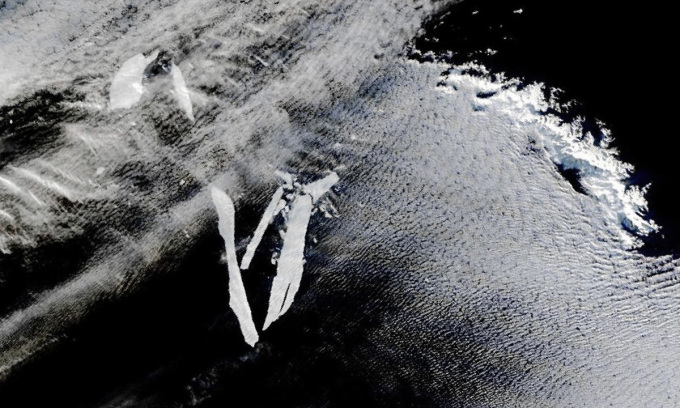
Fragments of the world's largest iceberg, A-76A, were captured by NASA's Terra satellite on May 24. Photo: NASA Earth Observatory/MODIS/Wanmei Liang
A-76A is the largest remaining piece of A-76, an iceberg with an area of approximately 4,320 square kilometers, measuring 170 kilometers in length and 25 kilometers in width, which broke off from the Ronne Ice Shelf in Antarctica in May 2021. By October 2022, satellite imagery showed A-76A, then approximately 135 kilometers long and 26 kilometers wide, entering the "Drake's Corridor," a region where icebergs are often swept away from Antarctica by strong ocean currents.
On May 24, NASA's Terra satellite captured new images of six pieces of A-76A drifting apart near South Georgia Island in the Scotia Sea, meaning the giant iceberg had broken off a few days earlier, according to NASA's Earth Observatory. The debris is approximately 2,415 kilometers from where A-76 broke off from Antarctica in 2021.
"It's impressive that it's traveled this far in just about two years. That clearly shows how strong the ocean currents are in this area of the Southern Ocean," commented Christopher Shuman, a glaciologist at the University of Maryland and NASA's Goddard Space Flight Center.
The world's previous largest iceberg, A-68A, also broke apart near South Georgia Island in December 2020 after drifting through the Drake Passage. A-76A didn't directly collide with South Georgia but could still impact nearby marine ecosystems. By mid-2021, when A-68A had completely melted, scientists estimated it had released approximately 900 million tons of freshwater into the ocean, much of it near South Georgia. It's likely A-76A will also release a large amount of freshwater into the surrounding area, impacting marine food webs.
Mark Belchier, director of the South Georgia Island and South Sandwich Islands Fisheries and Environment Agency, warned that new ice fragments will continue to break off and could become a major concern for ships operating in the area.
Thu Thao (According to Live Science )
Source link


































































































Comment (0)