

SGGP
Deputy Prime Minister Tran Hong Ha recently held a meeting with the Ministry of Education and Training regarding tuition fees and textbooks for the 2023-2024 school year.
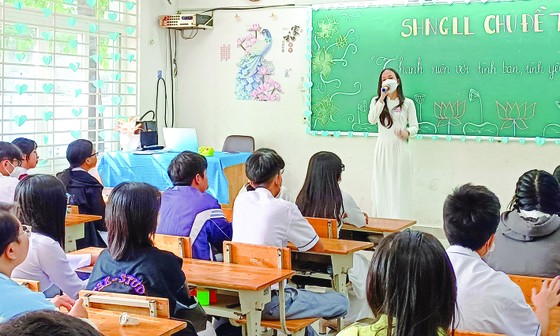 |
| Students and teachers of 11th grade at Vo Van Kiet High School (District 8, Ho Chi Minh City) during a class session. Photo: THU TAM |
Regarding the tuition fee adjustment plan for the 2023-2024 academic year, the Ministry of Education and Training stated that the People's Councils of localities are expected to approve the tuition fees for the new academic year in early July. For higher education , universities must decide on tuition fees and announce them before students register for admission.
Deputy Prime Minister Tran Hong Ha agreed with the plan for universities and vocational education institutions to implement a tuition fee increase roadmap in accordance with Decree 81/2021/ND-CP (regulating the mechanism for collecting and managing tuition fees for educational institutions within the national education system and policies on tuition fee exemption and reduction, and support for learning costs); at the same time, appropriate support policies must be in place to create conditions for policy beneficiaries, the poor, the disadvantaged, and vulnerable groups to have equal access to higher education.
For other educational levels, tuition fee adjustments are decided by the People's Councils of provinces and cities according to local conditions. The Ministry of Education and Training needs to clearly assess the social impact, especially the impact on policy-beneficiary groups, vulnerable groups, and those who may be unable to attend school due to increased tuition fees, in order to develop specific support plans.
In economically viable areas where socialization is necessary, autonomy should be encouraged for public educational institutions based on accurate and comprehensive cost calculations, allocating state budget funds to support vulnerable groups, disadvantaged individuals, and those in remote areas, while ensuring that state budget investment in education is not reduced.
The Ho Chi Minh City People's Committee has just announced the list of textbooks for grades 4, 8, and 11 to be used in educational institutions in Ho Chi Minh City from the 2023-2024 school year.
Accordingly, for grade 4, there are a total of 27 approved textbooks across 12 subjects. Of these, English, Art, and Physical Education each have 3 approved textbooks; while the remaining subjects – Vietnamese, Mathematics, Ethics, Science, History and Geography, Experiential Activities, Technology, Music, and Informatics – each have 2 approved textbooks.
For grade 8, there are 36 approved textbooks across 11 subjects. English leads in the number of approved textbooks with 6; followed by Mathematics with 4; the remaining subjects, including Literature, Informatics, History and Geography, Fine Arts (part of the Arts subject), Technology, and Physical Education, each have 3 textbooks; while Natural Science, Career Guidance and Experiential Activities, Civic Education, and Music (part of the Arts subject) each have 2 textbooks.
Specifically, Grade 11 has 62 approved textbooks across 15 subjects. Art leads in the number of approved textbooks with 11; followed by Physical Education with 8 approved textbooks (covering various topics including badminton, volleyball, basketball, soccer, and sepak takraw); Mathematics, Technology, Informatics, Career Guidance and Experiential Activities, and English each have 4 approved textbooks; Literature, Geography, Chemistry, Physics, Biology, Music, and Economic and Legal Education each have 3 approved textbooks, while History has 2.
In the 2023-2024 school year, the entire country will continue to gradually implement the 2018 General Education Program in grades 4, 8, and 11. According to the plan, the program will complete its implementation at the general education level by the 2024-2025 school year for grades 5, 9, and 12.
Source

























































Comment (0)