


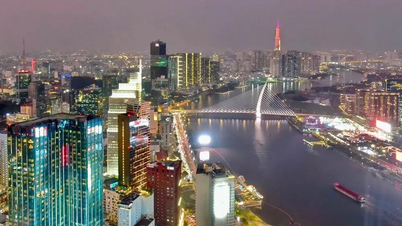
In leading urban centers such as Hanoi , Ho Chi Minh City, Da Nang, and Can Tho, a series of key transportation projects are being accelerated. The goal is not only to alleviate traffic congestion, but more importantly, to remove bottlenecks in logistics infrastructure – a fundamental element for enhancing national competitiveness, optimizing supply chains, and attracting foreign direct investment.
In fact, the progress of implementing strategic transportation infrastructure projects in growth poles has seen concrete changes. In the North, Hanoi is prioritizing resources to complete the ring road network, especially Ring Road 4 - Capital Region, which plays a crucial role in connecting industrial zones and clusters in the West and Southwest of the capital with neighboring provinces such as Hung Yen and Bac Ninh , creating a seamless transportation corridor.
In the South, Ho Chi Minh City is also gradually reshaping its regional connectivity structure by focusing on the implementation of the Ring Road 3 and Ring Road 4 projects and urgently bringing urban railway (metro) lines into commercial operation. At the same time, the research and promotion of the Can Gio International Transshipment Port project is expected to significantly increase the capacity to receive import and export goods by sea for the entire Southeast region. In the Central and Southwest regions, Da Nang and Can Tho are also accelerating investment in seaports, expressways, and logistics centers to strengthen their roles as transshipment hubs for goods in each region.
The urgent need to improve transportation infrastructure directly impacts the operational efficiency and costs of the logistics industry. According to forecasts in the National Logistics Service Development Strategy, with a target growth rate of 12–15% per year, the total revenue of the Vietnamese logistics market is likely to reach US$250–280 billion by 2035.
Discussing this potential, Mr. Dao Trong Khoa, Chairman of the Vietnam Logistics Services Business Association (VLA), commented that Vietnam is entering a new phase of development, requiring a logistics infrastructure system that is commensurate in both scale and level of integration. Once this scale is achieved, logistics will no longer be merely an auxiliary service, but will have the potential to transform into a "super industry" playing a crucial coordinating role in the economic structure.
However, the VLA Chairman also frankly pointed out the obstacles that need to be overcome in practice: "From a logistics perspective, we often emphasize three factors: connectivity, synchronization, and operation. If a seaport is very modernly invested in, but the road, rail, inland container depot (ICD) and warehouse connections are not seamless, then the overall logistics costs will still be high. Therefore, the focus of the next phase needs to shift from concentrating on 'building more' to 'optimizing operations,' ensuring interoperability between modes of transport to reduce intermediate costs."
In reality, the proportion of logistics costs to total production costs in Vietnam is still quite high compared to the regional average. Completing the ring road and expressway network will help shorten the time it takes for goods to move from factories to export gateways, thereby helping transportation businesses optimize vehicle turnover, save fuel, and improve profit margins.
Besides public investment, the participation of the private sector in logistics infrastructure development is yielding positive results. The socialization of infrastructure, with the emergence of large enterprises with strong financial and technological capabilities, not only helps alleviate budgetary pressure but also contributes to improving supply chain management capabilities according to international standards.
Commenting on this trend, Mr. Dao Trong Khoa believes that the participation of leading companies in building networks of logistics parks or smart sorting centers – modern logistics facilities using high-level automation technologies such as automated guided robots (AGVs), artificial intelligence (AI), and automated conveyor systems – will be a suitable approach for modern logistics operations: closely integrating physical infrastructure and digital technology platforms.
Nevertheless, for socialized models to truly contribute to the common good, VLA representatives noted that regulatory agencies need to focus on three core elements. These are: a transparent mechanism for data access rights to maintain neutrality; standardized data systems to ensure interoperability with logistics businesses, ports, and customs agencies; and finally, infrastructure investment must closely align with the national transportation network plan.
From the perspective of attracting investment, Mr. Dau Anh Tuan, Deputy Secretary General of the Vietnam Chamber of Commerce and Industry (VCCI), added that current FDI investors, especially in the high-tech and semiconductor sectors, demand a very stringent logistics ecosystem. The fact that major cities are focusing on upgrading connectivity infrastructure is a strong signal of the government's commitment to improving the investment environment, thereby strengthening confidence for multinational corporations to continue expanding their production scale in Vietnam.
Despite clear directions, the implementation of large-scale infrastructure projects still faces certain difficulties, particularly in compensation, support, and resettlement. Delays in land clearance are frequently the main reason affecting the overall construction progress of key projects.
In addition, the mechanism for attracting resources through public-private partnerships (PPP) and the coordination among localities within the economic region also need to be more tightly improved. To ensure that transportation infrastructure truly has a ripple effect, it is necessary to consider separating land clearance into independent projects to be implemented in advance; and at the same time, strengthen decentralization and delegation of authority to localities in flexibly balancing capital resources, Mr. Dau Anh Tuan emphasized.

In the vision for 2030, infrastructure investment needs to aim for synchronization and multi-layered development. A new expressway or port complex should not only serve motorized vehicles but also integrate digital infrastructure and green energy networks. As obstacles related to land acquisition and investment mechanisms are gradually removed, the transportation system in major cities will become a solid foundation, creating momentum for Vietnam's logistics industry to optimize operating costs and contribute positively to the double-digit economic growth target that the whole country is striving for.
Source: https://baotintuc.vn/kinh-te/tang-toc-ha-tang-do-thi-lon-luc-day-cho-logistics-vuon-tam-20260518082808000.htm


![[Image] Hanoi's urban life under the challenge of a "scorching hot" environment](https://vphoto.vietnam.vn/thumb/1200x675/vietnam/resource/IMAGE/2026/05/25/1779706979265_nang-nong-t5-2026-minh-duy-7-4636-jpg.webp)
![[Image] Close-up view of the interchange connecting the two expressways and Long Thanh Airport.](https://vphoto.vietnam.vn/thumb/1200x675/vietnam/resource/IMAGE/2026/05/25/1779703378210_ndo_br_z7863716673926-224453a31600126cce10622af6290afd-4549-jpg.webp)












































































Comment (0)