

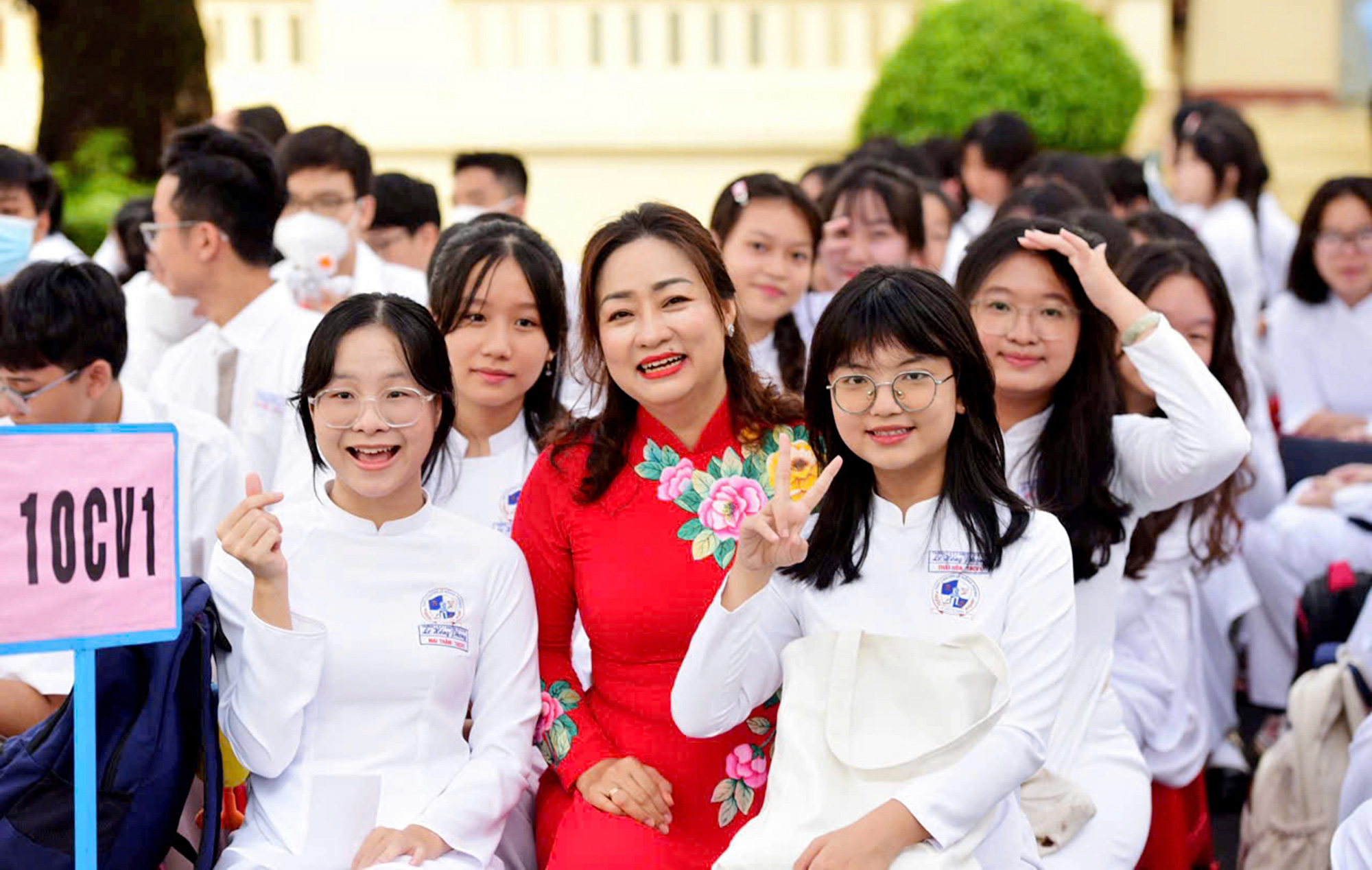
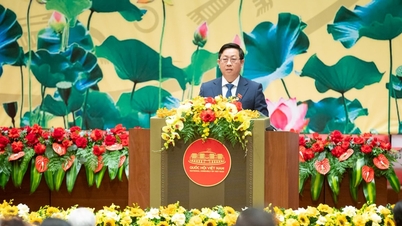
A policy that prioritizes teacher salaries will be a breakthrough in attracting talent – Photo: DUYEN PHAN
Presenting the draft law, Minister of Education and Training Nguyen Kim Son clearly stated that the salary policy for teachers will be given priority.
Salaries must be sufficient to attract talented individuals to education.
Accordingly, the basic salary according to the teacher salary scale is ranked highest in the administrative and public service salary scale system. Teachers are entitled to professional incentive allowances and other allowances depending on the nature of their work and the region, as stipulated by law.
Teachers will continue to receive seniority allowances until the salary policy under Resolution 27 is implemented. Teachers who are recruited and assigned a salary for the first time will have their salary increased by one level in the administrative and public service salary scale system.
Speaking at the group discussion, Minister of Labour, Invalids and Social Affairs Dao Ngoc Dung stated that only when teachers' living standards are secured can they focus on their work effectively instead of "worrying about tutoring and struggling to make ends meet." Therefore, special attention should be paid to the issue of teachers' salaries and allowances.
Representative Pham Khanh Phong Lan (Ho Chi Minh City) suggested that there is a need for more policies to attract students to the teaching profession, as well as policies to support and reward teachers who are committed to the profession, especially teachers in remote and disadvantaged areas.
Meanwhile, delegate Thai Van Thanh ( Nghe An ) suggested clearly defining the resources of the central government and local governments to implement policies for teachers, ensuring that the law is feasible, effective, and put into practice as soon as possible.
The policy to attract teachers in the draft law is necessary. However, Representative Pham Trong Nghia (Lang Son) pointed out that the content of the draft law is still too general. It lacks the breakthrough needed to create appeal and is not persuasive enough to attract highly qualified and talented individuals to work in particularly difficult areas.
This is especially true when they only receive preferential treatment in recruitment and incentive allowances, without knowing the exact level of these allowances or what salary and benefits they will receive.
"Without specific and clear policies, attracting teachers, as intended by the draft law when it proposes this regulation, will be very difficult to achieve," Mr. Nghia said.
Furthermore, the bill does not clarify what constitutes a highly qualified person, a talented person, or a person with exceptional aptitude. Therefore, he suggested clearly defining these categories to facilitate practical application.
Recruitment should be conducted to avoid a situation where there is an oversupply or shortage of teachers in some areas.
The draft Law on Teachers grants the education sector autonomy in recruiting and employing teachers. Specifically, the Ministry of Education and Training and the Ministry of Labor, Invalids and Social Affairs are the lead agencies responsible for developing strategies, projects, and plans for the development and overall staffing of teachers under their management, which are then submitted to the competent authorities for approval.
Coordinate the staffing of teachers in public educational institutions according to the number assigned by the competent authority; educational management agencies or educational institutions are responsible for recruiting teachers.
Representative Thai Van Thanh argued that the above regulation creates favorable conditions for localities and educational institutions to proactively develop plans for the development of the teaching staff, from recruitment and evaluation to training of human resources.
Specifically, when educational management agencies are in charge of recruitment and personnel management, they can proactively utilize, deploy, rotate, and second staff to meet requirements.
He cited the current situation where one district has a surplus of teachers but cannot transfer them to districts experiencing shortages because the education sector is not authorized to manage staffing levels.
"For a long time, we've been saying that we're short about 120,000 teachers, of which 72,000 haven't been recruited yet. The reason for the slow recruitment is due to multiple layers of bureaucracy, such as going through the internal affairs department, then back to the education department, and then back to the internal affairs department again – 3-4 rounds that slow down recruitment, resulting in the new school year starting but we still don't have teachers," Mr. Thanh said.
According to Mr. Thanh, if the above regulation is implemented, it will resolve the current situation of localized teacher shortages and surpluses.
Deputy Chairman of the Committee on Culture and Education, Ta Van Ha, also affirmed that teachers are a special group that needs attention in order to serve the cause of developing education and training and high-quality human resources.
However, there is currently a situation of localized teacher shortages and surpluses, with teacher quotas allocated based on local population. There is a surplus of teachers in large cities, but a shortage in disadvantaged areas. Teacher recruitment is still handled by the local internal affairs departments, which cannot fully solve the problem of teacher shortages and surpluses.
Given the above situation, Mr. Ha suggested that teacher recruitment should be entrusted to the local education departments. Furthermore, reducing staffing levels should also be considered to ensure the best possible teaching quality.
Source: https://tuoitre.vn/tao-chinh-sach-dot-pha-cho-nha-giao-20241110074703016.htm














































































Comment (0)