Innovating thinking in lawmaking.
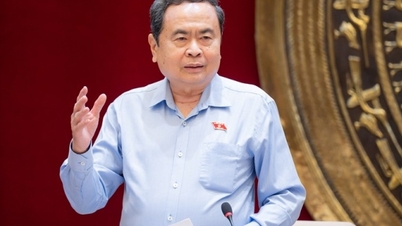
Mr. Ta Van Ha, Vice Chairman of the National Assembly's Committee on Culture and Social Affairs , expressed his impression that the 15th National Assembly term marked many institutional breakthroughs. With the motto "wherever obstacles arise, they will be removed immediately," the term saw 10 regular sessions and 9 extraordinary sessions. Through these, the National Assembly completed an unprecedented volume of legislative work.
Legislative work has not only undergone a qualitative transformation but also a quantitative one. Deputy Chair of the National Assembly's Committee on Law and Justice, Nguyen Thi Thuy, observed that while previous laws were often specific, they now only regulate framework issues, principles within the National Assembly's jurisdiction; specific, constantly changing issues are delegated to the Government, allowing for flexible policy responses. Each passed draft law should not only be a tool for management but also a driving force for growth.
The law-making process is also a highlight, with the maximum reduction of unnecessary procedures. Previously, most laws were enacted over two sessions, but now they are passed in a single session, saving 10-12 months for each law.
In particular, the approach focuses on removing legal bottlenecks. Instead of only the agency that issues a document having the right to amend it, the National Assembly issued Resolution 206, authorizing the Government and the Standing Committee of the National Assembly to issue resolutions to amend laws.
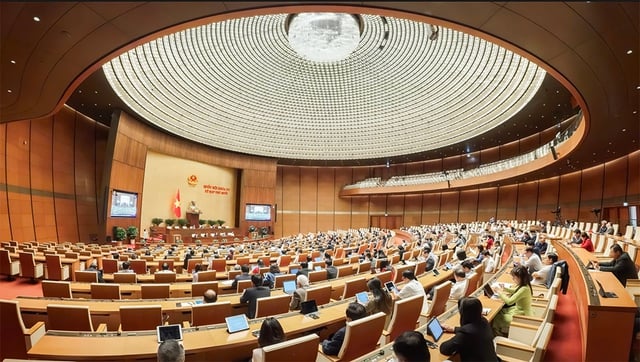
Lawmaking during the past term has seen many new developments, helping to remove institutional bottlenecks.
PHOTO: GIA HAN
With the aforementioned innovations, Ms. Thuy concluded that in this extraordinary situation, extraordinary approaches are needed to quickly revive stagnant resources. "Businesses don't have lofty aspirations; they only hope for a smooth, consistent, and stable legal framework so they can invest and develop with confidence in the long term," said the Vice Chair of the Committee on Law and Justice.
Looking back at the entire 15th term, Dr. Nguyen Quoc Viet (Faculty of Economics, Vietnam National University, Hanoi) also assessed that the National Assembly had done a very good job in its role as the legislative body, through focusing on perfecting legal frameworks, especially laws for the foundation of a market economy institution based on a new approach.
The completion and resolution of overlaps and conflicts in land, bidding, and planning laws help to unlock resources, even in the short term, and resolve stalled projects. The method of amending multiple laws with a single law also helps to unify and interconnect laws, freeing up resources for citizens, businesses, and government agencies alike in the implementation of procedures.
Addressing the situation where "the central government does everything, while local authorities wait for instructions"
Decentralization and delegation of power, coupled with resource allocation, also constituted a major institutional reform during the past term, clearly demonstrated by the Government's simultaneous issuance of 28 decrees on decentralization and delegation of power. This was the result of a large-scale review process involving 6,738 tasks and responsibilities of ministries, agencies, and governments at all levels; of which 2,718 key tasks were redefined, including 1,470 tasks that were decentralized and delegated to local governments and 1,248 tasks that were clearly defined between the provincial and commune levels.
At a higher level, along with the establishment of a two-tiered local government model, the Law on Organization of Local Government clearly defines the duties and powers of the chairman, vice-chairman of the People's Committee, and head of the People's Council at the commune level; it also specifically defines the management and problem-solving skills of the leadership and civil servants at the commune level.
In particular, the law has transferred the tasks and powers of the current district-level governments to the commune and provincial levels. The new commune level will assume approximately 86% of the tasks transferred from the district level, while the provincial level will assume about 14%. At the same time, it adds regulations to promote decentralization from the central government to the provincial level, especially in key areas such as planning, finance, budget, and investment…
The aforementioned figures not only reflect the scale of the reforms but also demonstrate a systematic effort to overcome the long-standing problem of "the central government doing things for the local government while waiting for instructions" in state management. The focus of this reform is to clarify authority, increase the autonomy of local governments, and link authority with specific responsibilities.
According to Dr. Nguyen Si Dung, former Deputy Head of the National Assembly Office, decentralization and delegation of power are clear manifestations of the constructive governance model. The State no longer concentrates power at the central level but proactively "shares power" with local authorities – those closer to the people, who understand the people better, and who can react more quickly. Another new point is placing the commune level at the center of decentralization, instead of concentrating it solely at the provincial level. This reflects the inevitable trend of modern governance: efficiency increases when power is given to the level closest to the people, provided that level has sufficient capacity and tools to implement it.
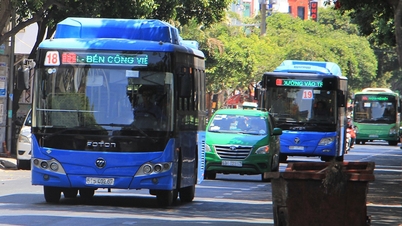
And reforms are not just on paper, as concrete examples have emerged in practice. For instance, in Ho Chi Minh City, from January 1, 2026, roads with fewer than four lanes will be managed by communes and wards, including both repairs and new construction. This approach allows local authorities to be more proactive, "instead of having to report even on small road repairs" – as Ho Chi Minh City Party Secretary Tran Luu Quang hopes.
Creating "ahead-of-the-line," "superior" policies.
Another outstanding institutional achievement of the National Assembly in the past term, according to Dr. Nguyen Quoc Viet's assessment, lies not only in its traditional legislative role but also in its capacity to create "forward-thinking" and "superior" policies. In the context of an economy facing new development challenges, the National Assembly has proactively participated in addressing unprecedented issues, moving towards a growth model based on the digital economy, green economy, and innovation.
A prime example of this new approach is the discussion and implementation of the "institutional sandbox" concept through pilot resolutions. The National Assembly has allowed controlled testing in key areas such as fintech, the development of international financial centers, and specific mechanisms in the amended Capital City Law and Resolution 98 for Ho Chi Minh City. These are groundbreaking policy initiatives that create new momentum for socio-economic development and pave the way for new growth models.
This view has received consensus from many experts and National Assembly delegates. When discussing the establishment of free trade zones and specific policies for Ho Chi Minh City, delegate Trinh Tu Anh (Lam Dong) argued that this is not merely a simple economic policy but also an important test of institutional thinking. Free trade zones are seen as a controlled experimental framework, aiming for new growth drivers based on innovation, modern services, and international competitiveness.
From a long-term strategic perspective, Dr. Nguyen Si Dung argues that, given the limitations of the traditional development model, a new institutional framework is a prerequisite for paving the way for innovation. The green economy and green finance sandbox is one of the tools that can meet this need, encompassing green credit, a pilot carbon market, green fintech, green industrial parks, etc.
With that in mind, establishing a green economy and green finance sandbox in Ho Chi Minh City would create an "institutional laboratory" for the entire country. If the mechanisms and models tested there prove effective, they can be quickly systematized, elevated to national policy, and replicated in other localities.
Source: https://thanhnien.vn/khoi-thong-diem-nghen-the-che-185260108182756493.htm


![[Image] Close-up view of the interchange connecting the two expressways and Long Thanh Airport.](https://vphoto.vietnam.vn/thumb/1200x675/vietnam/resource/IMAGE/2026/05/25/1779703378210_ndo_br_z7863716673926-224453a31600126cce10622af6290afd-4549-jpg.webp)


![[Image] Hanoi's urban life under the challenge of a "scorching hot" environment](https://vphoto.vietnam.vn/thumb/1200x675/vietnam/resource/IMAGE/2026/05/25/1779706979265_nang-nong-t5-2026-minh-duy-7-4636-jpg.webp)




















































































Comment (0)