

Proposal to allow parallel processing of procedures.
Accordingly, after six reporting rounds, HoREA has now compiled an additional 120 projects of businesses facing difficulties and long-standing obstacles in the fields of private investment, FDI, and PPP. in Ho Chi Minh City.
Of the 120 projects proposed for inclusion in this list of projects to be resolved, the majority are stalled due to legal procedures, land finance obligations, planning adjustments, updating of zoning plans, or adjustments to investment policies. Most have been "dormant" for many years, but the resolution of these obstacles has been extremely slow.

Many projects that have dragged on for decades without resolution have seriously affected the rights of customers.
PHOTO: DINH SON
In addition to legal and financial issues, the updated list also shows that many projects have been completed and are occupied by residents, but customers have not received their ownership certificates for many years. This greatly affects the rights of homebuyers.
Based on this reality, HoREA proposes that the city allow the parallel processing of investment, planning, and land procedures, instead of the current sequential approach. It also proposes allowing the separation of areas with completed legal procedures for prior implementation, and establishing mechanisms to support the resolution of land boundary disputes and enforce land acquisition in eligible cases.
If these obstacles are removed, tens of thousands of homes could be added to the market, helping to unlock capital flows, increase budget revenue, and ensure the rights of the people.
Some projects have been stalled for nearly 20 years.
Among them, many projects have been halted for decades and still have no solution. For example, the Saigon Venice social housing project in Binh Loi commune, Ho Chi Minh City, invested by United Nations International Investment Joint Stock Company (part of CT Group), covers an area of over 63 hectares. From 2019 to the present, the project has faced obstacles due to the legal review of projects belonging to Lang Le Farm, including the company's project.
To date, the review process has lasted more than six years. City leaders have assigned departments and agencies seven times to review and report on the project, but it remains incomplete, only reaching the stage of establishing a working group to review the Lang Le Farm, preventing the project from being implemented.
Therefore, the investor proposes that the Ho Chi Minh City People's Committee separate the company's social housing project from the Task Force reviewing Lang Le Farm and waive the legal review related to Lang Le Farm, as the project already received full consensus from relevant departments and agencies at the time of investment approval. Simultaneously, the company should be allowed to continue implementing the project according to regulations.
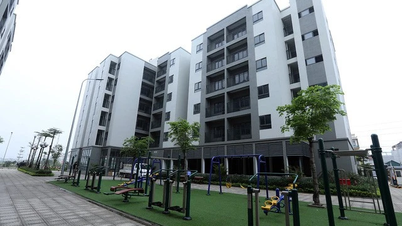
Another project by CT Group, Léman Luxury at 117 Nguyen Dinh Chieu Street, Xuan Hoa Ward, although completed and in use for many years, has not yet had its additional financial obligations calculated, preventing homebuyers from receiving their ownership certificates. Therefore, the company proposes that the Ho Chi Minh City People's Committee determine the additional financial obligations at the time of planning adjustment so that the company can pay them to the budget, serving as the basis for issuing ownership certificates to residents.

Although the Léman Luxury apartment complex was handed over in 2017, homebuyers have still not received their ownership certificates.
PHOTO: DINH SON
The high-rise apartment complex blocks 11.A, 11.B, 11.C, and 1.E in the Dong Tang Long New Urban Area, with the Compensation and Resettlement Corporation as the investor, received investment approval in 2009. In 2016, the investor was recognized and approved for completion by 2020. The method involves the investor constructing one block of resettlement housing and handing it over to the city in exchange for land use fees, while the remaining three blocks are for commercial development.
Currently, the project has completed all necessary legal procedures and is eligible to submit an application for a construction permit and commence construction. However, due to the lengthy review process regarding the land allocation mechanism and implementation method, the project has not yet undergone the land allocation and land use conversion procedures to begin construction. This prolonged delay in resolving the issue over many years has resulted in increased costs for the enterprise and wasted land resources.
Therefore, the investor requests permission to continue implementing the project according to the legal documents previously approved by the competent authority. Simultaneously, they request that procedures for land allocation and land use conversion be carried out in accordance with the law to create a basis for investment and construction, and to bring the land into use as soon as possible.
Source: https://thanhnien.vn/them-120-du-an-ton-dong-keo-dai-185260525174248405.htm


![[Image] Hanoi's urban life under the challenge of a "scorching hot" environment](https://vphoto.vietnam.vn/thumb/1200x675/vietnam/resource/IMAGE/2026/05/25/1779706979265_nang-nong-t5-2026-minh-duy-7-4636-jpg.webp)


![[Image] Close-up view of the interchange connecting the two expressways and Long Thanh Airport.](https://vphoto.vietnam.vn/thumb/1200x675/vietnam/resource/IMAGE/2026/05/25/1779703378210_ndo_br_z7863716673926-224453a31600126cce10622af6290afd-4549-jpg.webp)






















































































Comment (0)