

Change to attract customers.
Previously, many people were hesitant to visit museums due to the rigidity of the exhibits or the lack of appeal in the exhibition spaces. However, thanks to efforts to change exhibition methods, the rapid development of the fourth industrial revolution, and the digitalization of spaces, many museums have transformed into smart museums that attract a large number of visitors. Currently, many museums have boldly incorporated advanced technologies into their exhibitions, such as virtual reality (VR) and online 3D exhibitions, to serve the diverse needs of visitors.
A prime example is the National Museum of History, a pioneer in applying 3D virtual reality technology to its exhibitions many years ago. This technology not only offers the public engaging experiences but also provides long-term storage, facilitating visitors' continued access to information and research even after the exhibition has ended. By accessing the museum's website, visitors can explore exhibits in 3D using on-screen arrows, simultaneously viewing the exhibits and listening to the engaging commentary of a virtual guide.
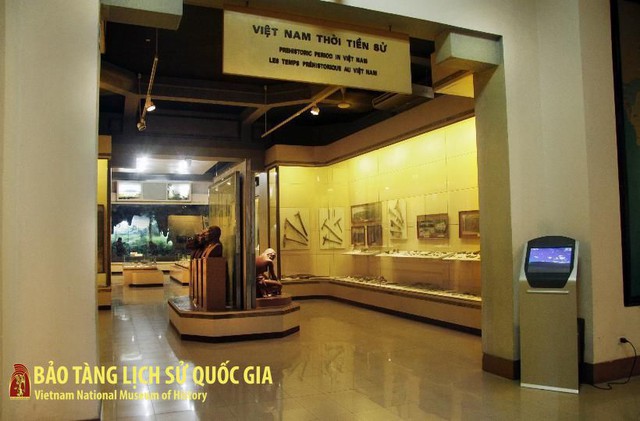
The National History Museum's 3D exhibition on prehistoric Vietnam.
Similarly, the Vietnam Fine Arts Museum is also one of the museums highly regarded for its implementation of digital technology to enhance visitor experience. Currently, the Vietnam Fine Arts Museum is applying many technological products to its exhibitions, such as the iMuseum VFA multimedia commentary system, 3D tours, and online art exhibitions. Notably, recently, with its VAES Online Art Exhibition Space Solution, the Vietnam Fine Arts Museum was awarded the Outstanding Digital Transformation Award.
Nguyen Anh Minh, Director of the Vietnam Fine Arts Museum, shared: "With the development of technology, the increasingly diverse needs of the public, and the requirement to preserve and promote the value of artifacts and cultural heritage, the application of digital technology is an inevitable trend in museum operations. It is considered a 'means' to attract the public, especially young people, to be more interested in museums, culture, and national history."
Because, when technology is applied, it helps museum artifacts and heritage, which are displayed in a static state, to have a story to tell, thereby creating a vivid and interactive experience for viewers, helping them easily access and understand more deeply the value of the exhibited heritage and artifacts. In addition, the application of digital technology helps museums become ideal tourist destinations, thereby enabling them to cooperate with travel and tourism businesses to develop the economy ."
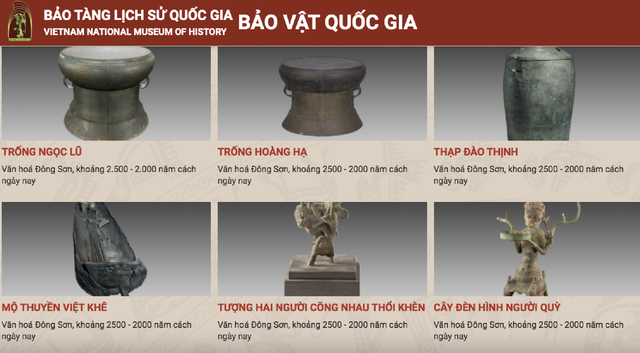
Images from the 3D virtual interactive exhibition "National Treasures" at the National History Museum.
According to Mr. Nguyen Anh Minh, in recent years, thanks to the active application of digital technology in introducing fine art works and the application of digital technology in modern online communication, the number of visitors to the Vietnam Fine Arts Museum has increased by 200-300% compared to previous years. "This is truly a new and effective direction in the museum's development in recent times," Mr. Nguyen Anh Minh emphasized.
Mechanisms and policies are needed to promote public-private partnerships.
Thus, it can be seen that, faced with the need for innovation to attract visitors, museums are forced to adapt to the times, diversify the forms of presenting artifacts, and improve the quality of the visitor experience. However, the application of digital technology in museum operations is still not considered a necessary task; therefore, there are currently no specific policies or regulations, so the application of digital technology in museum operations still faces many difficulties and challenges.
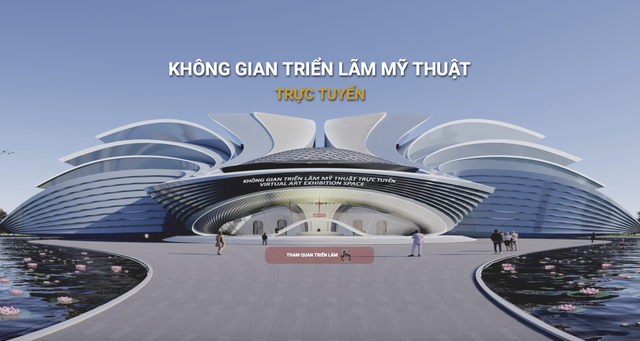
VAES online exhibition space of the Vietnam Fine Arts Museum
Mr. Nguyen Anh Minh stated: "The biggest challenge in applying digital technology to museum operations is human resources and finances. Currently, the museum's professional staff lacks personnel with in-depth expertise in information technology, making it impossible to independently develop technology-related products. Furthermore, investing in technology is very expensive. For example, using 3D mapping technology, a single projector costs billions of dong, not including product design costs. Museums typically lack the funds to implement this. Therefore, museums often have to seek support and cooperation from external partners to jointly carry out projects."
"However, to date, the State still lacks regulations, mechanisms, and policies to promote public-private partnerships and mechanisms to encourage individuals and organizations to collaborate with museums in investing in the application of digital technology in museum operations. Therefore, there are not many socialized projects, and not all cooperation models are effective or sustainable," said Mr. Nguyen Anh Minh.
According to Mr. Nguyen Anh Minh, another difficulty encountered when applying digital technology in museums is that technology easily becomes outdated, so continuous improvement and updating of new technologies are necessary. Meanwhile, museum human resources are not sufficient to meet the demand and still require cooperation with businesses that have high-quality technological resources. In addition, copyright protection is also a challenge for museums today.
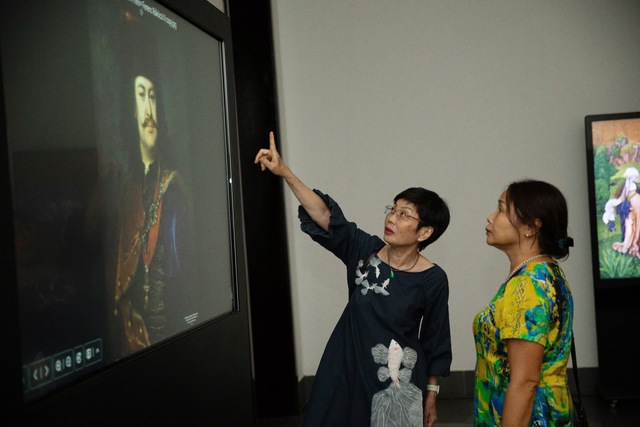
Visitors experience a digital exhibition using interactive screens at the Vietnam Fine Arts Museum.
To address the difficulties and strongly promote the application of digital technology in museum operations, contributing to attracting more visitors in the future, Mr. Nguyen Anh Minh stated: "The State needs to have more appropriate mechanisms and policies to attract socialized capital, promote public-private partnerships, especially in the field of promoting the value of museum artifacts on a digital platform. Because with such mechanisms and policies, museums will have the opportunity to choose more suitable and high-quality partners, firstly those with strong financial capacity to accompany the museum for a long time. Secondly, they should possess modern technology, keep up-to-date, and anticipate global technological trends to meet the operational needs of the museum as well as the viewing needs of the public."
In addition, museums must also focus on training high-quality, professionally skilled human resources to effectively operate the technology after it is transferred. At the same time, they need to continue innovating and creating new exhibition content so that the application of technology will make it more attractive to visitors.
Source: https://toquoc.vn/ung-dung-cong-nghe-so-tao-suc-hut-de-bao-tang-den-gan-hon-voi-cong-chung-20241011104820251.htm

![[Photo] General Secretary and President To Lam presides over a meeting with the Central Organizing Committee.](https://vphoto.vietnam.vn/thumb/1200x675/vietnam/resource/IMAGE/2026/06/03/1780482764658_a1-bnd-4741-3342-jpg.webp)

![[Photo] Secretary of the National Assembly Party Committee, Chairman of the National Assembly presides over the meeting of the Standing Committee and Executive Committee of the National Assembly Party Committee.](https://vphoto.vietnam.vn/thumb/1200x675/vietnam/resource/IMAGE/2026/06/03/1780480353201_ndo_br_bnd-2585-jpg.webp)
![[Photo] First session of the 14th Congress of the Vietnam Trade Union](https://vphoto.vietnam.vn/thumb/1200x675/vietnam/resource/IMAGE/2026/06/03/1780465947883_ndo_br_img-3852-jpg.webp)
















































![[Video] Sunset at Lap An Lagoon – Where the sun sets over the fishing nets](https://vphoto.vietnam.vn/thumb/1200x675/vietnam/resource/IMAGE/2026/05/31/1780192137701_beach-landscape-sea-water-nature-grass-745871-pxhere-com.jpeg)





































Comment (0)