

For this year's summer-autumn rice crop, localities in the province plan to plant approximately 36,500 hectares. To date, farmers have planted nearly 32,800 hectares, reaching almost 90% of the plan.
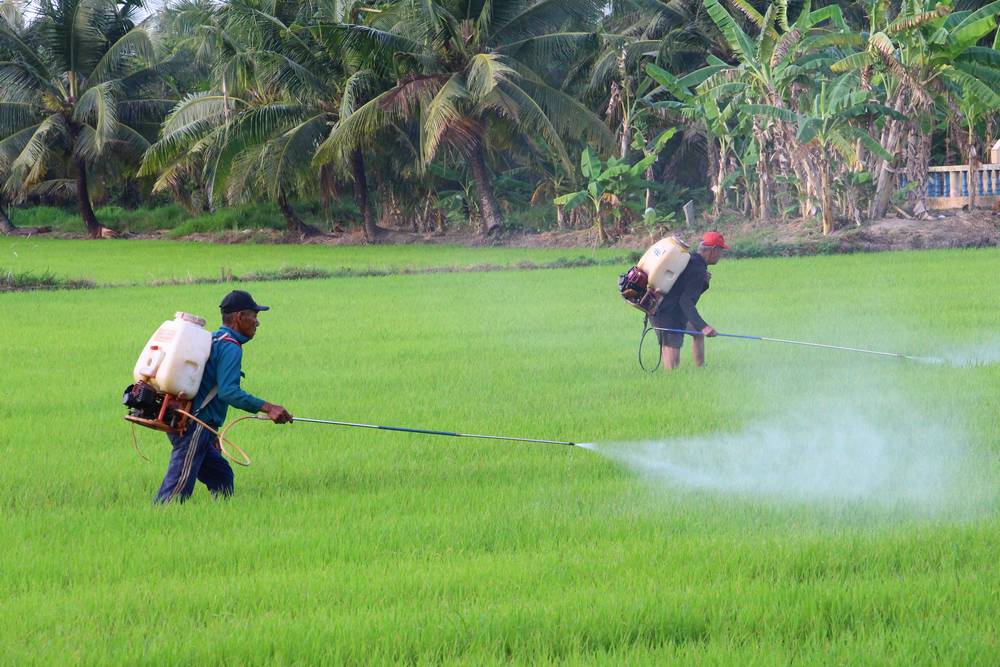 |
| Farmers need to inspect their fields regularly to promptly control diseases in rice crops. |
Observations in various localities show that farmers prioritize the use of high-quality rice varieties such as OM18 and OM5451, and use less fragrant rice varieties due to their susceptibility to pests and diseases. Farmers proactively reduce the amount of seeds sown and apply techniques to reduce production costs, while also reducing greenhouse gas emissions and increasing mechanization in sowing, fertilizing, and spraying.
Taking proactive measures to prevent lodging in rice crops right from the start of the season, Mr. Nguyen Van Tam ( Binh Phuoc commune, Mang Thit district) said: “After the winter-spring crop, I prepare the land very carefully, making it airy, eliminating some soil-borne pests, helping the rice grow better, with stronger roots, and reducing lodging. Besides that, I also sow the OM5451 rice variety in rows, only 8-9 kg per hectare.”
According to many farmers, the weather from the beginning of the season until now has been a mix of hot sunshine and unseasonal rain, increasing the risk of various rice diseases. While spraying fungicide to treat rice blast, Mr. Tran Van Hanh (Long Phuoc commune, Long Ho district) said: “This season, we predict that there may be more diseases on the rice crop, so I regularly inspect my fields. When I see diseases appearing, I take preventative measures and spray at the right time. If I miss the opportunity, the disease will spread quickly and cost more money.”
According to authorities, several rice diseases have appeared recently and are likely to increase significantly. Specifically, in the past week, the area affected by rice leaf roller was over 500 hectares, an increase of over 230 hectares compared to the previous week; the area infected with blast, brown spot, and yellow leaf disease was over 350 hectares, an increase of 100 hectares, with a prevalence rate of 5-10%, affecting rice crops from tillering to heading. These diseases are scattered across communes in Long Ho, Mang Thit, Binh Tan, Tam Binh, Tra On districts and Binh Minh town…
Specifically, the incidence of rice blast, brown spot, and yellow leaf disease may increase due to hot, sunny weather, frequent unseasonal rains, and the fact that the disease is developing during the tillering to heading stages of rice; leaf roller may appear and cause mild damage during the tillering to heading stages. In particular, fields with dense planting, excessive nitrogen fertilization, and fields using susceptible varieties may experience moderate levels of infection.
Furthermore, the complex weather patterns of hot, dry conditions are very favorable for rice pests and diseases during the seedling stage, especially thrips, which will cause severe damage. Thrips damage leaves by curling at the tips, wilting, shrinking, and turning yellow, particularly in fields with low water levels. Rice stem borers (rice leafhoppers) appear and cause localized damage to rice crops from the late tillering to heading stages.
Forecasts indicate that the infected area will continue to increase due to low temperatures, high humidity, the use of susceptible varieties, and excessive nitrogen fertilization. If detected and not managed promptly, it could cause damage and affect rice yield. In addition, attention should be paid to rats during the rice sowing stage, whiteflies, and bacterial leaf blight during the heading and flowering stages.
The Department of Crop Production and Plant Protection recommends that the transitional weather conditions, combined with the rice growth stage, are conducive to the emergence and spread of pests and diseases. Therefore, farmers need to regularly inspect their fields to implement effective management measures, especially for diseases. If early signs of disease appear, stop applying nitrogen fertilizer and promptly apply specific pesticides, avoiding mixing them with foliar fertilizers. Spray to prevent rice blast and grain discoloration before and after the rice has fully headed. Continue to monitor, care for, and manage infected areas effectively.
Meanwhile, the area infested with rice weeds is increasing rapidly over the rice seasons. Farmers are advised to thoroughly prepare the land before sowing to avoid losses in rice yield. For summer-autumn rice in the seedling stage, attention should be paid to thrips, and pesticide intervention should be limited when the population density is low. Applying solutions such as flooding the fields with water combined with fertilization will strengthen the plant's resistance, helping it recover more quickly.
Mr. Nguyen Ngoc Thanh, Deputy Head of the Crop Production and Plant Protection Sub-Department (Department of Agriculture and Environment), said: The Sub-Department has coordinated with localities to disseminate information, provide training, and transfer scientific and technical advancements, especially on sustainable rice cultivation, to farmers. To date, based on the results achieved, the Sub-Department continues to promote and guide farmers in applying the advanced technical solutions they have been trained in to practical production, helping to achieve high efficiency in the Summer-Autumn rice crop.
Although this year's summer-autumn rice crop is predicted to face many difficulties due to weather and diseases, with support from specialized agencies and diligent care from farmers, it is believed that the crop will be highly effective, helping to increase profits for farmers.
Text and photos: NGUYEN KHAN
Source: https://baovinhlong.com.vn/kinh-te/nong-nghiep/202505/tap-trung-cham-care-lua-he-thu-34c4db0/













































































Comment (0)