

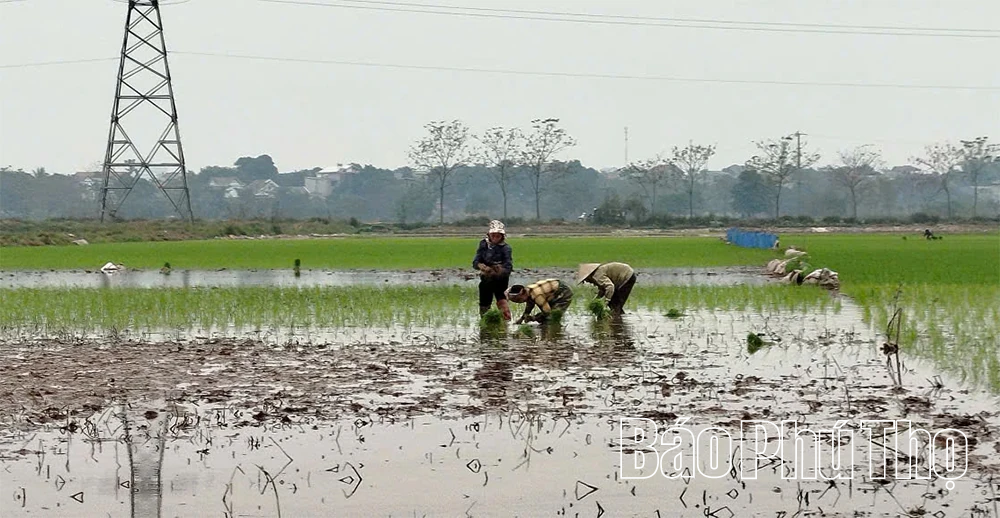
Farmers in Dao Xa commune are sowing and planting early spring tea.
These days, the outdoor temperature is quite low, and the drizzle only intensifies the feeling of coldness. Nevertheless, in localities throughout the province, farmers still go to the fields early in the morning to sow seeds, prepare the soil, harrow, and plant the spring crop according to the seasonal schedule.
Taking a break after several rounds of plowing, Mrs. Ha Thi Binh from Nhang Que area, Thanh Son commune, said: "We have to hurry to prepare the land, sow seedlings, and transplant early spring rice to avoid the possibility of being affected by the minor floods. This is the main crop, so we will focus our investment to achieve the highest efficiency. After plowing, my family will add green manure and harrow the soil before sowing and transplanting to both limit the use of chemical fertilizers, reduce costs, and revitalize the rice fields."
According to the plan, this spring, the entire province will plant approximately 80,250 hectares of rice. The expected yield is over 62.2 quintals/hectare; the total production is expected to reach approximately 500,000 tons. Besides rice, the province also plans to plant about 22,600 hectares of corn and 12,600 hectares of various green vegetables; 5,300 hectares of peanuts; 1,680 hectares of sweet potatoes and some other crops during the spring planting season.
Currently, farmers are focusing on planting early spring rice, completing land preparation and sowing to prepare for planting late spring rice. To ensure stable rice growth and minimize damage from weather conditions, for areas already planted, farmers have proactively flooded the fields to keep the newly planted rice warm. For areas where seedlings have been sown, they are covered with plastic sheeting to protect the young seedlings from the cold.
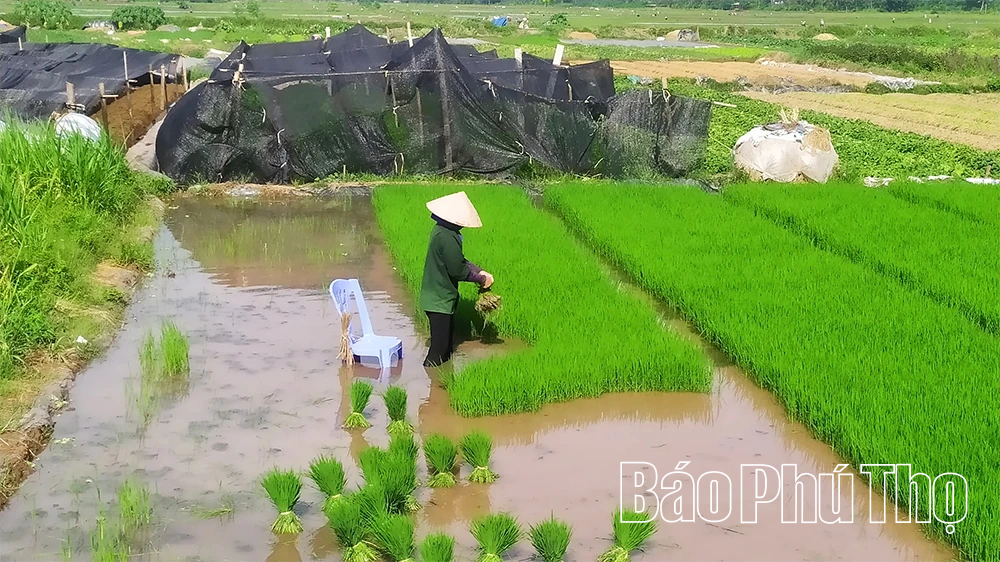
Farmers in Phung Nguyen commune are preparing rice seedlings for early spring planting.
Comrade Nguyen Hong Yen - Head of the Department of Crop Production and Plant Protection, emphasized: For this year's spring crop, based on the province's policies and directions, localities need to closely monitor the production situation and closely track weather developments to provide timely and decisive guidance and direction appropriate to the reality, planting all the planned area, avoiding the situation of abandoned fields and crop failures.
Directing the implementation of proper tea and seed structure, and sowing seedlings according to the province's seasonal schedule. Encouraging land consolidation and concentration associated with the development of single-crop fields to uniformly apply technical advancements and introduce mechanization into production to achieve the highest possible results in the spring crop.
To date, localities have prepared sufficient quantities of seeds, with the correct crop structure, fertilizers, irrigation water, and other agricultural supplies according to the production plan for the spring crop of 2026 that has been implemented. The agricultural sector also requires specialized units to send staff to coordinate with localities to closely monitor the fields, guide people on measures to protect seedlings from the cold, and closely monitor the weather situation to adjust planting and cultivation accordingly, avoiding sowing seedlings too early.
Farmers are advised to sow rice around the beginning of spring, avoiding sowing and fertilizing seedlings with nitrogen when temperatures drop below 16 ° C. For crops such as corn, peanuts, and beans, in addition to planting at the right time, farmers should take advantage of soil moisture for planting and use good quality varieties that are in line with the agricultural sector's structure, and avoid planting on days when temperatures are below 15 ° C.
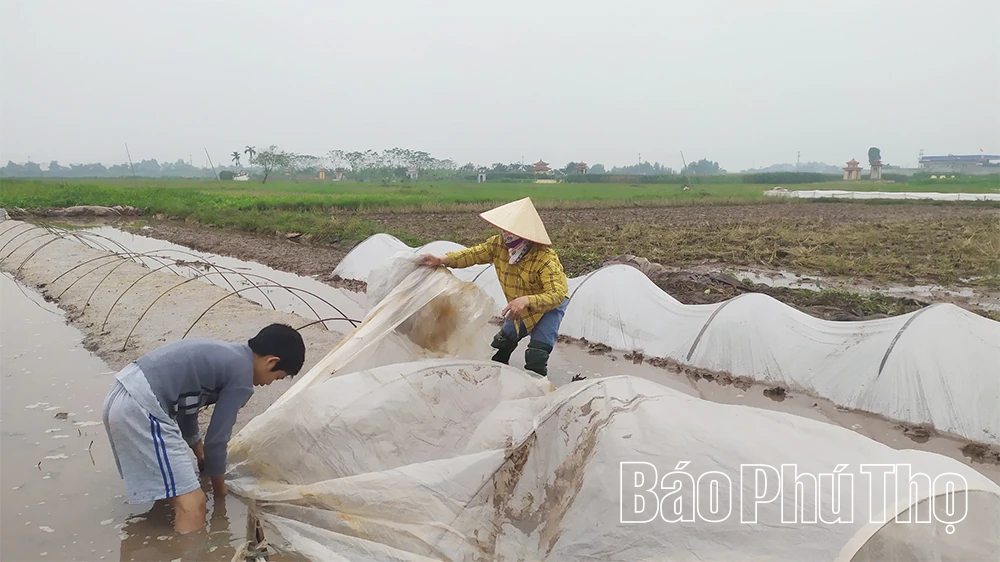
Take proactive measures to protect rice seedlings from the cold when planting.
To minimize the risk of farmers purchasing substandard supplies that could affect productivity and yield, the Department of Agriculture and Environment has deployed units to coordinate with local authorities to inspect agricultural supply businesses, ensuring the supply of quality seeds and materials in accordance with the issued catalog.
At the same time, irrigation companies are requested to direct irrigation enterprises to coordinate with local authorities to organize water extraction according to the water release periods when hydropower plants open their sluice gates, ensuring sufficient water storage to keep transplanted rice warm and to support late spring planting.
To minimize damage caused by natural disasters, localities also need to proactively monitor weather conditions closely and prepare prevention and control plans to minimize damage in the event of a disaster.
Quan Lam
Source: https://baophutho.vn/tap-trung-gieo-cay-lua-xuan-246396.htm

![[Photo] General Secretary and President To Lam receives Amazon's Senior Vice President David Zapolsky](https://vphoto.vietnam.vn/thumb/1200x675/vietnam/resource/IMAGE/2026/05/22/1779466547770_a1-bnd-3513-6601-jpg.webp)














































































Comment (0)