

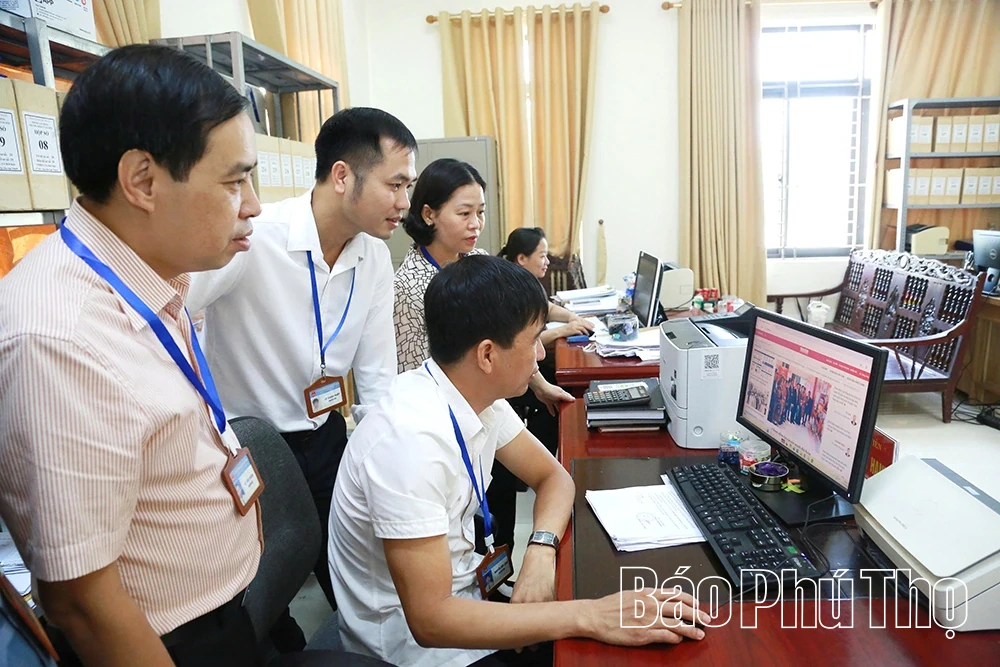
The staff of Lap Thach commune has been organized and strengthened to ensure sufficient quantity and quality, meeting the requirements of the tasks.
Part 1: Ensuring Quantity, Improving Quality
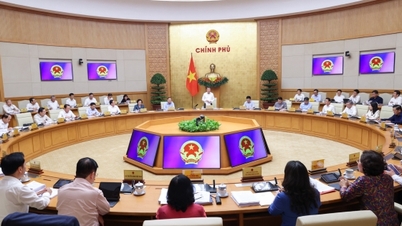
Immediately after the two-tiered local government model came into operation, the province seriously implemented the arrangement and placement of commune-level officials and civil servants in accordance with the Party's principles and State regulations. The commune-level officials and civil servants were strengthened; their leadership and management capabilities were improved; and new working methods gradually took shape. However, the shortage of officials in disadvantaged communes and the fact that the quality of some grassroots officials does not yet meet the requirements of new tasks are challenges that the province must focus on addressing.
Efforts to reorganize and strengthen the team of grassroots officials.
As of May 15, 2026, the province had 65,823 commune-level officials and civil servants (10,331 civil servants and 55,492 public employees). Of these, 59,784 held university degrees or higher, accounting for 91%; and 17,720 held intermediate-level or higher political theory qualifications, accounting for 27%. Generally, the province's grassroots-level officials and civil servants possess strong political convictions, good moral character, are sufficient in number, and most have professional qualifications that meet the required standards. They demonstrate a sense of responsibility, organizational discipline, and proactive adaptation to new task requirements.
During the nine months of operating the two-tiered local government model, the province has reviewed, screened, and proactively assigned, transferred, and seconded over 750 individuals to work at the commune and ward levels. At the commune level, 140 out of 148 Party Committee Secretaries; 137 out of 148 Chairmen of the People's Committees; and 100% of the Chairpersons of the Party Committee's Inspection Committees are not local residents. This is a groundbreaking solution, clearly demonstrating the province's high political determination to prioritize resources for the grassroots level, ensuring the stable, effective, efficient, and smooth operation of the commune-level apparatus in implementing the two-tiered local government model. To meet practical requirements, the Provincial Party Standing Committee has directed the review and development of a plan to consolidate, assign, and add 74 Vice-Chairmen of the People's Committees at the commune level.
Departments and agencies have strengthened professional and technical guidance for grassroots units according to the motto "accompanying, supporting, and guiding." As a result, the leadership and management capacity of grassroots Party committees and governments has gradually improved, and working methods have shifted towards a more scientific and flexible approach. The activities of Party committees, People's Councils, People's Committees, and political and social organizations in 148 communes and wards have gradually become more organized, ensuring comprehensive Party leadership and unified government management, contributing to maintaining political stability and social order, and creating a foundation for socio -economic development and building a cleaner and stronger Party and political system.
Increase the number and improve the quality of grassroots officials.
Besides the achievements, it is necessary to frankly acknowledge that grassroots-level personnel work still has some limitations, such as the uneven quality of the staff. The leadership and management capacity, as well as the professional and technical skills of some grassroots officials, do not fully meet the requirements and tasks of the new era; daily work is not handled promptly; and there are still signs of reluctance to think critically, innovate, and be creative... A portion of grassroots officials have not kept pace with the progress and requirements of administrative procedure reform and digital transformation.
In particular, there is still a surplus and shortage of personnel; an imbalance between sectors and professions, with many personnel in social sciences (33%) and arts and culture (21%), but a shortage in information technology, engineering, construction, land management, education management, and healthcare. Notably, personnel with expertise in science and technology, land management, and natural resources and environment account for only 1.5% of the total number of personnel assigned to communes; this is most evident in some remote areas and areas with limited socio-economic development conditions where there is a shortage of personnel.
In response to this situation, the communes proactively reviewed their existing staff, submitted reports to the Department of Internal Affairs, and posted notices to attract personnel. Mr. Bui Van Khanh, Chairman of the Lac Son Commune People's Committee, stated: The commune has publicly announced the need to fill 25 positions at the Commune People's Committee. Specifically, the Economic Department needs 11 positions, the Culture and Social Affairs Department needs 9, the People's Council and People's Committee Office needs 2, and the Public Administrative Service Center needs 3. If the number of applications exceeds the number of positions, the commune will prioritize those with higher professional qualifications; children of meritorious individuals, children of martyrs, children of wounded soldiers, children of disabled soldiers; those with higher work achievements in the last 6 years; and those with permanent residence in Lac Son commune...
Communes such as Da Bac, Hop Kim, Bao La, Pa Co, and Binh Xuyen have also proactively conducted reviews and publicly announced their staffing needs. The Department of Internal Affairs has also sent documents to provincial departments and agencies informing them about the review of personnel deployment, reinforcement, secondment, and the entitlement to attractive preferential policies and benefits.
Along with increasing the number of personnel, the province focuses on training and improving the quality of its staff in general, and grassroots officials in particular. On March 27, 2026, the Provincial People's Committee issued Plan No. 91/KH-UBND on "Training of Officials and Civil Servants in Phu Tho Province in 2026". Accordingly, the province will organize 27 training courses with 3,544 participants. The training courses will be organized according to target groups: key leaders of wards and communes with high urbanization rates; rural and mountainous communes; and training for professional and technical civil servants at the commune level. In particular, the province will organize online training for provincial and commune-level civil servants using MOOCs on the application of artificial intelligence (AI) in task execution, exploitation of digital platforms, virtual assistants, and data-driven decision-making; and opportunities and challenges from applying AI to support management activities. Data governance is linked to national digital transformation; ensuring information security.
The province has designated 2026 as the "Year of Improving the Quality of Grassroots Cadres." To realize this goal, on April 14th, the Provincial Party Standing Committee issued Resolution No. 27-NQ/TU on "solutions to improve the quality of grassroots cadres to effectively implement the two-tiered local government model and ensure double-digit growth, contributing to building a clean and strong Party and political system." The core points of the Resolution and the determination to create a breakthrough in the quality of grassroots cadres in Phu Tho province in the coming time will be clarified in the next issue under the title: Building a team of commune-level cadres "strong in implementation."
Willow
Source: https://baophutho.vn/tap-nbsp-trung-nbsp-nang-cao-chat-luong-can-bo-nbsp-co-so-255257.htm


![[Photo] General Secretary and President To Lam and the President of the Philippines hold talks.](https://vphoto.vietnam.vn/thumb/1200x675/vietnam/resource/IMAGE/2026/06/01/1780286997787_anh-man-hinh-2026-06-01-luc-11-09-43.png)








































































Comment (0)