

These days, as Tet (Lunar New Year) approaches, when relatives and close friends meet, many ask, "Have you had your year-end party yet?", "When is the year-end party?". Some friends whose families have settled abroad also call to inquire about Tet preparations, including the question: "Has your family had your year-end party yet?"... The year-end party is not a new custom; it has been a beautiful aspect of the nation's cultural life since ancient times.
When I was a child, I remember that from the 23rd of the 12th lunar month onwards, after sending the Kitchen God to heaven, in my hometown, along with preparing for the three New Year's meals, families, rich or poor, would hold a year-end party, considering it an indispensable task to end the old year. Many families held it on the 30th, but quite a few families did it earlier to make it easier to clean their houses.
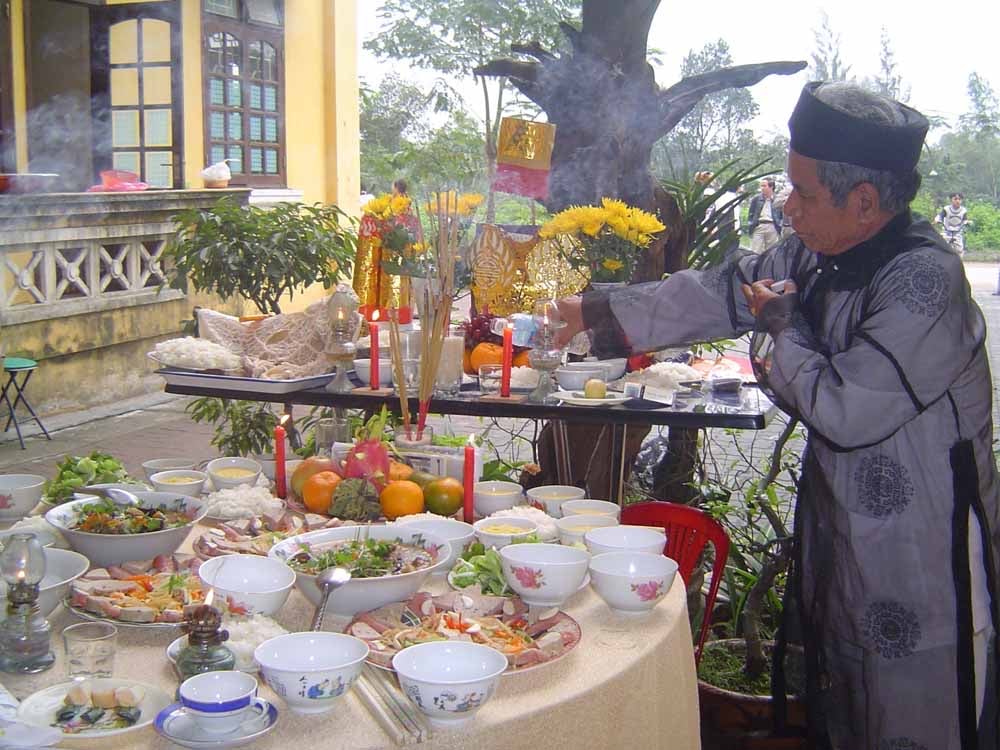 |
| A family in the countryside holds a year-end ceremony. |
Traditionally, in my family, my mother goes to the market early in the morning to buy the necessary items. Then, family members gather to prepare a feast to offer to heaven, earth, and deities, and another feast to offer to our ancestors and grandparents to celebrate Tet. The New Year's Eve feast usually has many dishes, depending on each family's preparations, but in my hometown, it's rarely without flowers, a platter of five kinds of fruit, wine, meat, sticky rice, sweet soup, and various cakes and pastries. In particular, the feast to offer to heaven, earth, and deities always includes a plate of betel nuts and leaves, a bowl of rice mixed with salt, and a boiled rooster with its wings crossed and its head slightly tilted forward. If a family slaughters a pig to share with relatives and neighbors during Tet, they use the boiled pig's head, covered with a thin white sheet of fat, as a substitute for the chicken, along with a pig's trotters, tail, and a little bit of each of the five internal organs as symbolic offerings.
In the year-end offering tray, incense and candles are two essential items. From my great-grandparents' time to my grandparents', my father always instructed my mother to buy fragrant, high-quality incense and candles for the New Year's offering, because the year-end ceremony only happens once a year. According to ancient beliefs, incense symbolizes the stars, connecting yin and yang, while candles symbolize the moon and the sun, so the offering tray on the altar, as well as the offering tray to heaven, earth, and deities, must always include them.
When the offerings were neatly arranged on the table, my father, dressed in formal attire, lit incense and prayed to heaven and earth, the gods, and our ancestors, expressing gratitude for the blessings bestowed upon our family in our business endeavors and for our well-being throughout the past year. While my father performed the ritual, the other family members stood with their hands clasped before the altar, showing their reverence amidst the fragrant, spiritual aroma carried on the cool breeze of the last day of the year. Later, when my siblings and I grew up and started our own families, we all followed the way my father taught us.
Tea is the last offering, and when the incense has burned out, a bowl of rice mixed with salt is scattered in the yard. That's when the year-end ceremony ends, and the family atmosphere becomes bustling, preparing for the last meal of the year. Like in many other rural areas, the year-end meal in my hometown is usually very lively, not only with family members but also with neighbors invited to share in the joy.
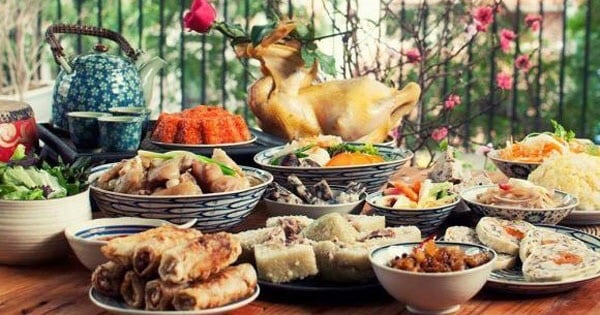 |
| Prepare the offering tray for the year-end ceremony. |
It can be said that the New Year's Eve dinner is not just a simple feast, but also embodies beautiful cultural traditions, creating a strong bond between family members, as well as neighbors, during the Tet holiday. Relatives, siblings, and children who live far away return home to reunite, reminiscing about family and clan matters, and discussing work and business. While in the city people discuss work, factories, and business, in the countryside, topics like rice, potatoes, cattle farming, and fish farming are also discussed, along with setting goals to strive for in the coming year. Children who haven't seen each other for a long time, besides enjoying a delicious meal, also have the opportunity to play, gather, and learn more about their elders and relatives.
From ancient times to the present day, even during the difficult economic periods of the centrally planned economy or the years of economic reform when life became stable and prosperous, families across Vietnam have always maintained the tradition of preparing a lavish and complete New Year's Eve feast. In some cases, due to personal circumstances or busy work schedules, the rituals may have been simplified, and the preparation of the New Year's Eve feast may have been quicker, but few people skip it when the end of the year approaches. Besides its traditional spiritual significance, the New Year's Eve feast is also an occasion for reunion and a way to express the national tradition of remembering one's roots. For those who live far from home, the arrival of Tet (Lunar New Year) evokes a flood of memories, including the image of sitting with family in a warm and cozy New Year's Eve meal.
HOANG NHAT TUYEN
Source: https://baokhanhhoa.vn/van-hoa/202501/tat-nien-net-dep-trong-doi-song-van-hoa-d127c06/
![[Photo] General Secretary and President To Lam and the President of the Philippines hold talks.](https://vphoto.vietnam.vn/thumb/1200x675/vietnam/resource/IMAGE/2026/06/01/1780286997787_anh-man-hinh-2026-06-01-luc-11-09-43.png)

















































Comment (0)