

The Odyssey spacecraft performed well and began communicating with operators during its week-long journey to the Moon.
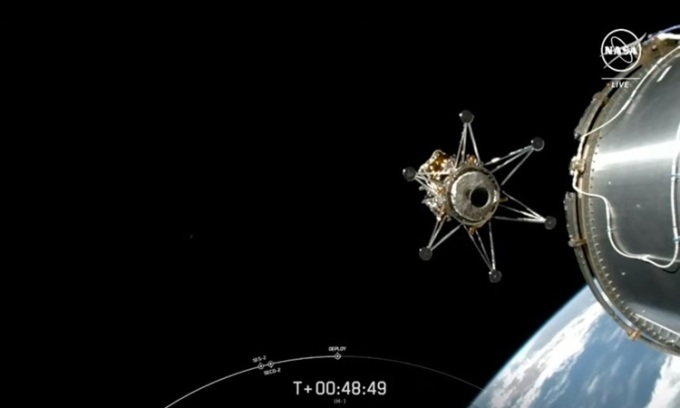
The Odyssey spacecraft separates from the Falcon 9 rocket. Photo: NASA TV
The Odysseus automated lunar lander, built by Houston-based Intuitive Machines, launched aboard a SpaceX Falcon 9 rocket on the morning of February 15th from NASA's Kennedy Space Center in Florida. The liftoff went smoothly, with Odysseus separating from the rocket and flying along its planned trajectory. The lander successfully deployed in space by establishing stable orientation, charging its solar power, and communicating via radio with the company's mission control center, Intuitive Machines announced approximately eight hours after launch.
The Odysseus spacecraft, about the size of a British telephone booth, will reach the Moon in six days if all goes according to plan. First, it will enter orbit around the Moon, then prepare to land on February 22nd at the bottom of a small crater about 300 km from the South Pole. If successful, the mission will go down in history. No private spacecraft has ever landed smoothly on the Moon, and the US hasn't launched a spacecraft to the lunar surface since the Apollo 17 astronauts returned to Earth in December 1972.
Odysseus carried 12 payloads, including six NASA instruments under the Commercial Lunar Payload Services (CLPS) program. NASA's instruments will perform a range of tasks, from testing new precision navigation and landing technologies to measuring how Odysseus's emissions interact with lunar surface soil and rocks during landing. Such data could pave the way for establishing a habitable base at the south pole in the coming years, a goal NASA is pursuing through its Artemis program. The remaining six payloads on Odysseus belong to various private clients, including Columbia Sportswear, a company that develops insulation technology for lunar landers.
With its IM-1 mission, Odysseus was the second lunar lander to launch under the CLPS program. The first spacecraft was Peregrine, built by Astrobotic in Pittsburgh. Peregrine launched on January 8th aboard a Vulcan Centaur rocket from United Launch Alliance. The launch was successful, but Peregrine suffered a serious fuel leak shortly afterward, forcing Astrobotic to guide the spacecraft through a controlled descent through Earth's atmosphere on January 18th.
An Khang (According to Space )
Source link

































































































Comment (0)