

Ms. Vuong Ngoc Thu was born and raised in Muong Khuong, and later settled in Bac Cuong ward ( Lao Cai city). Born in a poor rural area, from a young age, Ms. Thu helped her parents with daily chores and familiar farm work. Therefore, from a young age, she learned how to wrap various types of cakes and prepare traditional dishes. In Ms. Thu's memory, besides the minor festivals (which may or may not be celebrated), the villagers each year had three major holidays: Lunar New Year, the Full Moon Festival (the 15th day of the 7th lunar month), and the Dragon Boat Festival (the festival to kill insects).

Having left her village more than 10 years ago, Thư still follows her old habits, personally wrapping traditional cakes to offer to her ancestors during Tet (Vietnamese New Year). Being of the Nùng ethnic group, she makes "bánh gù" (black sticky rice cake) at the beginning of the year, "bánh gù" and "bánh rợm" for the 15th day of the 7th lunar month, and "bánh gio" for the Dragon Boat Festival. In the scorching May sun, while the villagers are harvesting rice, drying grain in the yards and straw in the fields, Thư drives from Lào Cai city to Bát Xát to ask for... two bags of straw. She brings the straw back to the third floor to dry until golden brown, then burns it to get the ash. Thư confided: "I have to go to Bát Xát to ask for straw because the villagers there cultivate Séng cù rice, and the dried straw smells very fragrant when burned. The ash after burning is used to soak the rice for making bánh gio. This is also one of the secrets to having delicious, golden, translucent, and chewy cakes for the Tet festival."

To prepare for this important Tet holiday, Ms. Thu also took the opportunity to drive to the outskirts of the city to pick chít leaves to wrap the cakes. According to Ms. Thu, the chít leaves used for wrapping the cakes must be young leaves, boiled until cooked, and then used to wrap the cakes to give them a distinctive aroma. Besides making cakes with glutinous rice soaked in wood ash water, many families also make cakes with glutinous rice mixed with finely ground charcoal from the Nuc Nuc tree, roasted cardamom, and salt... Regardless of the method, the cakes must use wood ash (or charcoal) because, according to belief, it can ward off bad luck and misfortune...
Gio cake is a popular cake among many ethnic groups; in some places it is called chit cake, three-horned cake, or buffalo horn cake. While perceptions of the dish, its wrapping, and preparation may vary, gio cake is a traditional food eaten during the Tet holiday (a festival honoring the extermination of insects).
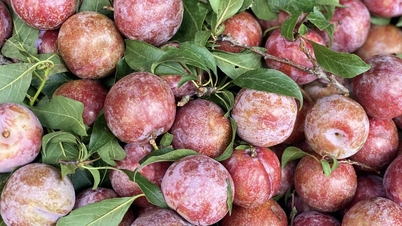
Besides sticky rice cakes, depending on local customs, the ancestral offering tray may include chicken, duck, pork trotters, fermented rice, and fruits (usually sour). Many people believe that on this day, certain foods, especially fermented rice and sour fruits, can eliminate parasitic insects in the body. May is also the plum season in Lao Cai, so plums are the most common fruit seen during this festival.

Every year, besides preparing the offerings for her ancestors, Mrs. Tung Thi Hoa, from Na Ha village, Lung Vai commune (Muong Khuong district), goes to the market early in the morning to buy 1-2 kilograms of plums or a bunch of lychees for her grandchildren... to ward off insects. To increase the "effectiveness" of the extermination, Mrs. Hoa instructs her grandchildren to eat a few sour plums right after waking up. She still holds this belief because since she was a child, she heard from adults that eating sour fruits and fermented sticky rice on the morning of the Dragon Boat Festival, before eating a meal, helps expel parasitic insects that can harm humans. Offering incense to ancestors and eating sour fruits to ward off insects is a way to hope for a healthy year and a bountiful harvest.
“As the children and grandchildren grow older, every May I hear some of them grumbling that eating sour food in the morning isn't good for them and can easily cause stomach aches, but everyone smiles brightly, grimacing as they enjoy this most special breakfast of the year. Maybe they're right, but it's a tradition, and everyone tries to preserve it because it's become a habit. We only get rid of pests once a year, that's all,” Mrs. Hoa explained with a smile.

For farmers like Mrs. Hoa, the Dragon Boat Festival is a special festival closely linked to the harvest and the weather. The May sun urges the fields to ripen to a golden hue, marking the harvest season. However, May also brings hot weather, heavy rains, and is a period when diseases are easily spread, affecting both crops and people. The Dragon Boat Festival is an occasion for people to express their wishes for a successful year of production, a bountiful harvest, and good health and peace. Later, although many families left farming and their hometowns, this custom was preserved, becoming a traditional festival for many ethnic groups. In Lao Cai, the Dragon Boat Festival (Tet Doan Ngo) is one of the main holidays for ethnic groups such as the Kinh, Tay, Nung, Giay, Phu La, Muong, Thai, Pa Di, and Bo Y. Each ethnic group has a different definition, concept, or legend about this holiday, but most relate to agricultural practices and consider it a day to eliminate pests, hoping for a bountiful harvest and good fortune and health for the family.
Presented by: Le Nam
Source
![[Image] Close-up view of the interchange connecting the two expressways and Long Thanh Airport.](https://vphoto.vietnam.vn/thumb/1200x675/vietnam/resource/IMAGE/2026/05/25/1779703378210_ndo_br_z7863716673926-224453a31600126cce10622af6290afd-4549-jpg.webp)


![[Image] Hanoi's urban life under the challenge of a "scorching hot" environment](https://vphoto.vietnam.vn/thumb/1200x675/vietnam/resource/IMAGE/2026/05/25/1779706979265_nang-nong-t5-2026-minh-duy-7-4636-jpg.webp)


































































Comment (0)