

Expectations for an end to traffic congestion.
According to information from the Ministry of Transport , by the end of 2023, three major transport projects will be completed and put into use: My Thuan 2 Bridge, My Thuan - Can Tho Expressway, and Tuyen Quang - Phu Tho Expressway.
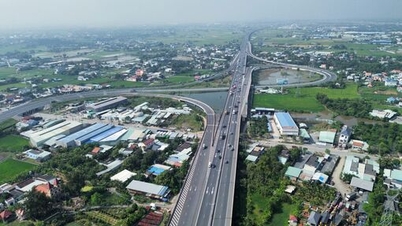
The My Thuan 2 Bridge project, with a total length of 6.61 km, designed with 6 lanes and a design speed of 80 km/hour, commenced in March 2022 and has now reached over 96% of the contract value, with the main cable-stayed bridge section completed. The contractor is completing the remaining items to open the bridge to traffic before December 31st. This project, with a total investment of 5,000 billion VND, is not only significant as the largest cable-stayed bridge designed and constructed by Vietnamese contractors, but also a project eagerly awaited by the people of Tien Giang and Vinh Long provinces in particular, and the Mekong Delta region in general.
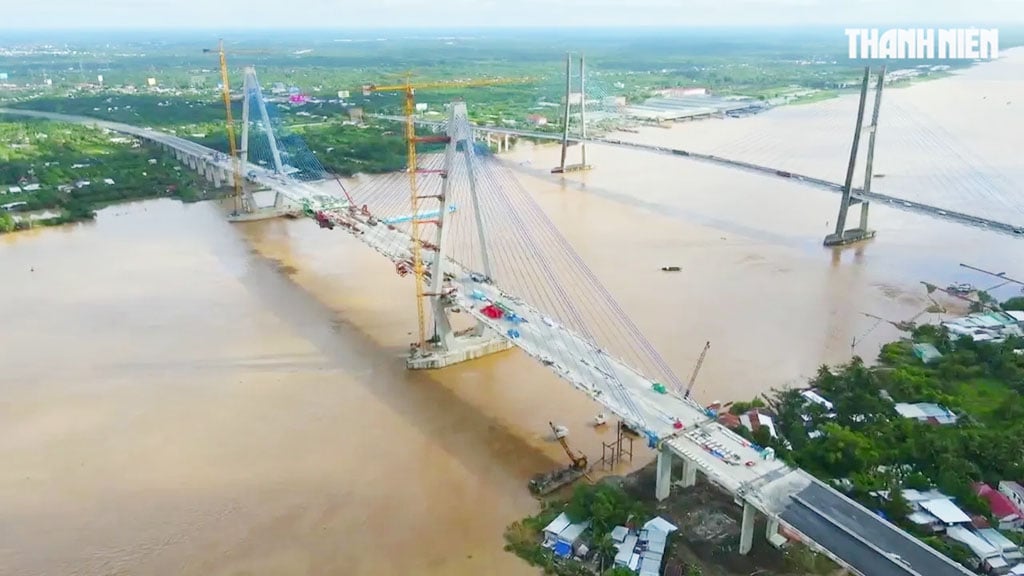
The My Thuan 2 bridge, running parallel to the existing My Thuan bridge, is nearing completion.
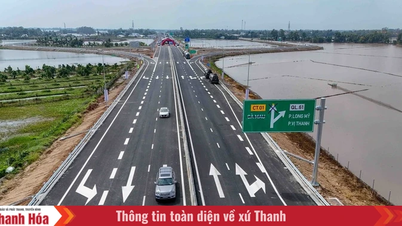
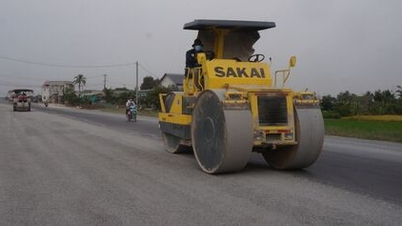
In addition, the My Thuan - Can Tho expressway, with a total length of nearly 23 km, Phase 1, a 4-lane project, commenced in January 2021 and has now reached 76% of the contract value. The bridge section is basically complete, and asphalt paving has been completed on more than 8 km; 80% of the traffic safety system has been assembled at the construction site to accelerate progress and bring the project to completion before December 31st. Thus, when My Thuan Bridge 2 is completed, together with the My Thuan - Can Tho expressway, the expressway from Ho Chi Minh City to Can Tho, over 160 km long, will be connected, shortening travel time to just over 2 hours instead of nearly 4 hours as it is currently.
Excited to invite friends to his hometown in Soc Trang after a test drive last weekend, Minh Dang (from District 11, Ho Chi Minh City) said it only took him 4 hours to travel from Ho Chi Minh City to Soc Trang, including rest stops at highway rest areas. Starting early at 6 am, the road was relatively empty, but the traffic increased significantly on the Ho Chi Minh City - Trung Luong expressway. Therefore, Dang could only drive at 60 km/h in many sections. It wasn't until he reached the Trung Luong - My Thuan expressway that he could maintain a steady speed of 80 km/h. Furthermore, the My Thuan bridge is currently overloaded, and the heavy traffic on weekends also prevented him from driving faster.
"Before the Trung Luong - My Thuan expressway was built, it took my family at least 7 hours to travel back to our hometown by bus, almost two whole days if we traveled during the day. If we tried to travel at night, we'd arrive exhausted the next morning. Now, it only takes about 4 hours, which is a huge relief. Not only do we get to admire the orchards and rice fields on both sides, but we still have enough time to get to work. If the My Thuan 2 bridge and the new expressway section are completed, the travel time to Soc Trang will be shortened by at least another 30 minutes to an hour. The My Thuan - Can Tho route, especially the bypass around Vinh Long City, is currently overloaded. Connecting this route before Tet would significantly alleviate the traffic congestion during this year's Tet holiday," said Mr. Minh Dang.
Similarly, Mr. Pham Huu Hau (from Vinh Long province) said that every year during Tet (Lunar New Year), even though he's from the Mekong Delta, much closer to Ho Chi Minh City than many of his colleagues, his journey home for Tet is no smoother than others. The road is only about 150 km long, but he always encounters terrible traffic jams during the holiday season. The worst are the Ben Luc Bridge (Long An province), the An Thai Trung and An Huu intersections (Tien Giang province), and the My Thuan Bridge area (Vinh Long province), where traffic is constantly congested. The most terrible traffic jam is undoubtedly the My Thuan Bridge area, where he can be stuck for hours.
"Because the My Thuan Bridge is the only road from Ho Chi Minh City to my home in Vinh Long, and many others do too, everyone flocks here. Sometimes, even on the access road, I have to inch forward for 30-45 minutes just to reach the bridge. I remember several times during Tet (Lunar New Year) when I came home late, only getting a break on the afternoon of the 29th or 30th, so when I was almost home, I was so anxious. Yet, at the end of Tien Giang province, just crossing the river to get home, the road seemed to stretch on endlessly because of traffic jams. It was very difficult and tiring," Mr. Hau lamented, affirming that the My Thuan 2 Bridge, which will be put into use before this Lunar New Year, will be a joy for most people in Vinh Long and the Mekong Delta provinces.
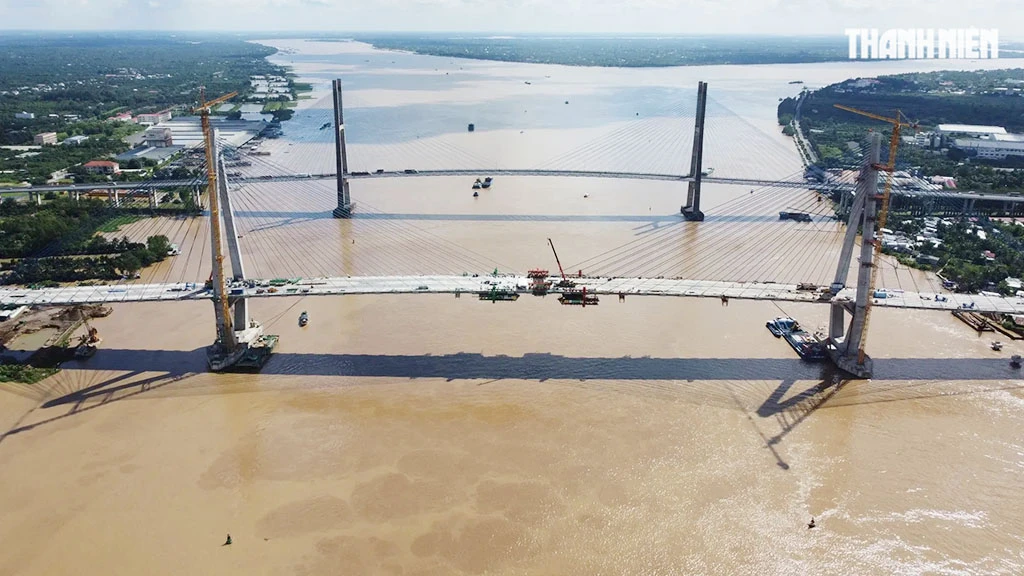
The My Thuan 2 Bridge project has reached over 96% completion.
Wherever the expressway connects, we're happy.
For over a decade, while many provinces and cities across the country have been bustling with construction and inauguration of numerous expressways, the southern region in general and the Mekong Delta in particular have been almost "frozen." Only one expressway project was started (the Trung Luong - My Thuan expressway, over 50 km long) and had to endure a long period of inactivity, only being completed and put into use on April 30, 2022. Therefore, news of the commencement and completion of each expressway project in the Mekong Delta region brings immense joy to the people of the South.
In mid-June, the Chau Doc - Can Tho - Soc Trang expressway, over 188 km long and passing through four provinces in the Mekong Delta, with a total investment of nearly 44,700 billion VND, officially commenced construction. Expected to be completed in 2027, the Chau Doc - Can Tho - Soc Trang route, along with the An Huu - Cao Lanh route, are two expressways along the region's horizontal axis. They will connect the vertical routes, reducing pressure on National Highway 1, Route N1, and especially the overloaded National Highway 91. Simultaneously, they will contribute to completing the regional transportation network, connecting the economies and societies of the Western provinces with Cambodia and other Southeast Asian countries.
According to the Ministry of Transport's plan, the Mekong Delta region will have approximately 760 km of expressways by 2030, with an additional 420 km to be invested in after 2030. The total estimated investment for expressway projects in the Mekong Delta region during the 2026-2030 period is approximately 200,000 billion VND.
"It has been a long time since the southern region, especially the Mekong Delta, witnessed such significant progress in transportation infrastructure," shared Dr. Nguyen Huu Nguyen (Vietnam Urban Planning and Development Association).
According to Dr. Nguyen, for many years, the southern key economic region and the Mekong Delta have been somewhat "disadvantaged" compared to the northern provinces in terms of transportation network connectivity. The sluggish transportation infrastructure for many years has "tied down" the economy and hindered the speed of urban formation and development. Therefore, the simultaneous commencement and completion of key projects in the south is a step towards realizing the policy of strengthening the transportation network for the South and the Mekong Delta. This is the right direction that the National Assembly and the Government have also identified for a sustainable, long-term development vision. Wherever expressways connect, people are happy.
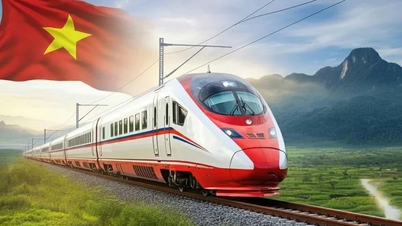
"These projects are even more significant because they are completed at a time when the entire country's economy is facing difficulties. Wherever roads are connected, the economy will develop. People will also save time, money, and effort on travel. Not only expressways but also high-speed railways and waterways are being actively invested in by the central government and various ministries and agencies. The southern and western regions are facing a huge boost to economic development," commented Dr. Nguyen Huu Nguyen.
Previously, I only went back to my hometown twice a year, during Tet (Lunar New Year) and mid-year. Traffic jams and long journeys made me dread it. This year, I've been back three times in 10 months. If there were an expressway to Can Tho or Soc Trang, I'd probably be able to go back every one or two months, practically like a vacation. Any expressway connecting to these areas would be a welcome addition, making work and studies more convenient. People from the Mekong Delta like me, who live far from home, would be able to travel back more frequently, strengthening our bonds with family and loved ones.
Mr. Minh Dang (from Soc Trang province, currently living in Ho Chi Minh City)
Source link
![[Photo] Prime Minister Pham Minh Chinh presides over a meeting on private sector economic development.](/_next/image?url=https%3A%2F%2Fvphoto.vietnam.vn%2Fthumb%2F1200x675%2Fvietnam%2Fresource%2FIMAGE%2F2025%2F12%2F20%2F1766237501876_thiet-ke-chua-co-ten-40-png.webp&w=3840&q=75)


![[Photo] Prime Minister Pham Minh Chinh presides over the conference announcing the establishment of the International Finance Centre in Vietnam.](/_next/image?url=https%3A%2F%2Fvphoto.vietnam.vn%2Fthumb%2F1200x675%2Fvietnam%2Fresource%2FIMAGE%2F2025%2F12%2F21%2F1766309817714_ndo_br_dsc-3400-jpg.webp&w=3840&q=75)











































































Comment (0)