

In an article for the American travel magazine CnTraveler, writer Chris Schalkx recounts a short but enriching journey from the bustling city of Ho Chi Minh City to the Mekong Delta. He likens the trip to stepping through two worlds : on one side, the city vibrating with engines and lights, and on the other, the tranquil Mekong Delta, intimately connected with its seasons and waterways.
Ho Chi Minh City: The city trembles in the sunset light.
Chris took to the streets of Ho Chi Minh City as the sun set, the pavement still radiating heat. The air vibrated with the roar of approximately 9 million motorbikes and the laughter and chatter of 11 million people spilling out into alleyways, balconies, and sidewalk cafes.
Doors were wide open everywhere. Old men sat with glasses of iced beer, women in silk pajamas fanned the charcoal grills, and meat was being roasted. A small park had been transformed into a public gym, with pop music blaring from crackling speakers. The scene Chris described was overwhelming yet vibrant, brimming with everyday detail.
To fully experience it, he chose to immerse himself in the flow of traffic: sitting behind a vintage Vespa driven by guide Bui Quan Khanh. The scooter weaved through the bustling traffic, neon-lit bars, and brightly lit skyscrapers, allowing Chris to observe the city from a local's perspective.
The car drove through narrow alleyways and residential areas, where evening life unfolded right on people's doorsteps. The guide told Chris about the city's transformation with the new metro line and the megacity plan announced last July, aiming to turn it into a new economic hub for Southeast Asia.
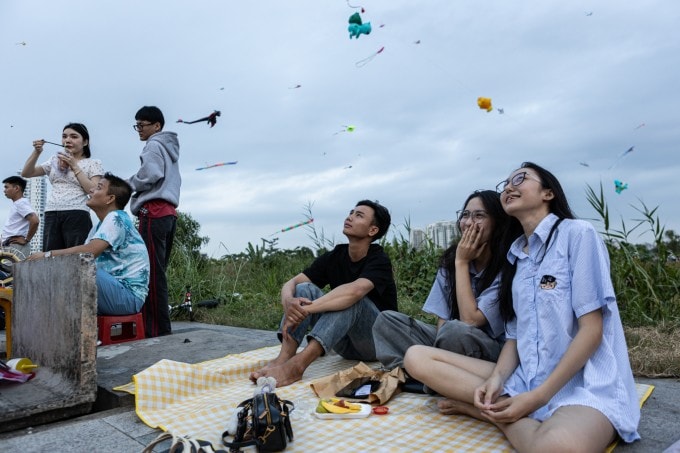
Near Ba Son Bridge, the vacant land has become a recreational space where locals come to fly kites in the late afternoon.
Street food and nightlife
Amidst the city's array of smells, Chris recalled the faint aroma of herbs and fish sauce wafting through the streets. He and his guide stopped to eat stir-fried snails and drink passion fruit juice at a cafe overlooking the Rainbow Bridge – a bridge designed by French architect Gustave Eiffel.
In the fluorescent light, Chris watched the woman making shrimp pancakes, and then customers wrapping them in fresh vegetables. These small details, as he documented them, create the unique rhythm of the city, where food , history, and modern life intertwine.
Chris described his subsequent days in Ho Chi Minh City as being immersed in a "whirlwind of color and movement." He visited vegetable stalls in the market, mingled with the thick smoke of incense in temples in the Chinese quarter, and experienced new restaurants, revealing a city that is constantly changing.
Leaving the city, immersing myself in the slow pace of life in the Mekong Delta.
Leaving the suburbs, the Mekong Delta unfolds with its rice paddies and orchards, surrounded by a complex network of canals. Branches of the Mekong River flow through this area, supplying water to this agricultural hub that accounts for more than half of Vietnam's production.
Along the road, chickens scurried under the wheels, while motorbikes sped past carrying large sacks of jackfruit. Tour guide Thuan Khuc told Chris, "This is Vietnam's rice granary. Every 10 kilometers or so, the crops change depending on the soil." In just a few sentences, he helped Chris visualize the richness of this land.
Can Tho and Cai Rang floating market in the early morning.
The following morning, the group arrived in Can Tho to take a boat trip to visit Cai Rang floating market. On the river, traders exchange agricultural products and fresh fish right on their boats. The bows of the boats are often painted with eyes, a belief that brings good luck.
Chris and his group visited the boat of Ms. Bay, who has been selling noodle soup on the river for over 40 years. The details of her long-standing connection were enough for him to feel the depth of a profession born and raised alongside the water, where tourists' breakfasts are intertwined with the rhythm of life at the floating market.
On country roads: bicycles, rice wine, and field mice.
Leaving the floating market, the group of tourists cycled along the dike road, passing by village gatherings. In Co Do district, locals waved and invited guests into their homes for drinks after work.
Chris tried rice wine and grilled field mouse. For him, it was an unforgettable experience, not only because of the unusual food but also because of the hospitality. His guide, Thuan, said, "They have everything you need, from fish in the pond, rice in the fields, and an abundant water supply."
Mr. Thuan further explained that the people here have spent many generations digging canals, managing water resources, and stabilizing their lives. The land, once a swamp, attracted many waves of migrants seeking to develop it. He used the saying "sell distant relatives, buy close neighbors" to explain the strong bond and mutual support among the people of the Mekong Delta.
A cultural labyrinth amidst the waterways.
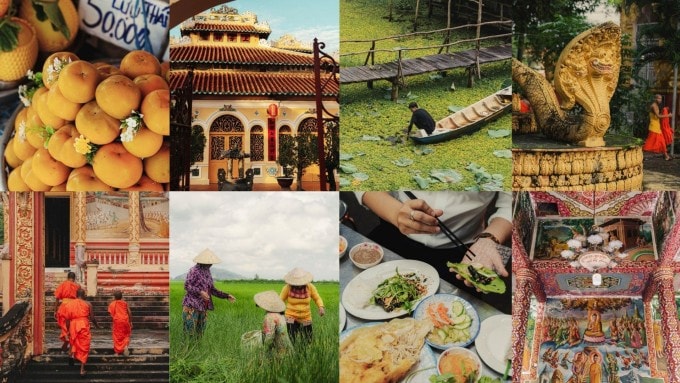
Chris was guided through a labyrinth of rivers and canals, where the diverse cultures rivaled the crops in the fields. He visited opulent Khmer temples, where monks in saffron robes swept the courtyards, evoking a sense of tranquility amidst a land of constant change.
The group visited the floating Cham village of Chau Giang. Here, women wore hijabs, greeted each other with "as-salamu alaykum" ("Peace be with you" in Arabic), and wove silk in wooden houses. The unexpected shift in language, clothing, and lifestyle gave Chris a clearer understanding of the rich culture of the delta.
Slow down to savor each moment.
Chris and his guide traversed flooded forests and bird-filled swamps. However, he emphasized that it was the "unscripted" moments that truly left a lasting impression: stopping at a roadside cafe, or when the children on either side of the road simultaneously shouted "helloooo" as he cycled past.
The journey, a combination of bicycle and van for some long stretches, gave him the feeling of being fast enough to avoid overly crowded tourist spots, yet slow enough to smell the sun-dried coconut shells or stop for tea in the backyard of a kind stranger.
Chau Doc: Sunset marks the end of the journey.
The final leg of the journey took Chris to the riverside town of Chau Doc. As the sun set, the water in the fields was tinged with the hues of twilight, and the palm leaves cast swaying shadows. A boat drifted by, and in the distance, the bustling sounds of the night market echoed.
Chris concludes his journey with an image of a day ending just as it began: in constant motion, somewhere between the land, water, and the whispering soul of Vietnam. For him, it's the feeling of stepping through two worlds and realizing they are connected by the people and stories along the way.
Experience suggestions from Chris's journey.
- Spend time in both Ho Chi Minh City and the Mekong Delta to experience the differences in pace of life.
- Experience the city by motorbike with a local guide and hear stories about the urban past and future.
- Take a boat trip to visit the floating market, and stop for breakfast on the river to understand the life of the local people connected to the water.
- Combining bicycle and van travel on country roads allows for unexpected stops, from roadside cafes to invitations for tea or drinks.
Source: https://baonghean.vn/tp-hcm-va-mien-tay-hai-the-gioi-tren-mot-hanh-trinh-10316006.html













![[Photo] Prime Minister Pham Minh Chinh attends the Conference on the Implementation of Tasks for 2026 of the Industry and Trade Sector](/_next/image?url=https%3A%2F%2Fvphoto.vietnam.vn%2Fthumb%2F1200x675%2Fvietnam%2Fresource%2FIMAGE%2F2025%2F12%2F19%2F1766159500458_ndo_br_shared31-jpg.webp&w=3840&q=75)







































Comment (0)