

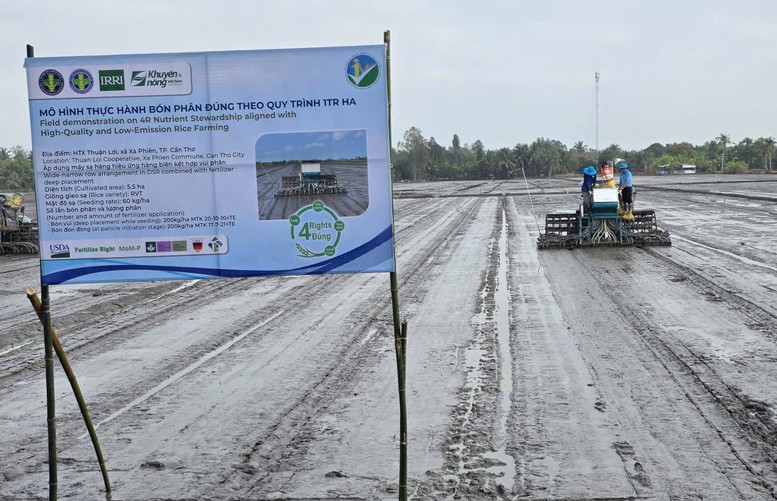
Applying the "four correct principles" in fertilization is a solution aimed at reducing input costs, efficiently utilizing resources, and cutting greenhouse gas emissions in rice production - Photo: VGP/LS
On December 19th, at Thuan Loi Cooperative (Xa Phien commune, Can Tho city), the Can Tho City Department of Agriculture and Environment, in collaboration with the International Rice Research Institute (IRRI), Tu Sang Company, and MTK Fertilizer Company, organized the "Farmers' Day for Applying Fertilizer According to the Government's 1 Million Hectare High-Quality, Low-Emission Rice Cultivation Process". This event is a concrete step towards bringing technical solutions from policy into practical production in the fields.
Bringing the 'classroom' to the fields.
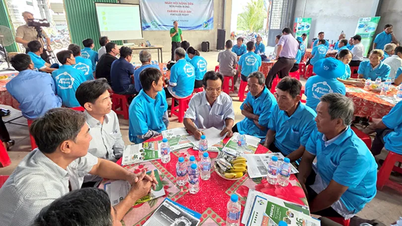
Approximately 150 delegates representing management agencies, specialized units, and industry organizations such as the Department of Crop Production and Plant Protection, the Vietnam Food Association, and the National Agricultural Extension Center, along with 100 farmers from three cooperatives in the region, directly participated in the event. The unique aspect of the event lay not in its scale, but in its approach: instead of training in a hall, all content was delivered directly in the rice fields.
Here, farmers receive direct guidance on the technical process for cultivating 1 million hectares of high-quality, low-emission rice under the government 's specialized rice cultivation program. The focus is on applying the "four correct principles" in fertilization, nutrient management according to specific zones (SSNM), and water management using the alternating wet-dry method (AWD). These solutions aim to reduce input costs, efficiently utilize resources, and cut greenhouse gas emissions in rice production.
Associate Professor Dr. Nguyen Van Hung, a senior expert at IRRI, stated that the technique of "proper fertilization" is not limited to general recommendations but is supported by new technologies. "Applying the right type of fertilizer, in the right dosage, at the right time, in the right place, and in the right way is not only a technical principle but also a supporting technology and solution that helps farmers reduce input costs by 20-30% while maintaining, or even increasing, productivity. This is the foundation for Vietnamese rice cultivation to integrate into the global sustainable value chain," he emphasized.
Digital technology supports farming decisions.
In addition to direct guidance, IRRI experts also introduced digital tools such as Rice Crop Manager (RCM) and EasyFarm. These applications allow farmers to access farming recommendations based on specific ecological zones, soil conditions, and weather patterns, instead of relying entirely on traditional experience.
Through two-way exchange, farmers not only "listen for information" but also ask questions and compare it to their own rice fields. Technical procedures are therefore transformed into specific, easily applicable production skills that are suitable for local conditions – a key factor in making sustainable solutions a reality.
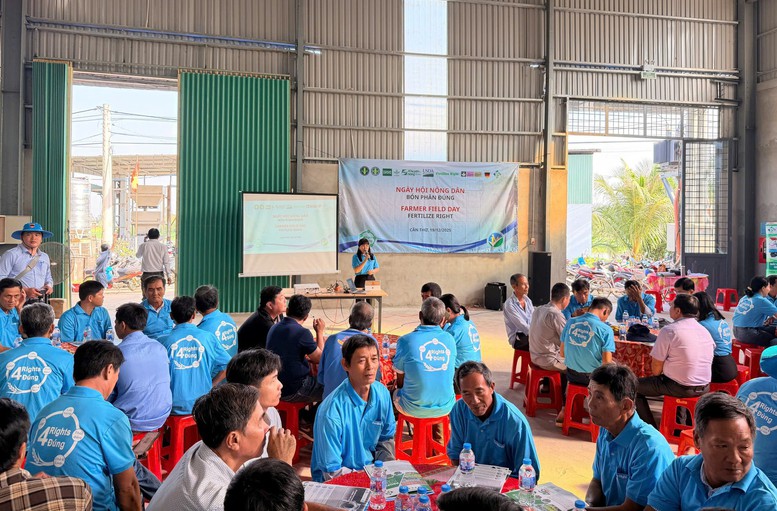
Through two-way exchange with experts, farmers not only "listen for information" but also ask questions and compare the information with their own rice fields - Photo: VGP/LS
Mechanization demonstrations build confidence.
One of the most engaging activities at the event was the demonstration of mechanized sowing and fertilization right on the Thuận Lợi Cooperative's field, witnessed by 50 farmers from the cooperative. Under the collaboration of IRRI and Tư Sang Company, the machinery was operated directly, demonstrating its ability to simultaneously perform both sowing and fertilization accurately and uniformly.
According to experts, this technique helps rice plants grow better, reduces fertilizer loss, and lowers labor and production costs. These benefits are clearly demonstrated through practical demonstrations, creating a strong visual impact on farmers.
Mr. Nguyen Thanh Tam, Chairman of the Board of Directors of Thuan Loi Agricultural Cooperative, shared: “For many years, we have been sowing and fertilizing using traditional methods, which is labor-intensive and not very efficient. Today, seeing the machine complete both tasks in one go, accurately and quickly, I believe that this season's yield will be completely different. Importantly, it saves on fertilizer, which is not cheap these days.”
These firsthand experiences are considered crucial in helping farmers readily change their farming practices and gradually adopt modern, low-emission rice production models.
From best practices to scaling up the model.
The discussion at the event was lively, with numerous questions revolving around investment costs, access to machinery and mechanization services, as well as the process of participating in the 1 million hectare rice project. Experts and business representatives directly answered these questions, helping to resolve the practical concerns of farmers.
Speaking at the event, Ms. Nguyen Thi Giang, Deputy Director of the Department of Agriculture and Environment of Can Tho City, affirmed: “What we are witnessing today is not just a training session or a technical demonstration. This is proof of the transformation from policy guidelines to concrete actions in the fields. Can Tho is committed to continuing to support farmers, creating conditions for this sustainable rice farming model to be replicated, contributing to the successful implementation of the 1 million hectare rice project.”
The "Farmers Applying Fertilizer Correctly" event in Can Tho demonstrates that the transition to high-quality, low-emission rice cultivation is no longer a distant dream. When science and technology are brought directly to the fields and linked to the specific economic benefits for farmers, sustainable models have the potential to spread. From these practical steps, the project to cultivate 1 million hectares of high-quality, low-emission rice is gradually forming a solid foundation for widespread implementation in the future.
Le Son
Source: https://baochinhphu.vn/canh-tac-lua-xanh-voi-bon-phan-dung-tu-chu-truong-den-thuc-hanh-tren-dong-ruong-102251219163858143.htm
![[Photo] Prime Minister Pham Minh Chinh attends the Conference on the Implementation of Tasks for 2026 of the Industry and Trade Sector](/_next/image?url=https%3A%2F%2Fvphoto.vietnam.vn%2Fthumb%2F1200x675%2Fvietnam%2Fresource%2FIMAGE%2F2025%2F12%2F19%2F1766159500458_ndo_br_shared31-jpg.webp&w=3840&q=75)


























































Comment (0)