


Just thinking about Tet (Vietnamese New Year) brings back so many memories of my old house, of my mother, of the Tet dishes of yesteryear, like a fragrant aroma fermented over the years, gently spreading and permeating my soul as I open the lid of a jar of memories. I softly close my eyes, take a deep breath, and find in that warm yet distant scent a familiar and heart-wrenching aroma. It's the smell of my mother's Tet-style pork sausage.
Usually around the 28th of Tet (Lunar New Year), after my sister and I carried the basket of pork that the cooperative had given us from the village square back home, my father would sit on the porch and divide the meat into portions. From the lean meat, he would always set aside about half a kilogram in a small earthenware bowl, then call my mother over and say, "This is the meat for making pork sausage, wife." So my mother would take the bowl of meat, the small cutting board hanging in the kitchen, and a sharp knife and sit by the well in the courtyard. My sister and I would excitedly follow to watch her work. My mother would turn the earthenware bowl that my sister had brought out, rub the knife against the bottom of the bowl, flip it back and forth a few times, then cut the meat into several pieces, slicing the fresh, lean meat into bright red slices. Her hands moved quickly and precisely. Then, she would marinate all the meat in the earthenware bowl with fish sauce and MSG.
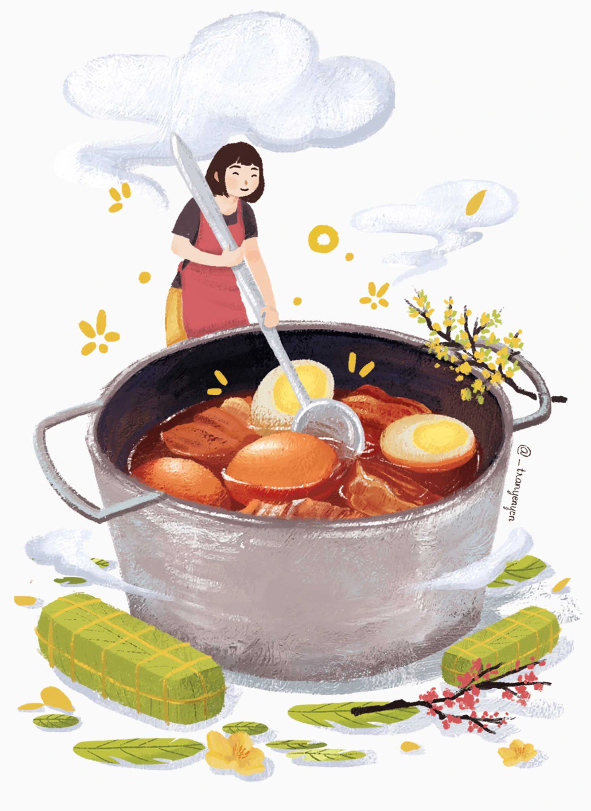
While my father was putting the marinated meat from the bowl into the mortar on the porch, my mother went to chop the washed scallions that had been drained in a small basket. In a flash, the scallions, mostly from the base, were finely chopped. The white and pale green scallions rained down on the cutting board, splashing pungent droplets of water into my eyes. Then the sound of my father's pounding stopped. My mother took the earthenware bowl containing the minced lean meat, which had become a thick, pliable, bright pink mass, and added the chopped scallions. She asked me to get her the basket of tofu that had been washed and drained on the porch. She put a dozen tofu pieces into the earthenware bowl, gently rotating it with a wooden pestle to break them apart, mixing them into a milky white mixture dotted with the green of the thinly sliced scallions.
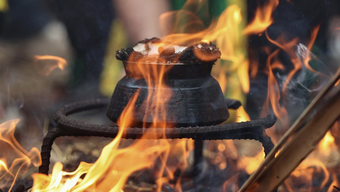
Finally, a fire was lit in the hearth. The dry, split pieces of acacia wood, scorched by the harsh sun and wind, caught the crackling straw fire, warming the kitchen in the twelfth lunar month. The fire crackled and popped. A black, sooty cast-iron pan was placed on the stove. My mother scooped solidified white fat from a ceramic jar onto the surface of the pan, then melted it into a layer of liquid fat.
My mother and sister sat shaping the meatballs. My mother was very skillful; none of them broke. Each meatball was the size of a butter cookie, still bearing the indentation of her finger. As she shaped them, she immediately dropped them into the hot oil. The pan of oil sizzled, splattering tiny droplets of oil. My mother often told my sister and me to sit far away to avoid getting burned, but we usually didn't move. My mother sat in the middle, turning the meatballs and making new ones. My sister and I sat on either side, our eyes glued to the meatballs changing color in the pan. From their initial opaque white, the meatballs gradually turned yellow, emitting a rich, savory aroma that filled the kitchen. When all the meatballs were golden brown and plump, my mother scooped them out into a large earthenware bowl. My sister and I swallowed hard, watching the meatballs that had just been scooped out, then looked at my mother as if pleading.
My mother, ever understanding our intentions, would smile at us, scoop a piece into a small bowl for each of us, and say, "Here! Taste it, then go see if your father needs anything done and help him." I reached out and took a piece of the still-hot sausage, blowing on it to cool it down before biting into it. Oh my! I'll never forget the taste of my mother's sausage! How fragrant, delicious, and rich it was. The hot, perfectly soft sausage melted in my mouth. The sausage wasn't dry like cinnamon sausage because it contained more beans, and it was wonderfully fragrant with the flavor of green onions. Usually, after finishing my piece, my sister would go help Dad, while I would beg to sit on the small chair and watch my mother continue, occasionally looking at her pleadingly, and my mother would always just smile.
Every Tet holiday, my mother would make a batch of steamed pork patties like that. There were about four or five medium-sized plates of them. She would store them in a small basket, placed inside a small rope frame covered with a sieve, and hung it in the corner of the kitchen. Each meal, she would take out a plate to prepare for the ancestral worship ceremony. With so many children in the family, steamed pork patties were a favorite of my siblings and me, so the plate would be gone in no time. I would usually put two or three pieces in my bowl to save some, then slowly dip them in a little strong fish sauce and eat them sparingly to savor the flavor throughout the Tet meal. Once, I climbed onto a small stool, stood on tiptoe, and reached for the rack hanging the steamed pork patties in the kitchen. I managed to grab a piece of pork patty, and as I cautiously stepped down, my mother came into the kitchen. My legs trembled, I dropped the patty to the ground, and burst into tears. My mother came closer, smiled gently, picked up another piece of meatball, and offered it to me, saying, "Stop crying! Next time, don't climb like that, or you'll fall and that would be terrible." I took the meatball she gave me, tears still welling up in my eyes.
Growing up, traveling to many places, and eating many Tet dishes from different regions, I came to understand and cherish my mother's "cha phong" (a type of Vietnamese sausage) so much. Sometimes, I wondered about the name of this dish. What is "cha phong"? Or is it "cha phong"? When I asked, my mother said she didn't know. This sausage, whose name is so simple and rustic, is actually a Tet dish of the poor, of a time of hardship. If you count it precisely, it's three parts beans to one part meat. Only with dishes like this could my mother bring Tet joy to her whole brood of children. There's nothing fancy or luxurious about it, nothing rare or precious!
Yet, as Tet approaches, my heart swells with the aroma of the kitchen smoke, my eyes sting with the taste of spring onions, and my soul is filled with images of my mother and my siblings gathered around a pan of braised pork patties over a crackling wood fire amidst the dry, biting north wind. Another Tet is coming to every home. This is also the first Tet I will have without my mother. But I will make my mother's braised pork patties again, as a habit, as a remembrance of distant seasons and past Tets. I tell myself that. Outside, the north wind seems to be starting to warm up.
Nguyen Van Song
Source



















































































Comment (0)