

HAIPHONG: The reason it's said that it's "easy work, big profit" is because they raise these animals but don't release the fry or feed them, yet still earn a daily income, ranging from a few hundred thousand dong to several million dong.
HAIPHONG: The reason it's said that it's "easy work, big profit" is because they raise these animals but don't release the fry or feed them, yet still earn a daily income, ranging from a few hundred thousand dong to several million dong.
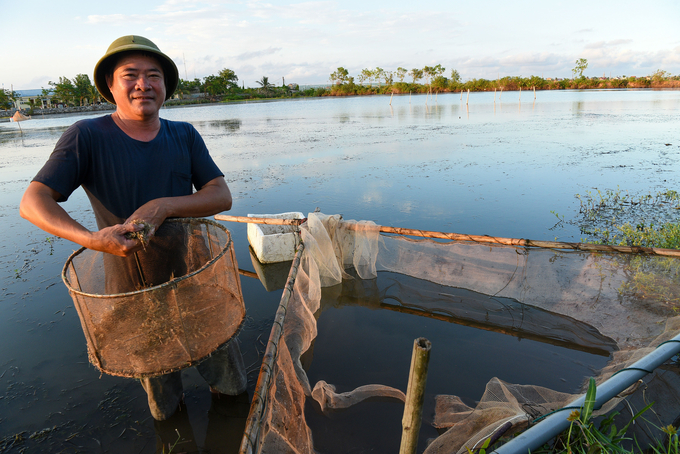
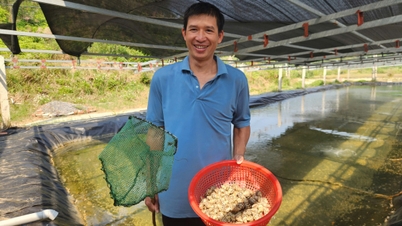
Mr. Luong Van Nhanh (Vinh Quang commune, Tien Lang district) pushes a net to catch shrimp. Photo: Duong Dinh Tuong.
Mr. Hoang Xuan Giang, an officer at the Tien Lang District Agricultural Extension Station in Hai Phong City, recounts a story from his hometown where two brothers were arguing over a memorial feast. One insisted that a shrimp was a small prawn, while the other maintained that a shrimp was a shrimp. They hadn't agreed for over a decade. If he had been there, he would have simply asked, "Does the shrimp have eggs?" and the argument would have been settled immediately. The principle is that aquatic creatures with eggs can't grow much larger; they're no bigger than the tip of a chopstick.
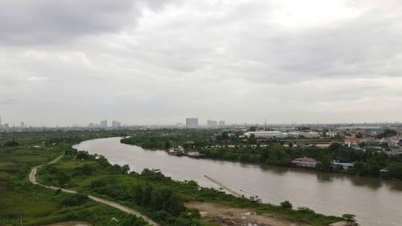
To raise shrimp successfully, three conditions are necessary: soil quality, water quality (the best water is slightly brackish), a substrate of seaweed for habitat, and a source of nutrients from various types of algae. Inside the dike of Vinh Quang commune, Tien Lang district, are long stretches of ponds that meet all these conditions. Luong Van Nhanh, who used to raise shrimp for hire for pond owners but found it ineffective, saw an opportunity and in 2020 rented a pond of over 1 hectare to raise shrimp himself, earning a profit through his labor.
He recounted that, in the past, no one paid attention to shrimp in aquaculture; they focused entirely on fish, prawns, and crabs. Now, the market favors shrimp, and since it requires little investment, some people have shifted from a secondary to a primary crop.
Although it's called farming, the shrimp reproduce naturally in the water source, rather than being stocked. Therefore, the pond owner only needs to maintain a suitable environment, with plenty of aquatic plants for them to hide in, and add organic fertilizers such as composted chicken or pig manure to create algae for the shrimp to eat. Shrimp farming requires a clean environment, so it can be said that this is an ecological model, following an organic and environmentally friendly approach.
Every day, Mr. Nhanh catches shrimp by setting traps or nets. During peak season, he can get over 10kg, while normally he gets 7-8kg. In the past, shrimp was a food for the poor; when he caught a lot, he would dry them and store them for later. But now he sells them on the spot for 140,000 VND per kilogram, preparing them into various dishes such as shrimp salad with rice crackers, or stir-fried shrimp with lime leaves and scallion oil...
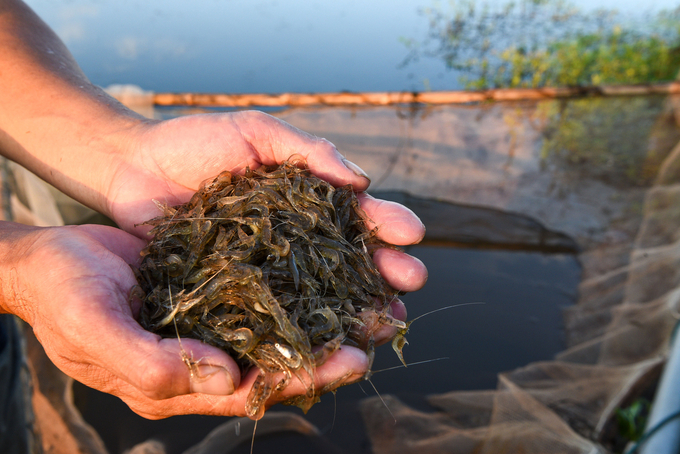
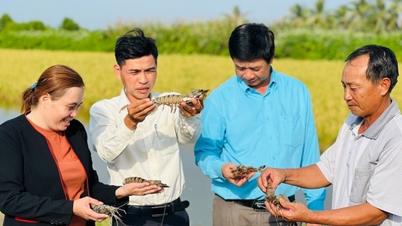
Raising shrimp requires a clean water environment. These shrimp, even at this size, already have eggs. Photo: Duong Dinh Tuong.
In years with good weather and little rain, shrimp swarm, meaning high yields. But this year, with the heavy rain, fewer shrimp swarm. The shrimp's natural predator is fish, but Mr. Nhanh doesn't filter them out; he lets them fight it out biologically. With over 1 hectare of pond, Mr. Nhanh earns about 250-300 million VND annually, spending only a few million VND on chicken and pig manure to make organic microbial fertilizer to cultivate algae for the shrimp. His profit margin is arguably the highest among current aquaculture practices.
Mr. Vu Van Doan was a pioneer in shrimp farming in the region. He has now transferred the management of the pond to his son, An. For the past two years, An has dedicated 3 hectares to implementing this shrimp farming model.
“When my father raised freshwater fish, shrimp were abundant, but later, when I switched to raising saltwater species, they all died. Two years ago, I switched to raising freshwater species and bought shrimp fry to breed. I harvest for 15 days each month and don't harvest for 15 days to allow them to reproduce. Each time I get about 30kg, so I earn 500-600 million VND per year. I'm currently breeding shrimp on the remaining 20 hectares. Because there are many low-value tilapia, I have to remove them all to prevent them from eating the shrimp, leaving only the high-value sea bass.”
"During the farming process, I noticed that shrimp also get diseases, the most dangerous being red body disease, which spreads from shrimp. There's no way to cure it; you just let them die on their own, but they won't all die, and the remaining ones will continue to reproduce," Mr. An said.
According to Ms. Nguyen Thi Huyen Thu, Deputy Head of the Tien Lang Agricultural Extension Station, shrimp farming has the potential to develop on a large scale if people understand their biological characteristics. Currently, the district has thousands of hectares of freshwater ponds and lagoons, plus thousands of hectares of brackish water ponds and lagoons, all perfectly suitable for shrimp farming.
Furthermore, in the low-lying areas of the rice paddies, shrimp farming can be combined if cultivated organically, without the use of snailicides, herbicides, pesticides, and without the overuse of chemical fertilizers. However, currently no households have adopted this approach.
Source: https://nongsanviet.nongnghiep.vn/tha-rong-de-nuoi-tep-lam-choi-an-that-d405832.html


![[Photo] Prime Minister Pham Minh Chinh attends the Conference on the Implementation of Tasks for 2026 of the Industry and Trade Sector](/_next/image?url=https%3A%2F%2Fvphoto.vietnam.vn%2Fthumb%2F1200x675%2Fvietnam%2Fresource%2FIMAGE%2F2025%2F12%2F19%2F1766159500458_ndo_br_shared31-jpg.webp&w=3840&q=75)












































































Comment (0)