


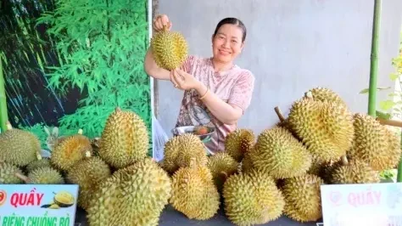
Mr. Pham Van Lam, from Tan Hoa commune, Can Tho city, harvests durian and sells it to traders for only 30,000 VND/kg.
Many efforts
In the first four months of 2026, the country's fruit and vegetable export turnover reached nearly US$2.06 billion, a 22% increase compared to the same period in 2025. China was the largest market, accounting for over 50% of the market share with a turnover exceeding US$1 billion. Other key markets such as South Korea, the US, Japan, and the Middle East maintained good growth rates of 15-20%.
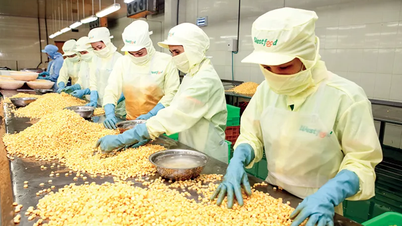
According to the Vietnam Fruit and Vegetable Association, official exports are increasingly playing a dominant role. The structure of exports is undergoing a positive shift, with the proportion and value of processed goods increasing; businesses are increasingly interested in investing in deep processing such as frozen products, dried products, and concentrated fruit juices.
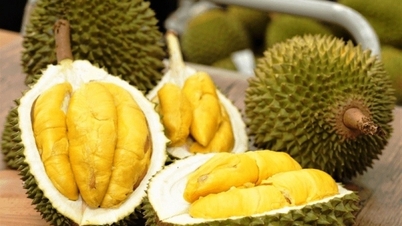
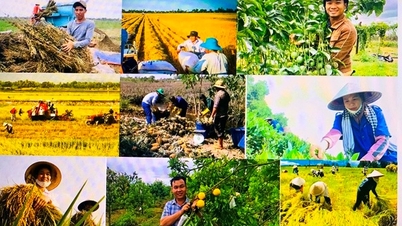
According to statistics from the Department of Crop Production and Plant Protection of Can Tho City, by the beginning of May, the total area of fruit trees planted in the city exceeded 100,300 hectares, including jackfruit, banana, durian, mango, longan, orange, lemon, sapodilla, pomelo, pineapple, custard apple, mangosteen, papaya, rambutan, and tangerine... Of these, durian is the main crop with an area of 14,483 hectares. Besides exporting fresh fruit, the main export items of Can Tho's fruits and vegetables are fruit juice, frozen fruit, dried fruit, canned fruit, and processed agricultural food products.
In recent times, 42 companies in the city have been linked with cooperatives and agricultural associations to produce durian for export to China, covering a total area of over 6,000 hectares. Can Tho City has identified the development of fruit and vegetable exports and agricultural products as a green and sustainable direction, enhancing added value and competitiveness, while strengthening regional linkages and developing value chains.
Determined to overcome challenges
By 2026, the country aims to achieve a fruit and vegetable export value of 10 billion USD. However, the biggest obstacle currently is the pressure on logistics and costs. In addition, infrastructure in raw material areas does not yet meet the requirements for production, harvesting, and preservation. The shortage of cold storage and cold supply chains leads to higher costs and significantly higher post-harvest losses compared to competing countries.
According to the Vietnam Fruit and Vegetable Association, the industry continues to face violations of food safety regulations in demanding markets such as Europe, Japan, China, and Taiwan regarding exported fruits and vegetables (such as durian, dragon fruit, passion fruit, and chili peppers). Simultaneously, importing countries are increasingly imposing stricter technical standards and non-tariff barriers, creating further difficulties for Vietnamese products. Violations of planting area codes and packaging facility codes still occur. The newly piloted traceability system still has many shortcomings. The inspection system sometimes fails to meet the export requirements of businesses in a timely manner. Currently, over 70% of Vietnam's fruit and vegetable products are still exported fresh. Deep processing capacity remains very limited in terms of variety, packaging is not truly attractive, and it lacks the capacity to regulate product consumption during peak seasons.
The most noticeable issue in recent days is the oversupply of durian in the Mekong Delta, with prices plummeting due to difficulties in exporting fresh fruit, leaving farmers in dire straits. Mr. Pham Van Lam, from Tan Hoa commune, Can Tho city, who grows 2 acres of Ri 6 durian, recently harvested 1.2 tons, selling it at 30,000 VND/kg. Mr. Lam said: “From the time the durian trees are treated to flower until the fruit is harvested, the investment cost is 1-1.2 million VND per tree. If the yield reaches 100 kg/tree, the farmers make a profit, but with a yield like mine, they only break even.”
Mr. Nguyen Van Can, a durian trader in Can Tho City, said that he currently buys and sells an average of 1-2 tons of durian per day. The current congestion of durian at testing facilities is making exports difficult and causing prices to plummet. If this situation doesn't improve, in June, when durian from the Mekong Delta peaks and coincides with the harvest season in the Eastern region, the market for durian will become even more challenging.
According to Mr. Nguyen Dinh Tung, Vice Chairman of the Vietnam Fruit and Vegetable Association, in 2026, the association will resolutely address the issue of quality, ending the situation of exported goods containing residues of banned substances exceeding regulations. He requested that functional agencies strictly control the issued planting area codes, strengthen post-inspection, and severely punish cases of fraud to protect the reputation of the national brand. He also called for improving the capacity and working methods of testing and inspection units to ensure quick and accurate results for businesses. Furthermore, he urged continued negotiations to open markets for potential products such as pineapples, avocados, custard apples, and plums. He emphasized supporting businesses in accessing priority transport routes, especially air transport for high-end fruits with short shelf lives, while simultaneously promoting cross-border digital trade and e-commerce.
In the long term, Mr. Nguyen Dinh Tung proposed that the Government and localities should have policies to encourage large corporations to invest heavily in deep processing plants right in concentrated raw material areas. He also suggested promoting the development of green agriculture , circular agriculture, and strongly applying Global GAP and organic standards to adapt to the EU's CBAM mechanism in order to maintain long-term competitive advantages. Furthermore, he proposed strengthening and improving the effectiveness of the "State - Farmers - Businesses - Scientists - Banks" linkage model to build a stable and sustainable supply chain in terms of both quantity and quality.
Text and photos: HOAI THANH
Source: https://baocantho.com.vn/thach-thuc-voi-nganh-rau-qua-a204774.html


![[Photo] General Secretary and President To Lam receives Amazon's Senior Vice President David Zapolsky](https://vphoto.vietnam.vn/thumb/1200x675/vietnam/resource/IMAGE/2026/05/22/1779466547770_a1-bnd-3513-6601-jpg.webp)















































Comment (0)