

On the morning of May 25th, at the Party Central Headquarters, General Secretary and President To Lam, Head of the Central Steering Committee on Science , Technology Development, Innovation and Digital Transformation, chaired a working session of the Standing Committee to discuss the guidelines for basic scientific research.
In his speech, General Secretary and President To Lam not only spoke about basic science but also reflected a new strategic awareness: Future competition among nations will primarily be a competition in knowledge, technology, and creativity, and building a national strategy for the development of basic science is an essential requirement.
General Secretary and President To Lam emphasized that basic science is not a field detached from reality, but rather the "root" that creates the capacity for innovation, technological self-reliance, and national competitiveness. A country that wants sustainable development must master fundamental knowledge instead of just receiving technology from outside.
A groundbreaking message in the speech by General Secretary and President To Lam was the need to create an environment of academic freedom and accept creative risks; a demand to reduce administrative management thinking in scientific research, and a strong shift from "management" to "creation." General Secretary and President To Lam also mentioned accepting delays, risks, and even failures in research because innovation cannot be fostered if scientists are always constrained by rigid mechanisms.
According to General Secretary and President To Lam, the identification, utilization, and rewarding of scientific talent must be given special importance. For Vietnam to achieve breakthroughs, it needs great scientists, strong research centers, and an environment that encourages young people to pursue cutting-edge science; science must be linked to the aspiration for national development. This is because the development of science and technology is not only aimed at economic growth but is also directly related to national independence, self-reliance, national security, and Vietnam's position in the new world order. This can be considered a strategic development mindset: Knowledge, technology, and people will be the core resources of the nation in the 21st century.
General Secretary and President To Lam also conveyed a message about the mission of universities and colleges in the new era of development. That is, universities and research institutes must become centers of innovation. Higher education institutions should not only train human resources but also become places that generate new knowledge, new technologies, and groundbreaking ideas. This requires strong reforms in financial mechanisms, governance, and international cooperation in scientific research…
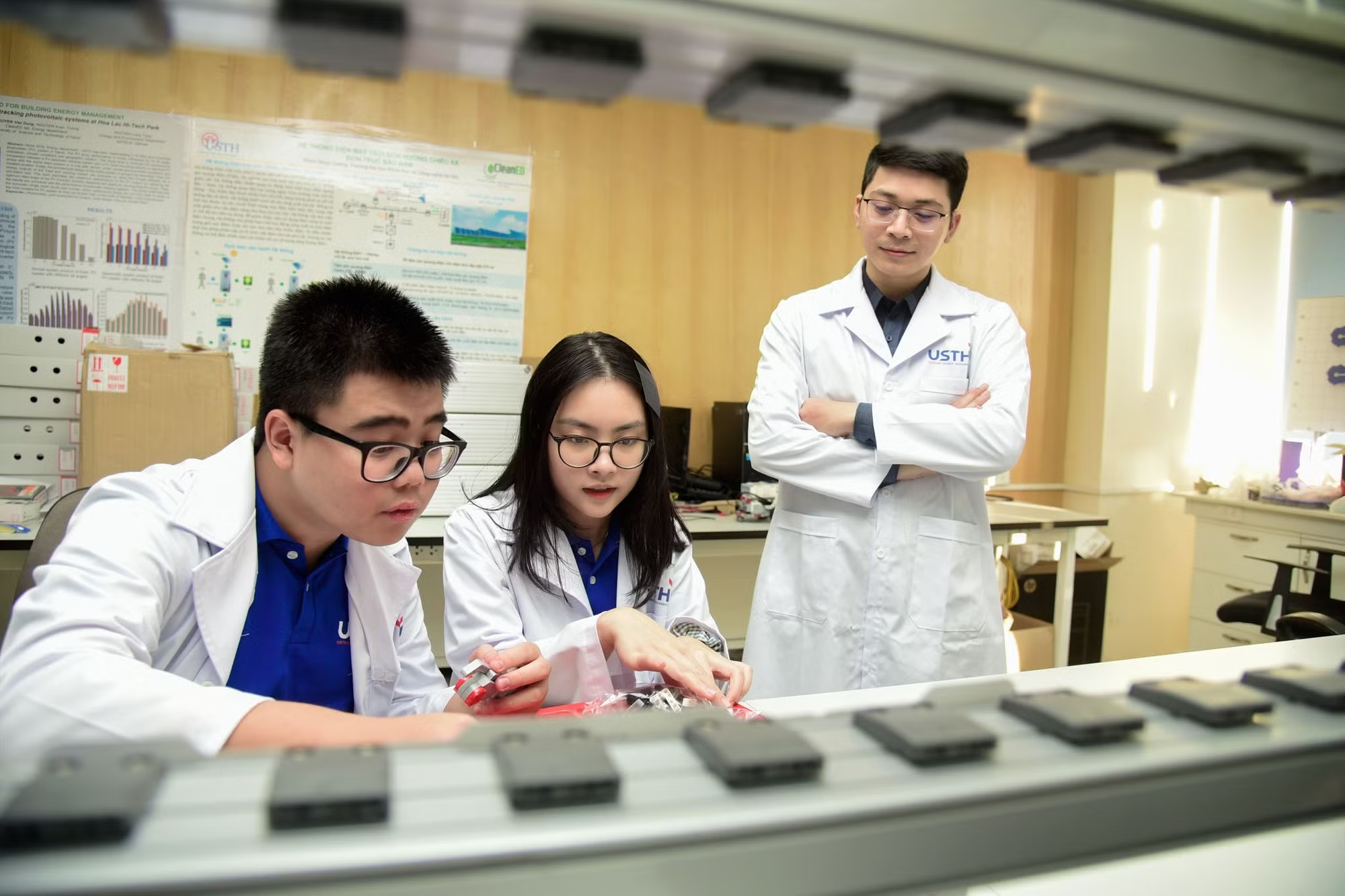
In recent years, Vietnam has demonstrated a strong commitment to developing science, technology, and innovation. Many major policies of the Party and State have identified science and technology as a key driving force for rapid and sustainable development, and a decisive factor in national competitiveness in the digital age. Of particular note is Resolution No. 57 of the Politburo. Resolution 57 identified the development of science, technology, innovation, and national digital transformation as a top priority breakthrough.
However, from a practical perspective, for basic science in Vietnam to truly become the foundation for national development as expected, many bottlenecks need to be addressed. One of the biggest bottlenecks currently is the short-term, immediate focus on investing in basic science. Many research projects are still pressured to quickly produce applied products or economic revenue, while the essence of basic research is the accumulation of long-term knowledge. This leads many scientists to choose "safe" research directions, lacking groundbreaking and pioneering works.
Furthermore, investment in basic science is fragmented and disproportionate to development needs. Vietnam's research and development (R&D) spending remains significantly lower than that of developed countries in the region, currently fluctuating around 0.4% - 0.5% of GDP, much lower than the world average (approximately 2.4% - 2.6%) and only a fraction of that of developed countries or other countries in the region. Many laboratories and research centers lack modern equipment, large databases, and research facilities that meet international standards. This scattered investment also makes it difficult to form strong research groups capable of global competition.
When basic science is properly positioned as the foundation of innovation and competitiveness, Vietnam will be in a position to create core technologies, master strategic fields, and enhance the country's standing in the new era of development.
Furthermore, the scientific management mechanism still faces many administrative barriers. Many scientists believe that the time spent on settlement procedures and administrative paperwork sometimes exceeds the time spent on research. The fear of making mistakes and the fear of responsibility in scientific financial management also lead to a lack of flexibility in project implementation, reducing the motivation for innovation. This is also a major paradox, given that science inherently needs an environment of academic freedom and acceptance of experimentation.
Another worrying reality is the "brain drain" and shortage of young researchers. Many talented students are reluctant to pursue basic science due to low income, limited career opportunities, and the pressures of life. A significant number of young scientists, after studying abroad, choose to stay overseas because of the more favorable research environment. If the human resources problem is not solved, Vietnam will struggle to build a strong enough scientific foundation for the future.
Furthermore, the link between research institutes, universities, and businesses remains weak. Many research projects have yet to find practical applications, while businesses lack confidence or the habit of investing in long-term research. This prevents the science and technology ecosystem from creating a cyclical process between basic research, applied research, and product commercialization. In addition, the importance of basic science in society is sometimes underestimated. Many still believe that basic science is "difficult to generate money" and "far removed from reality," while in fact, all modern technologies originate from fundamental knowledge.
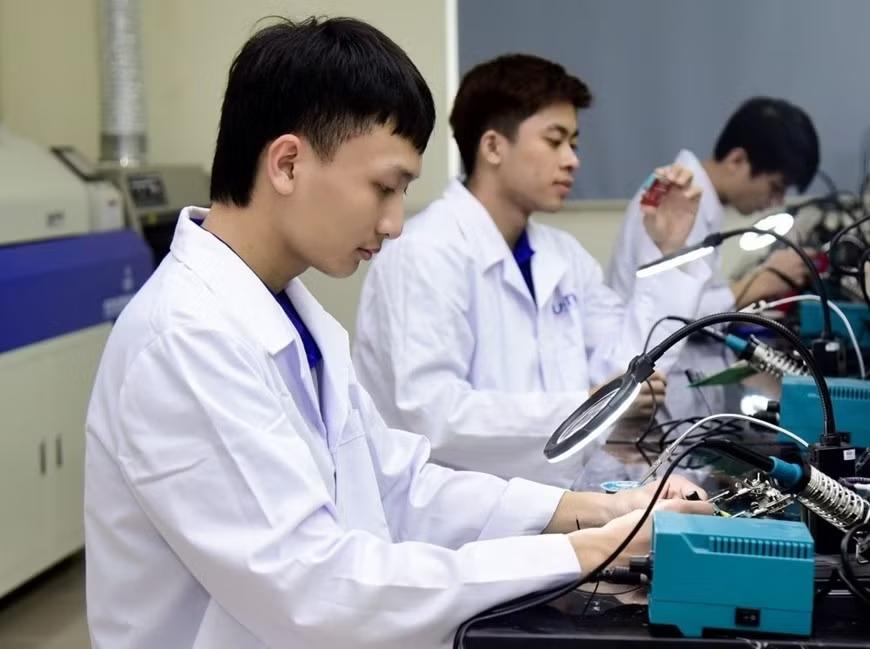
To overcome these bottlenecks, a strong reform of the investment and governance mechanisms for science is first necessary, aiming to grant greater autonomy to research institutions and scientists. The State needs to accept the risks in scientific research, as many major projects worldwide began with experiments that were not guaranteed to succeed. Alongside this, a long-term national strategy for the development of basic science needs to be developed, focusing on strategically important foundational fields such as mathematics, physics, new materials, AI, biotechnology, semiconductors, and cybersecurity. Investment must be focused and targeted to establish centers of excellence with regional significance.
Another urgent requirement is to improve the remuneration and working environment for scientists. It's not just about income; more importantly, it's about creating a transparent, open academic environment with opportunities for career development and where they are respected for their value. To retain talent, they must be able to make a living from science and be proud of their chosen research path. At the same time, it's necessary to strongly promote the linkage between the "State – universities – research institutes – businesses" to form a complete innovation ecosystem. Businesses should be encouraged to invest in long-term research through tax incentives, innovation funds, and strategic research collaborations.
Source: https://cand.vn/thao-go-cac-diem-nghen-de-khoa-hoc-co-ban-phat-trien-post812780.html


![[Photo] Secretary of the National Assembly Party Committee, Chairman of the National Assembly presides over the meeting of the Standing Committee and Executive Committee of the National Assembly Party Committee.](https://vphoto.vietnam.vn/thumb/1200x675/vietnam/resource/IMAGE/2026/06/03/1780480353201_ndo_br_bnd-2585-jpg.webp)
![[Photo] First session of the 14th Congress of the Vietnam Trade Union](https://vphoto.vietnam.vn/thumb/1200x675/vietnam/resource/IMAGE/2026/06/03/1780465947883_ndo_br_img-3852-jpg.webp)












































![[Video] Sunset at Lap An Lagoon – Where the sun sets over the fishing nets](https://vphoto.vietnam.vn/thumb/1200x675/vietnam/resource/IMAGE/2026/05/31/1780192137701_beach-landscape-sea-water-nature-grass-745871-pxhere-com.jpeg)
































Comment (0)