

On its journey to realize its aspiration of becoming a national center for clean and renewable energy, Khanh Hoa faces many challenges. These include transmission infrastructure, the environment, human resources, and especially institutional bottlenecks.
Facing the reality head-on, the determination to remove obstacles, perfect the legal framework, and unlock resources are the "lever" for Khanh Hoa to affirm its role in the national energy security strategy.
Untangling institutional bottlenecks
During his visit to Khanh Hoa province, Vice Chairman of the National Assembly Le Minh Hoan emphasized that, entering a new stage of development, in addition to natural resources, infrastructure, and human resources, Khanh Hoa province, like the rest of the country, is facing a particularly important resource: "institutions."
Law is not just for governing, but also for creating. A good legal system paves the way for innovation, unlocks resources, and so on.
From a legislative perspective, the lack of a separate Renewable Energy Law is creating a significant institutional "bottleneck," directly impacting the ambitions of localities like Khanh Hoa to become energy hubs.
As someone with extensive experience in energy development and nuclear safety, National Assembly Deputy Trinh Thi Tu Anh (15th term) analyzed that the current reality shows that regulations governing this field are scattered across many different legal documents such as the Electricity Law, the Investment Law, the Land Law, etc. This dispersion not only creates difficulties for local state management agencies when having to compare multiple layers of legal frameworks but also creates legal risks for investors, making them hesitant to undertake large-scale projects with long payback periods.
While global science is rapidly advancing with new forms of energy such as green hydrogen, green ammonia, and wave power, our current legal system still lacks clear definitions of licensing procedures, technical standards, and appropriate pricing mechanisms. This inadvertently slows Vietnam's progress in accessing international green capital and the most advanced technologies from major partners.
“To effectively exploit the potential of Khanh Hoa, especially in the context of the province's orientation towards attracting diversified investments: solar power, wind power, gas power, and nuclear power, the National Assembly needs to consider building a centralized legal framework soon. This could be an independent Renewable Energy Law or a groundbreaking, in-depth chapter in the amended Electricity Law.”
Systematically codifying these laws will help clearly establish the rights and responsibilities of all stakeholders. A unified law will serve as a "guiding principle," simplifying administrative procedures related to land allocation, sea areas, and power grid connections; and creating absolute transparency in mobilizing social resources," proposed National Assembly representative Trinh Thi Tu Anh.
Regarding Resolution No. 189/2025/QH15 dated February 19, 2025, of the National Assembly on some special mechanisms and policies for investment in the construction of the Ninh Thuan Nuclear Power Plant project, the People's Committee of Khanh Hoa province requests the Ministry of Industry and Trade to promptly report to the Government to submit to the National Assembly for consideration the adjustment and supplementation of some contents to suit the practical situation.
Institutional improvements not only help resolve current legal conflicts but also demonstrate Vietnam's strong commitment to the international community in the sustainable energy transition. From there, Khanh Hoa has a solid foundation to become a key element in the national energy security strategy, in line with Resolution 70-NQ/TW of the Politburo.
Solving the infrastructure and human resource shortage
Resolution 70-NQ/TW of the Politburo pointed out limitations and shortcomings in the energy sector's infrastructure, noting that it is still lacking and not synchronized. The power system is not yet developed in a synchronized and smart manner; the power grid is not effectively connected to power generation projects.
The power transmission grid is considered the "backbone" for delivering electricity from production sites to areas of demand. Currently, electricity is concentrated in areas with significant production advantages, such as Khanh Hoa province. However, the power transmission grid has not developed to match the growth of the power source.
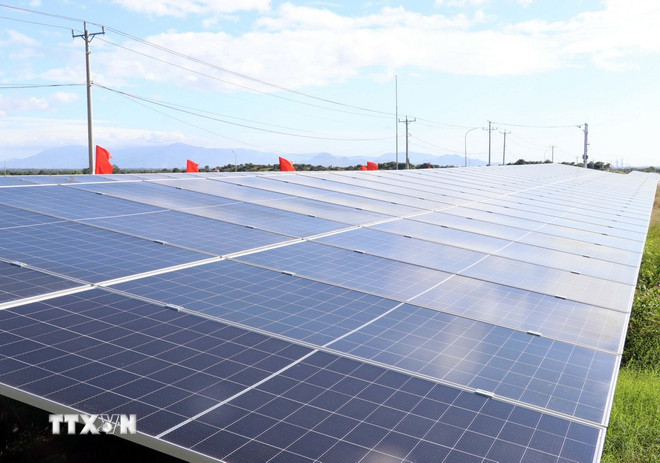
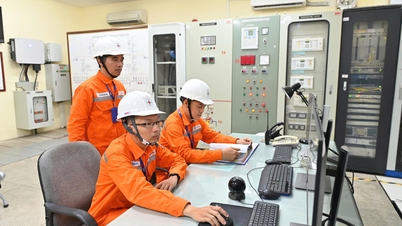
Since 2020, the Trung Nam-Thuan Nam solar power plant (Khanh Hoa province) has invested in a 500kV transmission system. This project has contributed more than 4.6 billion kWh of electricity to the national grid. The 500kV transmission system has relieved more than 32.5 billion kWh, of which over 27.9 billion kWh was transmitted to households.
"With the implementation of the National Power Development Plan for the period 2021-2030, with a vision to 2050 (referred to as Power Plan VIII) and Resolution 70-NQ/TW, the transmission system will be ensured to be stable, creating conditions for businesses to boost renewable energy production," said engineer Nguyen Minh Hieu, Head of the Technical Department of Trung Nam-Thuan Nam Solar Power Plant (Khanh Hoa province).
To ensure the release of the enormous power output from future power sources, the Prime Minister has approved a list of nationally important projects and key projects in the energy sector.
In Khanh Hoa province, many power transmission projects, especially nuclear power projects, are prioritized for investment. The Ninh Son 500kV Substation and Ninh Son-Chon Thanh 500kV Transmission Line project, with a capacity of 2,700 MVA, is expected to be operational in 2027. The upgraded Central-South transmission line (Van Phong-Binh Dinh 500kV line), with a capacity of 1,800 MVA, is expected to be operational in 2028.
The Bac Ai-Ninh Son Pumped Storage Hydropower Plant 500kV Transmission Line Project will be implemented in the 2025-2030 period. The grid connecting the Ninh Thuan 1 and Ninh Thuan 2 Nuclear Power Plants will be constructed and is expected to be operational in the 2031-2035 period.
Along with providing the infrastructure for renewable energy development, human resources remain key. Khanh Hoa province has more than 60 science and technology organizations; a training system including 17 universities, colleges, and vocational schools; 13 science and technology enterprises and 4 large digital technology enterprises, with a workforce of approximately 2,900 people.
Associate Professor Dr. Vu Thanh Son, Director of the Department of Cadre Training and Development (Central Organization Committee), noted that Khanh Hoa still faces many limitations; most notably, the scale and number of science and technology and innovation enterprises are still small, not commensurate with their development potential. The innovation and startup ecosystem is still nascent. The number of marine and energy startups is still very limited…
The Prime Minister has issued Decision No. 1012/QD-TTg approving the Project "Training and fostering human resources to serve the development of nuclear power until 2035" with the goal of having a total of 3,900 highly qualified workers by 2030 and approximately 670 newly trained abroad.
In addition, lecturers in nuclear power engineering specialties will receive training to supplement the teaching staff for training institutions tasked with training and developing human resources for nuclear power plants, totaling approximately 120 people (80 master's degree holders and 40 doctoral degree holders).
According to Mr. Vo Chi Vuong, Director of the Department of Internal Affairs of Khanh Hoa province, developing clean energy, renewable energy, and new energy sources is a strategic task of particular importance in ensuring national energy security. This opens up new opportunities for job development, especially in positions requiring high professional qualifications and skills; and provides a major orientation for human resource development.
Restarting the Ninh Thuan nuclear power project requires a highly well-prepared workforce, encompassing areas from state management, design, and operation to nuclear safety and security.
Facing reality head-on, frankly identifying bottlenecks and challenges, and resolutely addressing them is the path that will help Khanh Hoa reach its desired goals sooner.
Overcoming challenges not only demonstrates the courage and innovative thinking in leadership, direction, and management, but also affirms the aspiration to make Khanh Hoa the "capital" of renewable energy for the nation.
Article 1: With favorable timing and geographical advantages, Khanh Hoa possesses outstanding 'strategic assets'.
Lesson 3: Overcoming Challenges
Lesson 4: Expecting a Richer and Greener Future
Source: https://www.vietnamplus.vn/thao-go-cac-rao-can-vuot-qua-thach-thuc-post1091023.vnp


![[Photo] The courage of new recruits of Brigade 144 on the training ground.](https://vphoto.vietnam.vn/thumb/1200x675/vietnam/resource/IMAGE/2026/05/27/1779881651341_anh-man-hinh-2026-05-27-luc-18-32-52.png)
![[Photo] General Secretary and President To Lam and his wife begin their official visit to Thailand.](https://vphoto.vietnam.vn/thumb/1200x675/vietnam/resource/IMAGE/2026/05/27/1779881249412_anh-man-hinh-2026-05-27-luc-18-10-51.png)















































![[Photo] The courage of new recruits of Brigade 144 on the training ground.](https://vphoto.vietnam.vn/thumb/402x226/vietnam/resource/IMAGE/2026/05/27/1779881651341_anh-man-hinh-2026-05-27-luc-18-32-52.png)





















Comment (0)