

Do not generalize about all delayed projects.
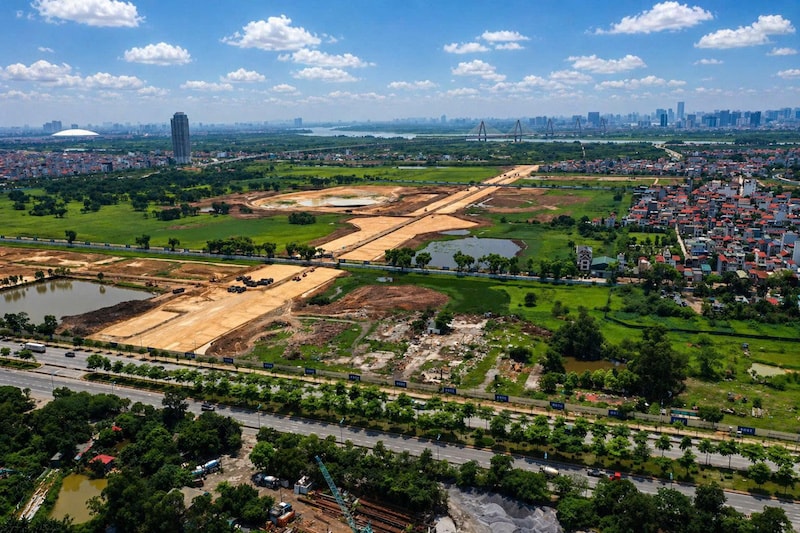
According to statistics from the Hanoi Department of Agriculture and Environment , out of a total of 829 projects reviewed, covering nearly 19,500 hectares of land, 488 projects (almost 59%) have been removed from the list of slow-moving projects. Of these, 307 projects have had their obstacles removed and are continuing implementation, while 181 projects have had their land revoked and operations terminated. Currently, 341 projects are still under monitoring and processing.
.jpg)
Based on these figures, experts attending the news program titled " Hanoi removes obstacles for projects, resolutely deals with delaying investors," produced by the Hanoi Press and Broadcasting Agency on the evening of April 28th, acknowledged that Hanoi's stance does not equate all delayed projects. Projects with the potential for implementation will have obstacles removed, while weak projects or those deliberately hoarding land will be eliminated.
The city requires investors to coordinate with the authorities, providing full reports on project progress, reasons for delays, financial capacity, ability to raise capital, implementation plans, and committed deadlines. This allows all parties to discuss solutions to resolve issues. If an investor lacks the capacity, the local authorities will propose that the city revoke the project to avoid wasting land resources and hindering socio-economic development goals in the area.
"The fact that over 700 delayed projects have been eliminated shows that Hanoi is very decisive and ready to remove weak projects and projects with incompetent investors," assessed Mr. Nguyen Chi Thanh, a real estate expert.
However, while hundreds of projects have had their obstacles removed, the number of projects actually implemented remains modest. In Quang Minh commune, out of 29 delayed projects, 22 are on the city's monitoring list. The local authorities have established working groups to review each project, identify the causes, and propose appropriate solutions.
“We are determined to deal with stalled projects, while providing maximum support to projects that meet the criteria for implementation… Requiring investors to commit to deadlines, demonstrate financial capacity, and be held legally accountable is creating a new ‘filter.’ This is the basis for Hanoi to both remove obstacles and filter, ensuring that land is used efficiently,” shared Mr. Phung Cong The, Head of the Economic Department, Quang Minh Commune People's Committee.
Preventing developers from "circumventing the law"
In reality, many businesses, even before implementing a project, still try to hold onto the land in order to benefit from rising land values. "If a business holds onto a project without the financial capacity, then holding onto the project is meaningless," said Professor Dang Hung Vo, former Deputy Minister of Natural Resources and Environment (now the Ministry of Agriculture and Environment ). He argued that the government reviewing the capabilities of businesses before deciding whether to allow them to continue implementing a project is the right approach, helping to eliminate weak businesses.
One problem facing authorities when deciding to revoke a project is that developers often use loopholes to change the project name, essentially using "new bottle, old wine," in order to occupy the land when they lack the capacity to implement the project.
Proposing a solution, Mr. Nguyen Van Dinh, Vice Chairman of the Vietnam Real Estate Association, stated that changes to projects, investment solicitation, and project transfers are all specifically regulated in the Law on Real Estate Business and the Law on Land.
Based on this legal framework, authorities can easily control deliberate attempts to circumvent the law. As laws become more transparent, stringent, and strictly enforced, exploiting loopholes becomes less easy.
According to Mr. Dinh, changing the role of the investor or updating business information is not overly complicated in terms of procedures, but it is mandatory to meet all the conditions and requirements of the law, especially the investor must demonstrate their capacity.
According to Professor Dang Hung Vo, the "new bottle, old wine" situation arises when the law lacks a specific system of criteria to assess the capacity of businesses. Therefore, if such a system of criteria is developed and combined with banking data, it is entirely possible to accurately identify the actual situation and operational capabilities of businesses.
Creating opportunities for capable investors to participate.
Experts believe that Hanoi needs strong determination to decisively eliminate underperforming businesses. However, this should be accompanied by mechanisms to support businesses with sufficient capacity to implement and bring projects into operation early to serve socio-economic development.
Representing real estate businesses, Mr. Nguyen Van Dinh shared that for projects in the inner city, land clearance is very complex, involving many households and various land sizes, requiring businesses to negotiate with each group of families. This is the biggest difficulty for businesses.
Previously, developers had to clear 100% of the land before a project could be implemented. Recently, new regulations have changed, reducing the land clearance area to 75%, allowing projects to proceed. Although this is a significant solution, the challenge of land clearance in urban areas remains a major obstacle.
In particular, businesses cannot clear and reclaim land without the strong support and decisive involvement of management agencies and local authorities. Therefore, the core issue remains whether the city is truly determined to resolve the difficulties and obstacles that are holding back these projects.
“I agree and highly appreciate Hanoi's strong determination and proactive approach in implementing numerous solutions, especially institutional reforms, aiming to create and support development while simultaneously addressing difficulties and promoting progress. Particularly with the amended Capital City Law, many unprecedented mechanisms have been opened up, and I hope that the obstacles causing project delays will be resolved soon,” Mr. Nguyen Van Dinh emphasized.
It can be said that reviewing and handling 341 slow-moving, non-budgetary projects not only resolves stalled projects, avoids wasting land resources, and solves a long-standing legal problem, but also serves as a "key" to unlocking social resources.
Through this review, the city is also determined to deal with developers who deliberately delay or "hoard land" using various tactics, creating opportunities for capable investors to participate in project development.
This is a necessary "purification" to transform planning "black spots" into growth drivers, ensuring a harmonious balance of interests between the State, businesses, and the people.
Source: https://hanoimoi.vn/thao-go-vuong-mac-giai-phong-nguon-luc-dat-dai-747478.html






































































































Comment (0)