

(NLĐO) - The James Webb Space Telescope has captured spectacular images of the ghostly Herbig-Haro object HH 30, where new planets are on the verge of being born.
The Herbig-Haro object HH 30 had previously been photographed by its predecessor, the Hubble Space Telescope. But now, under the "all-seeing eye" of the world's most powerful space telescope, the James Webb, astronomers have discovered a hidden protoplanetary disk.
According to Sci-News , the Herbig-Haro object is a bright patch of nebula from "protostars," appearing in star-forming regions, first observed by American astronomer Sherburne Wesley Burnham in the 19th century.
Later, the names of the first two astronomers to study this type of object in detail – George Herbig and Guillermo Haro – were used to name them.
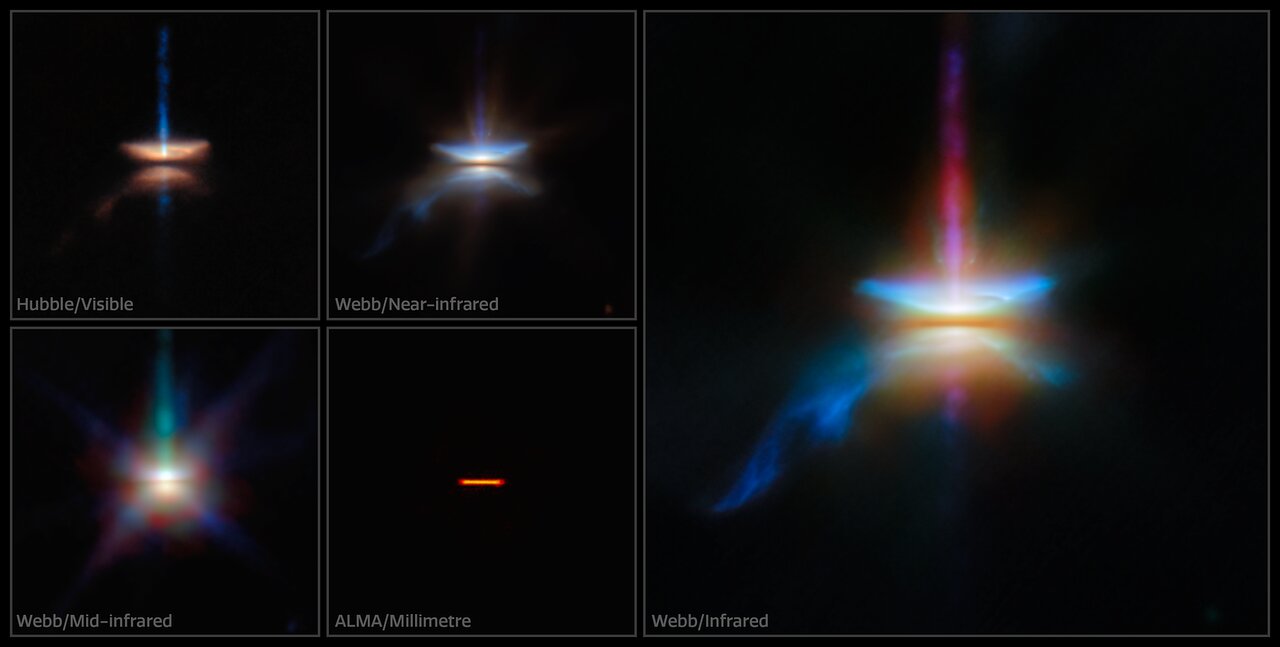
The "many faces" of the Herbig-Haro object HH 30, as ESA calls it, are images of HH 30 taken by various instruments on the James Webb spacecraft, as well as by Hubble and ALMA - Image: NASA/ESA/CSA
Herbig-Haro objects are formed when hot gas ejected from a newly formed star collides with surrounding gas and dust at speeds up to 250,000 km/h, creating a powerful shock wave.
They come in many different shapes, but the basic configuration is usually the same, with two streams of hot gas erupting in opposite directions from a forming star, flowing through interstellar space.
"HH 30 is an example of where this outflow of gas takes the form of a narrow jet," said the international research team led by the European Space Agency (ESA), one of the co-operators of the James Webb space program with the US and Canadian space agencies (NASA and CSA).
The new look of HH 30 revealed by James Webb shows a source star located at one end of the stream, hidden behind a protoplanetary disk that the star is illuminating.
A protoplanetary disk is a rocky, dusty disk that surrounds young stars. The material in the disk could coalesce into planets in the future.
By combining data from the ALMA ground-based observatory in Chile, scientists were able to observe millimeter-sized dust particles found in a narrow region at the center plane of the disk.
Meanwhile, shorter-wavelength infrared data from James Webb showed even smaller dust particles, about the size of bacteria, widely distributed within the disk.
Combined observations also showed that large dust particles had moved to settle in the location where they were found. This is a crucial stage in the planet-forming process.
In this dense region, dust particles clump together to form pebbles and eventually planets.
A high-speed stream of air ejected at a 90-degree angle from a narrow central disk was also found, surrounded by a wider conical flow.
"Taken together, these data suggest that HH 30 is a dynamic environment where tiny dust particles and massive gas plumes both play a role in the formation of new planets," the scientists concluded.
Source: https://nld.com.vn/lo-dien-sieu-vat-the-herbig-haro-the-gioi-moi-xuat-appear-19625021009412231.htm


![[Photo] General Secretary and President To Lam presides over a working session with the Central Policy and Strategy Committee on the development of the materials industry.](https://vphoto.vietnam.vn/thumb/1200x675/vietnam/resource/IMAGE/2026/05/21/1779359935432_a3-bnd-3129-1412-jpg.webp)





















































































Comment (0)