

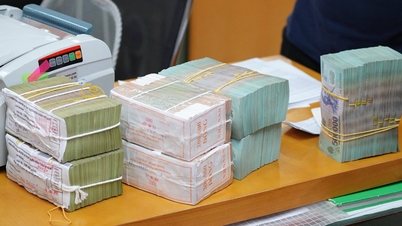
Dividends are a component of the return an investor receives when investing in shares. Current regulations require dividends to be paid within 6 months of the shareholders' meeting, but many companies are delaying payment.
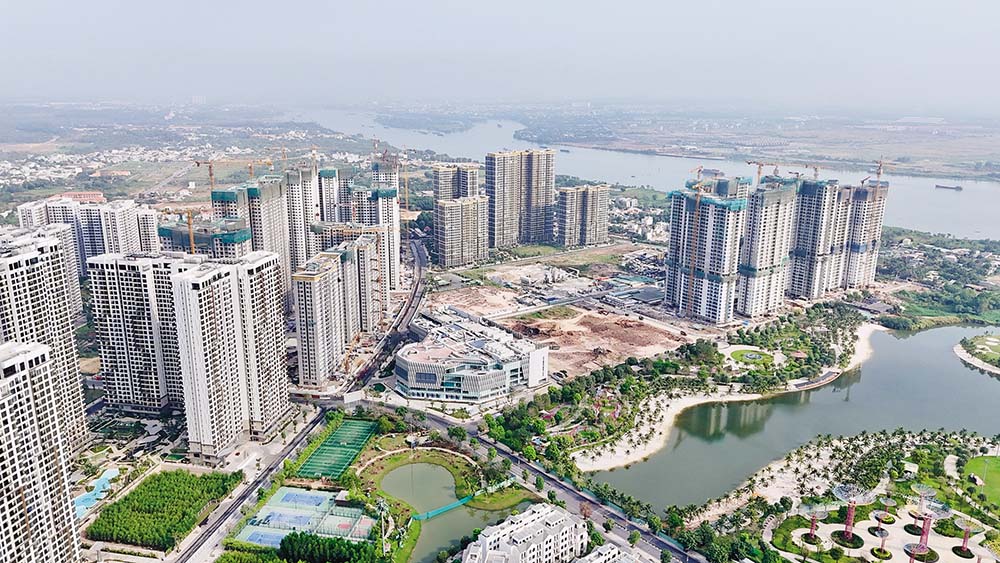 |
| Becamex IJC owes state shareholders nearly 50 billion VND in interest for delayed dividend payments. |
Various ways dividend payments are missed.
The documents for the 2024 Extraordinary General Meeting of Shareholders of Kinh Bac City Urban Development Corporation (Kinh Bac City, stock code: KBC), released last weekend, surprised many investors. The plan to distribute 20% of after-tax profits for 2022 in cash, which was approved by shareholders at the June 2023 meeting, is highly likely to be canceled at this year's meeting.
Specifically, according to the presentation to shareholders, the Kinh Bac City management board cited two reasons: Firstly, the company prioritizes allocating all financial resources in 2023 to repurchase all outstanding bonds that are due and due, totaling over VND 4,060 billion, bringing the bond debt to zero. Secondly, it is necessary to arrange financial resources to ensure the implementation and expansion of its projects.
It's worth noting that, at the time the dividend distribution plan was approved, the settlement of bond debt and ambitions for expansion investment were already mentioned by the Kinh Bac City leadership. Furthermore, since the end of 2022, the company had planned to spend trillions of VND to buy back KBC shares. The initial plan was for 100 million shares, later reduced to 50 million, and now, according to the plan at the upcoming meeting, it will be completely canceled.
With changes in cash flow projections, the Board of Directors stated that it will present a different profit distribution plan to shareholders at the 2024 Annual General Meeting. The dividend for 2022 remains uncertain at this time.
Shareholders can sue companies in court for violations of dividend payment regulations. However, the procedures are complex and time-consuming, discouraging many shareholders.
Presenting a plan to shareholders for approval and then canceling it, or even delaying its implementation for many years, is not unprecedented.
Despite achieving considerable success in rice exports last year, Binh Dinh Food Corporation (Bidifood) - a subsidiary of Vinafood2 - is struggling to balance its cash flow.
“The cost of goods sold has surged by more than 50% since July 2023, while the company has to maintain a circulating reserve of over 3,000 tons of rice (46 billion VND), leading to limited capital; reduced capital utilization efficiency and increased interest expenses. The company's financial situation is very difficult, and there is no money to pay the remaining dividends,” said Mr. Le Phat Tai, Chairman of the Board of Directors of Bidifood.
Bidifood's 2022 dividend was reduced from 170.5% to 30%. Although 10 out of 35 shareholders voted against it, the proposal was approved.
Although there was no resolution to change the dividend, shareholders of Song Da Urban and Industrial Zone Development Investment Joint Stock Company (Sudico) regularly received notices postponing the payment of cash dividends for 2016 and 2017. The company repeatedly cited difficult financial conditions as the reason.
Sudico underwent many changes in 2023, from its leadership and plans to restart major projects to a significant improvement in cash flow from business operations. However, the plan for paying outstanding dividends and distributing profits for 2023 will likely only be resolved at the shareholders' meeting on March 20th.
The shareholder protection mechanism is not strong enough.
For investors who contribute capital to a business, dividends are one of two sources of income, in addition to the profit from buying and selling transactions.
According to the provisions of the 2020 Enterprise Law, dividends must be paid in full within 6 months from the date of the conclusion of the annual general meeting of shareholders. The Board of Directors shall prepare a list of shareholders entitled to receive dividends, determine the dividend amount to be paid per share, and specify the payment deadline and method at least 30 days before each dividend payment.
Decree 122/2021/ND-CP, which regulates administrative penalties in the field of planning and investment - one of the six decrees guiding the implementation of the Enterprise Law - does not mention administrative penalties related to dividend issues.
With the above legal regulations, shareholders can sue in court for violations. However, the procedures are complex and the time spent on litigation is considerable, discouraging shareholders.
Even state-owned shareholders face the prospect of waiting for dividends for years, but at least they still receive additional penalty interest payments.
The outstanding interest payment on delayed dividend payments, amounting to nearly 50 billion VND, between Becamex and Becamex IJC, is expected to be paid if Becamex IJC's upcoming public offering of shares to raise 1,259 billion VND is successful. Becamex IJC has paid the entire principal of dividends due from 2011 to 2018 to Becamex (612 billion VND), but only 109 billion VND of the accrued interest of 257 billion VND has been paid.
Decision No. 21/2012/QD-TTg of the Prime Minister on the promulgation of the Regulations on the Management and Use of the Fund for Supporting Enterprise Restructuring and Development provided state shareholders with additional leverage in cases where enterprises delayed dividend payments by more than three months, ensuring that revenue flowed into the Fund. However, this fund ceased to exist after 20 years of operation. Furthermore, the regulations only protected a small group of shareholders, neglecting the dividend rights of other shareholders, who constitute a much larger number.
Source
![[Image] Hanoi's urban life under the challenge of a "scorching hot" environment](https://vphoto.vietnam.vn/thumb/1200x675/vietnam/resource/IMAGE/2026/05/25/1779706979265_nang-nong-t5-2026-minh-duy-7-4636-jpg.webp)


![[Image] Close-up view of the interchange connecting the two expressways and Long Thanh Airport.](https://vphoto.vietnam.vn/thumb/1200x675/vietnam/resource/IMAGE/2026/05/25/1779703378210_ndo_br_z7863716673926-224453a31600126cce10622af6290afd-4549-jpg.webp)










































































Comment (0)