

Global renewable energy production reaches record levels.
For the first time in history, renewable energy has surpassed coal to become the largest source of electricity generation. The world is entering a period of energy abundance. While three years ago, before the Ukraine-Russia conflict erupted, there was much talk of energy crises, now the world is transitioning from energy scarcity to energy abundance. This is the latest assessment from Rystad Energy, a leading independent energy research and information company worldwide.
For the first time, total electricity production from renewable energy sources globally, such as wind and solar power, has surpassed that from coal. The report shows that global solar power capacity increased by a record 31% in the first half of the year, while wind power increased by 7.7%. Total electricity production from solar and wind power increased by more than 400 TWh – exceeding the increase in total global electricity demand during the same period.
Malgorzata Wiatros-Motyka, Senior Grid Specialist at Ember Group, stated: “In the first half of 2025, we saw solar and wind power outpace electricity demand growth. Coal power production declined in China and India, resulting in lower emissions, and these are economies with rapidly growing demand. We can expect that the growth of coal power will soon come to an end.”
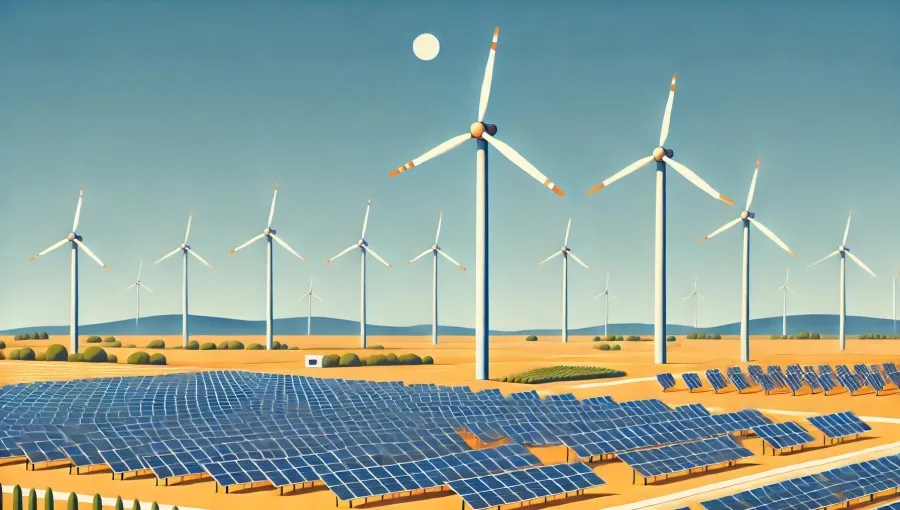
Renewable energy is expected to meet up to 90% of global electricity consumption growth this year.
Solar energy has become the primary source of electricity in the EU for the first time.
Renewable energy is expected to meet up to 90% of global electricity consumption growth this year, even as the number of data centers consuming billions of kilowatt-hours continues to grow.
In the European Union (EU), during the second quarter of this year, more than half of the net electricity generated also came from renewable energy sources.
According to Eurostat data, June was the first month in history that solar energy was the primary source of electricity generated in the EU, accounting for one-fifth of the energy mix. This was followed by nuclear power, wind power, hydropower, and natural gas. Thus, electricity from fossil fuels has virtually disappeared in Europe.
China is actively promoting renewable energy.
As for China, despite a slowdown due to policy changes, it is still expected to continue to lead the world in renewable energy growth, accounting for approximately 60% of new capacity added globally.
According to the IEA, the current momentum of technological innovation in China could help the country achieve its 2035 targets for wind and solar power five years ahead of schedule. This breakthrough also promises to bring many benefits to consumers in the country of over a billion people.
China's advantage in the renewable energy sector stems from its superior investment and technological innovation. Last year, investment in key renewable energy projects accounted for over 80% of China's total power investment. Technological innovation—particularly in photovoltaic cells and wind turbines—continuously improves conversion efficiency, making solar and wind power in China increasingly stable, efficient, and cheaper, thus increasing their share in the national power grid.
The positive impacts are most clearly seen in the Xinjiang Uyghur Autonomous Region, where more than 60% of the grid's capacity comes from renewable energy.
Feng Xiaoheng, Director of Operations for the Hami Solar Power Project in Xinjiang Uygur Autonomous Region, China, shared: “Our solar power project helps increase daily electricity production to 1.12 million kWh this year and can meet the electricity needs of approximately 200,000 households.”
In addition, renewable energy brings other benefits to the local economy, such as increasing job opportunities and improving people's incomes.
Li Yongxiang, a renewable energy project manager in Xinjiang Uygur Autonomous Region, China, stated: “Our renewable energy project has created many jobs for local people. Initially, we established a vocational training school for over 4,000 participants, including farmers and livestock breeders. Most of them were employed after completing the training, significantly improving their income and boosting local small businesses.”
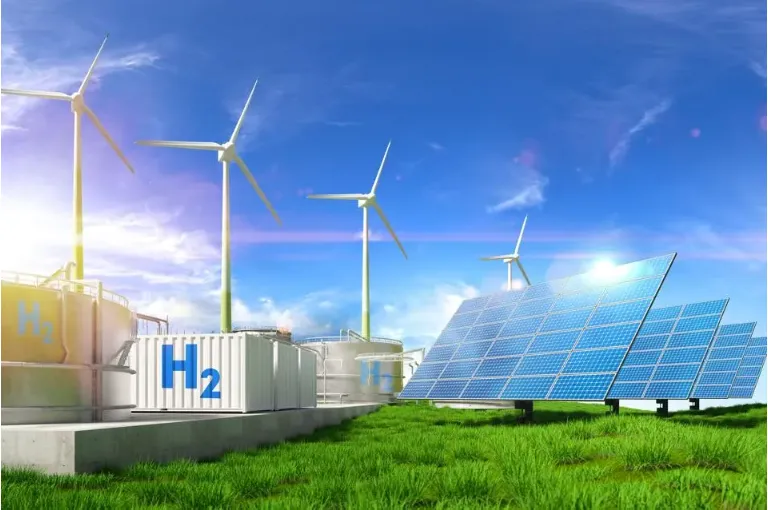
Utilizing surplus electricity is becoming a more viable method for producing inexpensive hydrogen fuel.
Japan implements solutions to lower the cost of hydrogen fuel.
In today's energy-rich era, even surplus solar energy is being used to produce hydrogen fuel at the lowest cost, with a view to commercializing this strategic carbon-neutral fuel.
Hydrogen is produced using clean energy sources such as surplus solar power, making it possible to produce hydrogen at a lower cost and more competitive in the market.
Utilizing surplus electricity is becoming a more viable method for producing inexpensive hydrogen fuel. The corporation is also building pipelines to distribute hydrogen fuel to areas of use.
Yasumitsu Okazaki, head of the Hydrogen Development team at Hokkaido Electric Power Company, Japan, stated: “Hydrogen production equipment is quite expensive and has high operating costs, so we are looking for ways to reduce equipment costs. I believe it is necessary to develop technologies such as extending equipment lifespan and for operators to make efforts to reduce costs.”
In Japan, hydrogen fuel is subsidized by the government at around 700 Yen (approximately 12,000 VND) per kilogram to compete with traditional fuels such as gasoline and diesel. Reducing the cost of hydrogen fuel will be a crucial condition for Japan to move towards a hydrogen society.
Source: https://vtv.vn/thoi-ky-doi-dao-nang-luong-100251011120800677.htm

![[Photo] Solemn bathing ceremony and Buddha procession in Hue](https://vphoto.vietnam.vn/thumb/1200x675/vietnam/resource/IMAGE/2026/05/31/1780228263543_1-jpg.webp)
![[Photo] Admire the coral "masterpiece" amidst the million-year-old heritage of Dak Lak province.](https://vphoto.vietnam.vn/thumb/1200x675/vietnam/resource/IMAGE/2026/05/31/1780221235105_anh-man-hinh-2026-05-31-luc-16-53-27.png)
![[Photo] The General Secretary, President and his wife begin their state visit to the Philippines.](https://vphoto.vietnam.vn/thumb/1200x675/vietnam/resource/IMAGE/2026/05/31/1780230559452_anh-man-hinh-2026-05-31-luc-19-28-11.png)
![[Image] Hanoi Police officially crowned champions of V-League 2025/2026](https://vphoto.vietnam.vn/thumb/1200x675/vietnam/resource/IMAGE/2026/05/31/1780244769054_ndo_br_039d561b692be875b13a-jpg.webp)

















![[Video] Sunset at Lap An Lagoon – Where the sun sets over the fishing nets](https://vphoto.vietnam.vn/thumb/340x192/vietnam/resource/IMAGE/2026/05/31/1780192137701_beach-landscape-sea-water-nature-grass-745871-pxhere-com.jpeg)










































![[Photo] Admire the coral "masterpiece" amidst the million-year-old heritage of Dak Lak province.](https://vphoto.vietnam.vn/thumb/402x226/vietnam/resource/IMAGE/2026/05/31/1780221235105_anh-man-hinh-2026-05-31-luc-16-53-27.png)



































Comment (0)