

Scientists have discovered the ominous presence of the African Superluminal, a massive column of hot rock rising from the earth and unexpectedly sculpting the eastern part of the continent.
We have long known that Africa is changing rapidly. Existing rift zones show that the continent is deforming and will soon separate in the future.
But a new study published in the scientific journal Geophysical Research Letters suggests that the "scenario" for this separation is far more complex and astonishing than we previously imagined.
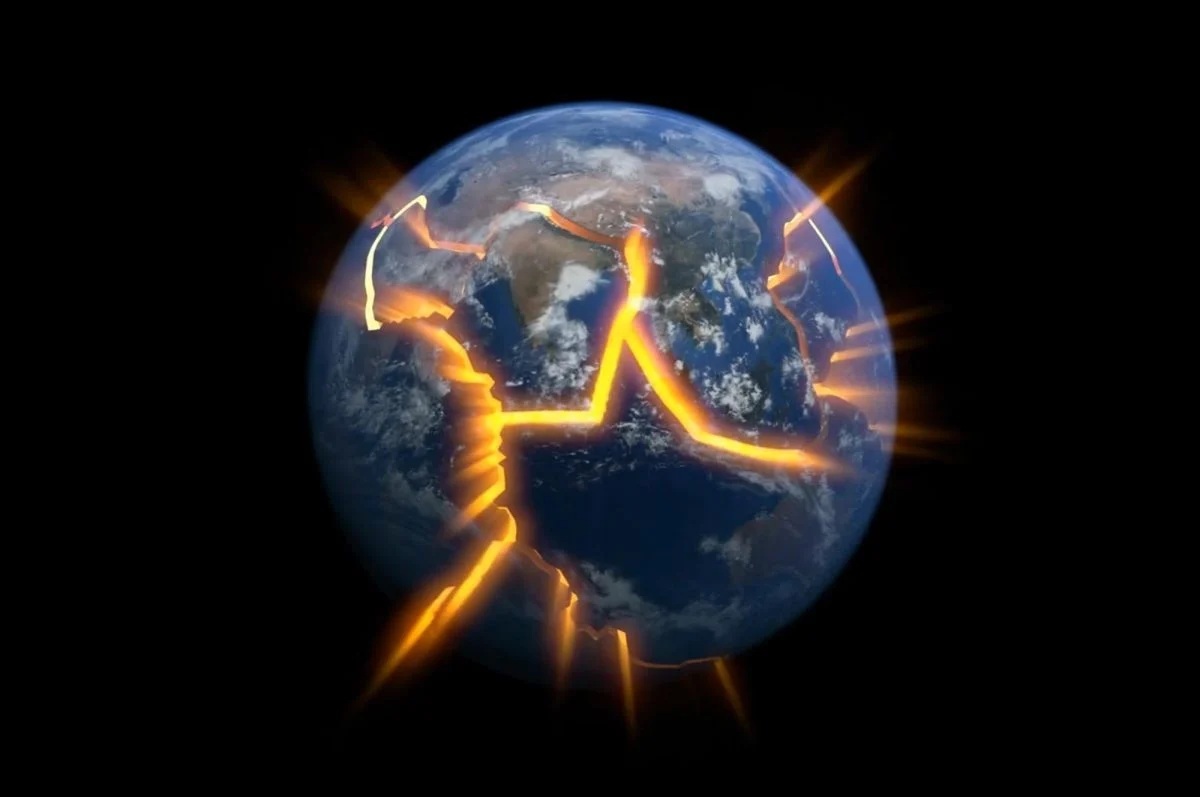
The Earth's continents are shaped by complex geological processes - Graphic image: SCITECH DAILY
For decades, scientists predicted that much of the deformation in fault zones would occur perpendicular to the fault direction, essentially pulling the Earth's crust apart horizontally, as the East African fault system operates.
But long-term GPS measurements have revealed something puzzling: parts of the area are also shifting parallel to the crack itself.
Associate Professor D. Sarah Stamps, a geophysicist from Virginia Tech (USA) and co-author, stated that the African Superplume is the culprit.
Not only does this column of hot rock rise from the earth, but it also creates a northward flow beneath the lithosphere, silently dragging continental plates along with it.
Furthermore, another independent study published in the scientific journal Journal of Geophysical Research: Solid Earth shows that the complex deformation process of Africa also involves small blocks of Earth's crust, called microplates, which are rotating independently within the rift zone.
The Victoria microplate, a geological entity sandwiched between the eastern and western branches of the East African Fault System, is rotating counterclockwise at a rate of approximately 0.0583 degrees per million years.
This rotation produces a peculiar effect: While most of the deformation is concentrated along the edges of the microplate—where the cracks slide at a rate of about 1.8 to 2.2 mm per year—its inner core remains surprisingly stable.
Taken together, these "underground forces" suggest that Africa is not simply divided by a few fissures, but is undergoing a complex continental restructuring.
Source: https://giadinh.suckhoedoisong.vn/thu-ky-la-dang-troi-len-tu-long-dat-lam-bien-dang-mot-luc-dia-172260505071721129.htm



![[Image] Nearly 125,000 Hanoi students completed the Literature exam for the 10th grade entrance exam.](https://vphoto.vietnam.vn/thumb/1200x675/vietnam/resource/IMAGE/2026/05/30/1780117233041_ndo_br_thiet-ke-chua-co-ten-2-png.webp)





















































































Comment (0)