


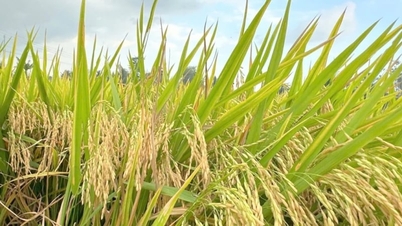
In the Red River Delta, rice fields in Hai Phong, Hung Yen, and Ninh Binh are beginning to change their farming methods: machine sowing, fertilizing along the rice rows, alternating wet and dry irrigation... Less seeds, less fertilizer, more water, but yields are maintained. Behind this change is the expectation of increasing the value and competitiveness of Vietnamese rice in the context of agriculture being forced to transform towards a green and sustainable direction.
Rice and fertilizer are planted in rows.
In the fields of Tan An commune ( Hai Phong ), instead of the scene of people manually transplanting rice seedlings or densely sowing seeds as before, a row seeding machine runs smoothly across the field. The machine simultaneously sows seeds and buryes fertilizer in the soil along the rice rows. The amount of seed used is only about 45 kg/ha, a reduction of 60-70% compared to the traditional broadcast sowing method.
This technology was researched and improved by the International Rice Research Institute (IRRI) in collaboration with Vietnamese partners, adapting imported machinery to suit local field conditions. The core principle is controlling plant density right from the sowing stage and placing fertilizer in the correct locations where the plant roots will develop.
According to Associate Professor Dr. Nguyen Van Hung, a senior expert at IRRI, mechanized sowing combined with simultaneous fertilization can solve many "difficult problems" in rice production: shortage of rural labor, wasted fertilizer due to leaching, and reduced greenhouse gas emissions from the fields.
"When fertilizer is placed in the right location, plants absorb it more effectively, reducing environmental losses. When plant density is properly controlled, rice grows uniformly, has a strong root system, and is less susceptible to pests and diseases, thereby reducing the need for pesticides," Mr. Hung explained.
Beyond just sowing, areas producing crops with reduced emissions also apply a comprehensive range of technical solutions: fertilization according to the "four correct principles"; water management using the alternating wet-dry (AWD) method; and integrated pest management (IPM). Each stage aims at a common goal: saving inputs, reducing emissions, while still ensuring productivity.
Keep rice farmers in the fields.
In many areas of the Red River Delta, farmers are increasingly reluctant to grow rice. Labor costs, seed prices, fertilizer costs, and pesticide costs are rising, while young workers are leaving the fields to work in factories and industrial zones.
The cost of hiring laborers for rice planting currently ranges from 350,000 to 400,000 VND per day. With a large area, this expense becomes a significant burden. Therefore, the introduction of a rice planting machine with integrated fertilizer application has attracted considerable interest from farmers.
Mr. Tran Thanh Phuong, Director of Huu Chung Agricultural Service Cooperative (Tan An commune, Hai Phong), said that the cost of production using the old methods was very high, making people uninterested in rice cultivation. Farmers hope that the new model will help reduce costs while still ensuring productivity and quality.
According to Mr. Tran Thanh Phuong, if the model proves to be clearly effective in terms of economics and the environment, farmers will certainly be eager to participate. Because what farmers care about most is still the profit margin per acre of land.
From a local management perspective, Ms. Luong Thi Kiem, Deputy Director of the Department of Agriculture and Environment of Hai Phong city, believes that the model of rice production with reduced emissions is a concrete step towards the city's green transformation goals. However, one of the major obstacles currently is the fragmentation of farmland, making it difficult to achieve synchronized mechanization.
To address this, Hai Phong has implemented several support policies: providing up to 300 million VND per machine for farmers investing in machinery; and offering 5 million VND per hectare per year for 5 years to encourage land consolidation. This is considered a crucial leverage to expand production scale and reduce emissions.
Businesses are entering the market with a comprehensive set of solutions.
Having participated in the project to develop 1 million hectares of high-quality, low-emission rice in the Mekong Delta, Mr. Duong Quang Sau, Deputy General Director of Vietnam Seed Corporation (Vinaseed), said that the company has a complete "set of solutions": providing seeds, linking the input supply chain, applying sustainable farming processes, and organizing product consumption.
In the northern region, Vinaseed has introduced two key varieties into its solution: Dai Thom 8 and VR20. These two varieties adapt well to the weather conditions of the North, are resistant to lodging, have good pest and disease resistance, and are suitable for small and medium-scale production.
According to Mr. Duong Quang Sau, if fertilizer and pesticide use can be reduced and alternating wet and dry irrigation is applied appropriately, production costs will decrease significantly, and greenhouse gas emissions will also decrease. In the Red River Delta, the unique characteristic of rice fields interspersed with residential areas makes the requirements for production safety and environmental protection even stricter. Therefore, reducing emissions in production is not only an economic issue but also linked to the quality of life of the community.
In the future, Vinaseed will continue to work alongside localities, not only providing seeds but also participating in building consumption chains to increase the value of rice grains.
Evaluating the model in the Red River Delta, Mr. Le Thanh Tung - Standing Vice Chairman and General Secretary of the Vietnam Rice Industry Association (VIETRISA) - said that the biggest new aspect of this model is the shift from manual sowing and transplanting methods to synchronized mechanization. When sowing seeds and applying fertilizer are done simultaneously and in the correct positions along the rice rows, it helps save on fertilizer use and increases the plant's absorption capacity. The rice grows uniformly, making care and pest and disease management easier.
According to Mr. Tung, in commodity production, cost reduction is a key factor in enhancing competitiveness, especially when Vietnamese rice has to compete with similar products in the international market. Even in the domestic market, lowering production costs is an important condition for increasing economic efficiency for rice farmers.
Mr. Nguyen Quoc Manh, Deputy Director of the Department of Crop Production and Plant Protection, stated that the Ministry of Agriculture and Environment has approved the "Emission Reduction Program for Crop Production in the period 2025-2035, with a vision to 2050". The pilot models in Hai Phong, Hung Yen, and Ninh Binh are concrete steps to translate this goal into practical production. Through each season, the technical solutions will continue to be tested, the processes refined, and replicated in many localities.
Source: https://baotintuc.vn/kinh-te/thuc-day-chuoi-lua-gao-giam-phat-thai-phia-bac-20260227114549745.htm








![[Infographic] Key points in the Hanoi Master Plan with a 100-year vision](https://vphoto.vietnam.vn/thumb/402x226/vietnam/resource/IMAGE/2026/05/26/1779750297385_quyhoach100nam-97685526052946271833906-43228536014852394887250.webp)





















































Comment (0)