And that lays the foundation for sustainable development.
Hanoi has simultaneously commenced construction on three large-scale rental housing projects. Upon completion, these three projects will add thousands of apartments to meet the housing needs of the people.
Reduce housing pressure for residents.
Over the years, rapid urbanization and a high rate of population growth due to migration have resulted in consistently high housing demand in Hanoi. Meanwhile, the real estate market is primarily focused on buying and selling, while rental housing development is fragmented and fails to meet the growing needs of workers, civil servants, students, and low- and middle-income groups.
Therefore, the implementation of a series of rental housing projects in Hanoi is of great significance. Among them, the most notable is the rental housing project in the Phap Van - Tu Hiep new urban area, Yen So ward, with a scale of 1,176 apartments and a total investment of nearly 1,396 billion VND from the city's budget. This is considered a pioneering project in the model of large-scale rental housing development using state resources.

A rendering of a recently launched rental housing project. Photo: Contributor.
The project in the Phap Van - Tu Hiep new urban area will utilize the existing student housing stock by renovating buildings A2 and A3 and constructing building A4, providing over 131,000 m2 of floor space to meet the rental needs of residents. This is not only a solution to save investment resources but also demonstrates flexible thinking in exploiting public assets.
In addition, Hanoi City also commenced a rental housing project in Viet Hung ward with 1,166 apartments, with a total investment of over 3,562 billion VND from the city's budget. Upon completion in 2028, the project will contribute to the formation of a modern, integrated residential area, creating a significant additional supply for the rental market in the eastern part of the city.
Notably, the private sector has also begun to participate strongly in this field. The Him Lam Long Bien mixed-use housing project, invested by Him Lam Joint Stock Company on an area of approximately 25 hectares, is expected to provide about 4,000 rental apartments along with a system of schools, green spaces, and other integrated public amenities. The participation of private enterprises shows that the rental housing model is gradually becoming an attractive direction, opening up the possibility of mobilizing social resources to address the growing housing demand.


When the three aforementioned projects are completed, thousands of new apartments will be put into operation. This will help alleviate the housing pressure for workers, students, civil servants, and many other groups who do not yet have the means to own a home.
Leveraging special mechanisms
Prime Minister Le Minh Hung once emphasized that rental housing must be identified as a strategic, long-term segment serving a large number of people, especially workers, students, officials, civil servants, and members of the armed forces – who have a great need for affordable rental housing. The Prime Minister requested Hanoi to prioritize and take the lead in urgently reviewing all planning, land funds, and public housing assets that are currently underutilized, in order to develop a plan for arranging and developing rental housing models.
Three recently launched projects not only add thousands of rental apartments but also mark a new step for Hanoi in its housing development strategy. From primarily focusing on housing for sale, the city is gradually shifting its mindset, viewing rental housing as a strategic, long-term segment. Hanoi is also researching appropriate mechanisms to attract businesses to invest and create a sustainable housing fund to meet the growing needs of its residents.
The implementation of the three aforementioned projects demonstrates that Hanoi is one of the pioneering localities in developing rental housing. The city has quickly concretized this policy through the issuance of a resolution on mechanisms and policies for investment, development, and support of housing in the area, while also urgently implementing specific projects.

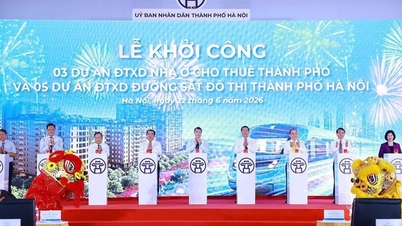
Prime Minister Le Minh Hung and delegates pressed the button to officially launch the construction of 5 urban railway lines and 3 rental housing projects in Hanoi. Photo: NHAT BAC
The shift from building housing solely for sale to developing both for sale and rent will expand access to housing for the people. This will also contribute to the formation of a more balanced and sustainable real estate market in Hanoi.
One of the key factors helping Hanoi realize its goal of developing rental housing is the effective application of special mechanisms. According to the 2026 Capital City Law and National Assembly resolutions on special mechanisms and policies for Hanoi, the city is granted more autonomy in the investment and construction process. Notably, the city is allowed to separate land clearance into an independent project, simplifying investment procedures and significantly shortening project preparation time.
Thanks to these mechanisms, rental housing projects in Hanoi have been implemented faster than before, creating a foundation for boosting the development of the housing stock in the coming years. Not only relying on budget resources, the city also aims to strongly mobilize the private sector to participate in investment. According to the leaders of the Hanoi Department of Construction, the city will continue to study appropriate policies to ensure benefits for businesses and create incentives for private investors to participate in the long-term and effective development of rental housing.


With support from specific mechanisms, the determination of the city government, and the increasingly active participation of businesses, Hanoi is opening up new directions for development in the housing sector. This helps increase opportunities for people to access stable and affordable housing, contributing to building a civilized, modern, and sustainably developed capital city.
At the groundbreaking ceremony for three rental housing projects on June 22nd, Chairman of the Hanoi People's Committee Vu Dai Thang clearly stated the city's goal: to gradually establish a professional, high-quality, and affordable rental housing market. These projects will contribute to reducing the pressure of home ownership at all costs; building a healthy, sustainable, and trend-aligned real estate market.
Source: https://nld.com.vn/thuc-day-phat-trien-nha-o-cho-thue-19626062520240779.htm










































![[Image] Ho Chi Minh City: Ma Lang area, Chicken-Rice Market about to change its appearance](https://vphoto.vietnam.vn/thumb/1200x675/vietnam/resource/IMAGE/2026/06/25/1782377698627_ndo_br_m1-jpg.webp)