

Allowing individual investors to purchase private placement bonds will contribute to the development of the bond market, as individual investors still account for a large proportion of the market. However, certain conditions must also be imposed on the issuing organization...

According to the draft amendments to several articles of the Securities Law, individual investors will be allowed to buy, sell, trade, and transfer privately placed bonds - Photo: QUANG DINH
Many experts have asserted this after the draft amendment to several articles of the Securities Law, presented to the National Assembly on October 29th, included a provision allowing professional individual investors to purchase private bonds when the issuing company has a credit rating, collateral, or a bank guarantee for payment.
Bond ratings should be used in conjunction with bond lots.
Speaking to Tuổi Trẻ newspaper, the general director of a credit rating company suggested that instead of applying "general" regulations to issuing companies, credit ratings should be required for the specific bond issues that those companies issue.
Furthermore, only professional individual investors are permitted to purchase bonds with an investment-grade credit rating or higher.
Long-term credit ratings are approximately 21 levels, from C (lowest) to AAA (highest). "A suitable rating for bonds that individual investors can buy should be BBB or higher, which corresponds to the average credit rating in the market," this expert suggested.
According to Mr. Nguyen Ly Thanh Luong, head of the Rating and Research Analysis Team at VIS Rating, unlike credit ratings at the issuer level, bond ratings analyze the risk of each issuance.
"This explains the differences between bonds of different characteristics and limits instances of mispricing. However, to date, no corporate bonds in Vietnam have been rated, unlike other markets in the region," Mr. Luong said.
According to Mr. Luong, investors can use bond credit ratings and the historical trading price of those bonds to determine the valuation reference for bond transactions. "For example, between bonds with similar terms and conditions."
"Bonds issued by organizations with better credit ratings will have lower interest rates compared to bonds issued by organizations with lower credit ratings," Mr. Luong analyzed.
Another expert also suggested that credit ratings should be applied to bonds and maintained throughout their lifecycle, rather than requiring credit ratings only for the issuer. This is because the product investors are buying is the specific bond issue.
"Decree 155 mentions credit rating of bonds, while Decree 65 only mentions credit rating of issuers and does not address the requirement for rating debt instruments or bonds," this person said.
Mr. Phan Phuong Nam, deputy head of the Commercial Law Faculty at Ho Chi Minh City University of Law, believes that the decree regulating credit rating services needs to be amended soon to improve the quality of bonds, and that stricter regulations should be implemented to prevent collusion and complicity in rating.
Furthermore, Mr. Nam also expressed concern about the possibility of individuals circumventing the professional investor certification process to freely buy and sell private bonds. "Individual investors should not be excluded from the private bond market, but regulations must be in place to ensure that professional investors are truly professional," Mr. Nam stated.
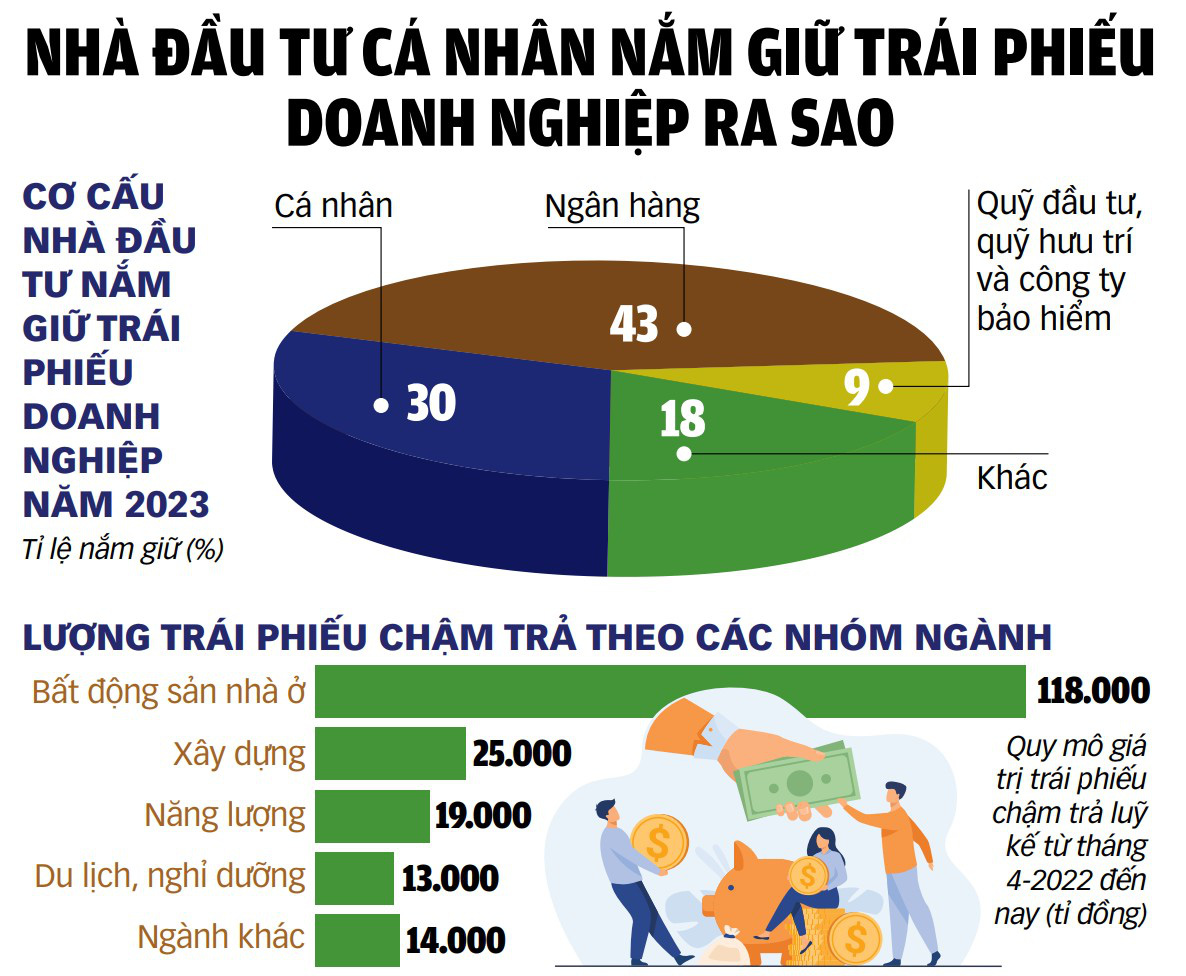
Source: Fiinratings, Vis Rating - Data: BINH KHANH - Graphics: TUAN ANH
Is a bank guarantee feasible?
In addition to credit ratings, according to the draft, issuing companies must have collateral or a payment guarantee from a credit institution to be eligible for individual investors to participate.
Mr. Nguyen Quang Thuan, General Director of FiinRatings, stated that unlike underwriting, payment guarantee means that the guarantor commits to paying part or all of the issuer's debt obligations in the event that the issuer is unable to fulfill its committed debt obligations.
"In the corporate bond market, there have been some bond issues guaranteed by commercial banks, and the rest are mainly corporate guarantees made by companies within the same group to the corporate bond issuer," Mr. Thuan said.
However, according to Mr. Thuan, the number of guaranteed bonds is still small and mainly consists of bonds purchased by insurance companies. Bonds offered to the public are almost never guaranteed by banks or financial institutions with strong financial resources and high credit ratings.
Therefore, Mr. Thuan suggested that Vietnam should consider establishing a legal framework for the creation of several organizations providing credit guarantee services, including bond guarantees, outside of credit institutions. These guarantee organizations could be privately established and operated by major Vietnamese financial and investment institutions and international organizations.
Mr. Huynh Hoang Phuong, advisor on asset management at FDIT, also stated that many bonds have failed to pay principal and interest on time over the past two years, even though the issuers still have collateral assets.
However, the assets pledged as collateral for bonds are mostly tied to the business cycle of the issuer, such as stocks.
Some collateral assets lack liquidity, such as suburban real estate, and even the legal status of the projects used as collateral may not meet the requirements... Therefore, if there is a bank guarantee, privately placed bonds are safer than publicly issued bonds.
However, according to Mr. Phuong, in reality, it will be very difficult to implement. Most organizations will choose the option of providing collateral instead of opting for a bank guarantee. "The fee for a payment guarantee is usually calculated by the bank as a percentage of the guarantee value over the entire guarantee period, so the cost incurred by the issuing company will be very high," Mr. Phuong said.
Valuation activities need to be tightened.
Mr. Huynh Hoang Phuong believes that handling collateral assets is a challenging process, even for banks, not just for bondholders. It requires time, effort, money, and manpower...
Therefore, according to Mr. Phuong, the activities of valuation companies/units should be tightened, with stricter regulations on assessing the value, risks, and legal aspects of assets in issuance documents.
According to Mr. Phan Phuong Nam from the Ho Chi Minh City University of Law, instead of tightening "pre-auditing," a "post-auditing" mechanism is needed. This is because the prominent cases that have eroded public trust in corporate finance recently mainly involved the misuse of funds.
Therefore, it is necessary to improve the mechanism for controlling the use of capital by businesses after issuance. "We need to increase sanctions and take strong measures to handle cases where issuing organizations misuse the funds. There should be timely warnings to investors," Mr. Nam noted.
* Mr. NGUYEN DUC CHI (Deputy Minister of Finance ):
Numerous regulations aim to improve the quality of bonds.

Mr. NGUYEN DUC CHI (Deputy Minister of Finance)
To mitigate risks for individual investors in the private corporate bond market and address past shortcomings, the draft Securities Law includes provisions aimed at improving the quality of bonds.
To allow professional investors, whether individuals or institutions, to participate, we propose that the company issuing the privately placed corporate bonds must have a credit rating.
The company issuing the individual corporate bond must have collateral or a payment guarantee from a credit institution.
We also propose revising the decision-making process for issuing corporate bonds to the public in order to further facilitate the expedited review and certification of eligible businesses for issuing bonds to the public to raise capital.
For publicly issued bonds, all individual and institutional investors, regardless of whether they are professional or non-professional, can participate. However, the new policy requires time for the market to adapt. Therefore, these regulations are expected to be submitted to the National Assembly for approval and take effect from January 1, 2026.
Source: https://tuoitre.vn/thuc-day-phat-trien-thi-truong-trai-phieu-20241030225753083.htm











































































































Comment (0)