

Deputy Minister of Science and Technology Tran Hong Thai said that priority will be given to national and ministerial-level research projects on semiconductor chips to create favorable conditions for master's and doctoral students to receive support when participating in research.
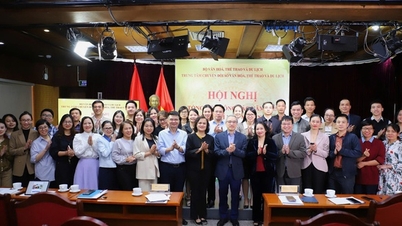
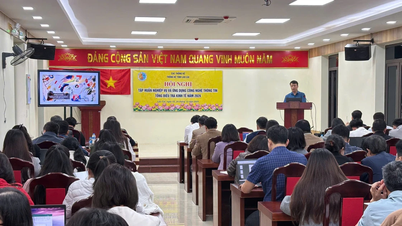
This information was presented at the workshop "Orientation of scientific and technological research and human resource development serving Vietnam's semiconductor industry," organized by the Ministry of Science and Technology in collaboration with Hanoi University of Science and Technology on April 17th.
At the workshop, participants highlighted the high demand for human resources in Vietnam's semiconductor industry. It is predicted that by 2030, Vietnam will need approximately 15,000 engineers for design and 35,000 personnel for manufacturing, packaging, and testing. However, the current supply is limited, necessitating solutions for developing a skilled workforce in semiconductor manufacturing.
Many scientists and businesses believe that the focus should be on training and developing human resources for core R&D (research and development) technology, connecting and forming an ecosystem, and establishing programs and tasks for strong research centers to develop semiconductor products and technologies.
According to Deputy Minister Thai, connecting and training should not only be in-depth but also focus on cultivating human resources and national products. This responsibility and role belongs to the Ministries of Education and Training and Planning and Investment. The Ministry of Science and Technology will provide annual guidance on scientific and technological research related to this field. "Semiconductor microchips are not yet included in the national program catalog, but they are present in many fields such as physics, materials science, and priority technologies," he said, adding that the Ministry of Science and Technology will prioritize national and ministerial-level research projects on semiconductor microchips. This is a way for universities to create opportunities for master's and doctoral students to participate in research with support.
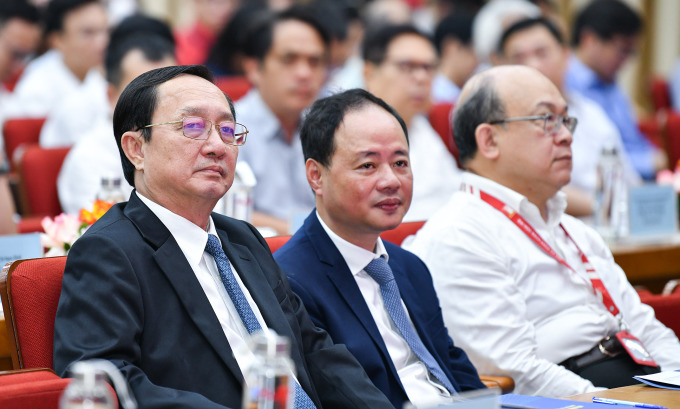
Minister of Science and Technology Huynh Thanh Dat and Deputy Minister Tran Hong Thai (from left) at the workshop on April 17. Photo: Duy Thanh/HUST
Regarding human resource training for the semiconductor chip industry, he said that the Ministry of Science and Technology is not allowed to provide training funding or scholarships, but can support it through research projects. The National Science and Technology Development Fund (Nafosted) identifies five priority areas each year. "In the future, alongside fields such as medicine and genetics, we will prioritize semiconductor microchips," the Deputy Minister said, expressing his desire to form research groups in cutting-edge industries, "which has been lacking in recent years."
"The Ministry of Science and Technology will provide support in various forms, including prioritizing research projects," he added, noting that the Nafosted Fund's program in the coming years will prioritize supporting young research groups. This means that a PhD with a 5-year research project will help pay the salaries of 3 staff members. The salaries may not be high, but this support is essential for their survival and development.
The Deputy Minister suggested that units should find ways to attract national and international experts to participate in research projects, gradually mastering the technology. According to him, although the market is small, there needs to be a clear direction for semiconductor development, for example, supporting universities in building laboratories and planning for the shared use of high-quality laboratories to overcome immediate difficulties.
Vietnam needs to clearly define the current state of its semiconductor chip technology and its position within the production chain. Questions such as whether Vietnam has already begun semiconductor chip production, and whether the world is offering Vietnam the opportunity to become a leading semiconductor chip developer globally and regionally, are being discussed. According to Mr. Thai, Vietnam has virtually no manufacturing involvement in the semiconductor chip technology process chain, only participating in design, packaging, and testing. The added value is low, and the raw materials for production are lacking, while resources remain limited.
While acknowledging the importance of FDI to Vietnam, the Deputy Minister argued that relying solely on FDI would prevent Vietnam from mastering technology and leave it perpetually in the role of supplying low-quality, low-income labor. Therefore, Vietnam needs to gradually learn and master technology.
Nhu Quynh
Source link




























































































Comment (0)