

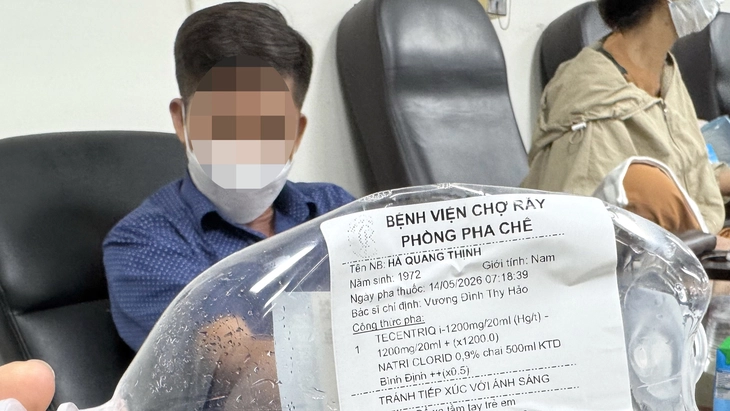
At Cho Ray Hospital, the number of cancer patients treated at the hospital increased by 42% after five years, and notably, the number of chemotherapy sessions increased sharply, by over 73% - Photo: Xuan Mai
When diagnosed with cancer, many people assume that not having the money to pursue the latest generation of drugs means giving up. However, with the solid support of health insurance and a scientific treatment plan, patients still have effective and affordable options.
Clinical practice at tertiary hospitals is proving that the most advanced "weapons" are not necessarily the most suitable, and the opportunity for survival remains wide open for those who understand this journey correctly.
Not everyone can afford the expensive treatment plan.
Speaking to Tuổi Trẻ newspaper, Dr. Le Tuan Anh, Director of the Oncology Center at Cho Ray Hospital (Ho Chi Minh City), said that the number of cancer patients treated at the hospital has increased by 42% in the past five years. The majority of cancer patients use medications covered by health insurance, significantly reducing the financial burden on patients.
The number of patients using expensive, newer generation drugs such as immunosuppressants or targeted therapies is small, as these drugs have strict indications and are not suitable for all cases.
Dr. Tuan Anh noted that cancer treatment is a comprehensive process that requires multidisciplinary consultation to develop a suitable treatment plan, including the total cost of the entire treatment process.
Depending on the individual case, the doctor will decide on the order of treatment, such as surgery, chemotherapy, radiation therapy, immunotherapy, or targeted therapy. It is crucial that patients see the "big picture" of the entire treatment journey so they can prepare financially, find a treatment location, and manage their travel and living arrangements.
Targeted therapy and immunotherapy are conditional treatments, meaning they are not suitable for all patients. There are cases where tests fail to detect a matching gene mutation, making their use impossible even for those with sufficient financial resources.
During consultations, doctors must present suitable options for patients to consider. If financial and health conditions permit, patients are usually given priority for the most effective option.
However, there are cases where cancer patients have access to the best medication but their condition is unsuitable due to liver failure, kidney failure, or other health problems; in such cases, the doctor will switch to the next, more appropriate option.
There isn't a single right treatment option for every case; there's always a priority order in treatment protocols. Typically, there's a first-choice option, followed by second, third, and so on, based on proven effectiveness. Doctors must consider many factors before deciding on the appropriate treatment plan for a patient.

Depending on the individual cancer patient's case, the doctor will decide on the order of treatment, such as surgery, chemotherapy, radiation therapy, immunotherapy, or targeted therapy.
More types of cancer drugs should be added soon to be covered by health insurance.
According to Dr. Vo Duc Hieu, Deputy Director of the Ho Chi Minh City Oncology Hospital, cancer treatment drugs in Vietnam are becoming increasingly diverse and specialized, encompassing not only traditional chemotherapy and hormone therapy but also targeted therapies and new-generation immunotherapy drugs, which are more effective but also have rapidly increasing costs.
The Ministry of Health's licensing of additional cancer treatment drugs (biologic drugs belonging to the immunotherapy group) increases competition, expands choices for patients, and creates opportunities to reduce the cost of generic drugs. This is a global trend, implemented by countries like the US and Europe, not just Vietnam.
Thanks to many new drug classes and new biosimilars, patients—especially those in advanced stages—have benefited significantly not only in treatment outcomes but also in reduced treatment costs. However, the most important thing is to promote early detection and screening, which leads to less expensive and more effective treatment compared to later stages.
Responding to questions from Tuoi Tre newspaper about how to ensure patients have early access to affordable cancer treatment drugs, Ms. Tran Thi Trang, Director of the Health Insurance Department, Ministry of Health, said that although health insurance only covers a portion, including new generation cancer drugs in the list still has great significance for patients.
"These drugs are highly effective but very expensive. The fact that health insurance covers 30-70% of the cost significantly reduces financial pressure and increases access to treatment," Ms. Trang said.
In addition to expanding the range of cancer drugs, the upcoming draft by the Ministry of Health will also add 24 drugs for treating chronic diseases such as cardiovascular disease, diabetes, respiratory diseases, mental illnesses, and urinary tract infections. These are all diseases that require long-term treatment, making the accumulated costs a heavy burden for many families.
According to Ms. Trang, the process of developing the new list of drugs covered by health insurance is being accelerated. Currently, the Ministry of Health has organized about half of the more than 20 expert councils to evaluate drug groups such as cardiovascular, respiratory, oncology, metabolic, and infectious diseases.
"This is a mandatory process to ensure scientific accuracy and precision. Each active ingredient, indication, nomenclature, and condition of use must be carefully reviewed. According to the plan, the expert councils will be completed in May before moving on to the legal review phase to submit to the Ministry of Health leadership for promulgation. The list is expected to be issued in the second quarter," Ms. Trang said.
The Ministry of Health encourages businesses to help cover the co-payment portion of costs not covered by health insurance. "There are some very expensive medications, and insurance only covers a portion, leaving a significant burden on patients. Therefore, encouraging businesses to provide additional support is essential," Ms. Trang said.
She also stated that this is an approach many countries have adopted to increase access to cancer treatments. Some countries have implemented centralized drug price negotiation mechanisms, shared risks between insurance funds and pharmaceutical companies, or established separate support funds for cancer patients.
These solutions not only help reduce treatment costs but also bring long-term socio-economic benefits as patients receive early treatment, reducing complications and maintaining their ability to work.
Focus on prevention rather than treatment.
Dr. Vo Duc Hieu, Deputy Director of the Ho Chi Minh City Oncology Hospital, stated that in order to cope with the projected rapid increase in new cancer cases and deaths (approximately 45% and nearly 50% by 2045), the Vietnamese healthcare system needs to make comprehensive, synchronized, and decisive preparations starting now.
In particular, strengthening cancer screening and public health strategies is crucial and the most cost-effective strategy for reducing the burden of cancer, specifically:
Implement measures to reduce risk factors, such as through communication about healthy lifestyles (diet, exercise, not smoking, limiting alcohol) and controlling environmental factors that cause cancer.
Develop and implement a large-scale cancer screening program: focusing on common and effective cancer screening programs (such as breast, cervical, and colorectal cancer). Particular emphasis should be placed on strengthening the capacity of primary healthcare facilities (commune health stations, regional clinics) in providing initial counseling, screening, and timely referrals...
Strengthening support programs for cancer patients.
Over the past period, the Ministry of Health has worked with many foreign pharmaceutical research and manufacturing units to strengthen cooperation and implement support programs for patients.
In this context, the Permanent Deputy Minister of Health, Vu Manh Ha, proposed that research units collaborate with the Ministry of Health to implement models for early disease screening and detection, initially piloting them in high-risk groups for certain types of cancer.
According to the Deputy Minister, Vietnam is entering a new phase of development with the requirement to continue improving the healthcare system towards equity, quality, efficiency, sustainability, and international integration, with the people at its center.
The Ministry of Health is focusing on several major directions, including improving health institutions and policies, strengthening the sustainability of health financing and universal health insurance; promoting the application of science and technology, digital transformation, and improving the quality of medical examination and treatment; and encouraging the responsible participation of the business community to mobilize more resources for people's healthcare.
Source: https://tuoitre.vn/thuoc-ung-thu-tam-ve-song-dat-do-20260603235634086.htm

![[Photo] General Secretary and President To Lam presides over a meeting with the Central Organizing Committee.](https://vphoto.vietnam.vn/thumb/1200x675/vietnam/resource/IMAGE/2026/06/03/1780482764658_a1-bnd-4741-3342-jpg.webp)



![[Photo] Secretary of the National Assembly Party Committee, Chairman of the National Assembly presides over the meeting of the Standing Committee and Executive Committee of the National Assembly Party Committee.](https://vphoto.vietnam.vn/thumb/1200x675/vietnam/resource/IMAGE/2026/06/03/1780480353201_ndo_br_bnd-2585-jpg.webp)


















































![[Video] Sunset at Lap An Lagoon – Where the sun sets over the fishing nets](https://vphoto.vietnam.vn/thumb/1200x675/vietnam/resource/IMAGE/2026/05/31/1780192137701_beach-landscape-sea-water-nature-grass-745871-pxhere-com.jpeg)






































Comment (0)