

- "Financial passport" for small business owners
- The trend of personalizing financial services.
Commitment to greening
At the COP26 conference in November 2021, the Prime Minister announced a commitment to achieving net zero emissions by 2050. This is not only a significant environmental milestone but also demands a shift in economic development thinking. In this context, the finance and banking sector plays a central role, not only providing capital but also monitoring and guiding businesses towards green transformation.
This pressure is increasing as major export markets such as the EU, the US, and Japan are tightening their requirements for ESG (Environmental, Social, and Governance) standards. According to the World Bank, Vietnam needs to invest an additional 6.8% of GDP annually (equivalent to US$368 billion by 2040) to achieve net-zero emissions. This requires innovative financial policies and close cooperation between the government, banks, and businesses.
In fact, green finance has gradually penetrated the domestic banking system. Many large banks such as BIDV , Vietcombank, and MB Bank have implemented green credit, invested in renewable energy, sustainable agriculture, and even issued green bonds to raise capital from international organizations.

Vietcombank is implementing a green credit support program, creating favorable conditions for businesses to invest in clean production models.
Accordingly, BIDV is one of the leading banks in green finance, not only accompanying the Government in commitments to combat climate change but also leading the market with a total green credit outstanding of over 74 trillion VND by the end of 2023, accounting for 12% of the total green credit outstanding in the entire economy.
Notably, BIDV is the first Vietnamese bank to successfully issue green bonds under ICMA standards, totaling VND 2,500 billion. Following this success, BIDV launched a green deposit product, raising VND 3,000 billion in the first tranche of 2024. This capital is committed to energy-saving and environmental protection projects, helping businesses achieve sustainable development while enhancing their competitive advantage.
VPBank is implementing green credit, targeting environmentally friendly projects such as renewable energy, green buildings, waste treatment, and sustainable agriculture and forestry. VPBank is building a green credit framework with a strict capital management process, ensuring that loans truly serve the purpose of sustainable development.
With its focus on the agricultural sector, Agribank has prioritized funding for green projects over the years, financing numerous wind power, solar power, and small-scale hydropower projects. The bank also flexibly provides credit and financial advice to farmers and businesses following clean agricultural models. Currently, Agribank has supported funding for over 40,000 green agricultural models nationwide.
In addition, Vietinbank launched the Green Deposit product, applicable to time deposits and demand deposits in VND, USD, and EUR. Ms. Le My Phuong Uyen, Head of the Product and Service Team at Vietinbank's Ca Mau Branch, said: "The Green Deposit product not only helps the bank mobilize sustainable capital but also creates a bridge for businesses to partner in green development strategies."
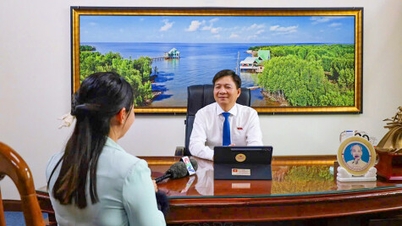
Mr. Le Quan Thuong, Director of VPBank's Ca Mau Branch, shared: “Green finance is not just a trend, but also a responsibility of banks in shaping a sustainable economy. Banks not only provide capital but also accompany businesses in the green transformation process, helping them access preferential financial sources, advanced technology, and opportunities for sustainable development. The bank's goal is to build a comprehensive green finance ecosystem where both large and small businesses can access resources for development while ensuring responsibility towards the environment and society.”

"Green deposits" are a sustainable partnership with Vietinbank.
Drivers of innovation and challenges
Although commercial banks have made significant strides in implementing green finance, achieving sustainable development goals requires a synchronized ecosystem in which the government, businesses, and banks work together.
Currently, green finance support policies in Vietnam are still under development. The State Bank of Vietnam has issued Circular 17/2022/TT-NHNN on green credit activities, but more specific incentive mechanisms are needed, such as preferential interest rates, tax exemptions for green loans, or certification as a "Green Enterprise," to increase attractiveness. In addition, banks need to standardize criteria for evaluating green projects, ensuring that capital flows are truly directed towards areas that have a positive impact on the environment. Currently, the evaluation criteria are inconsistent, making it difficult for businesses to access green credit.
Alongside the shift towards green credit, banks are also actively applying digital technology for more effective management and monitoring. Artificial intelligence and big data can help assess a company's ESG compliance, thereby optimizing its green investment portfolio. Accordingly, some banks have experimented with blockchain data in tracking and transparentizing green finance flows. This solution helps reduce fraud and increase efficiency in managing loans geared towards sustainable development.
Green finance is not only for large enterprises but also needs to reach small businesses and individual households. However, in reality, this group faces difficulties in meeting the stringent criteria of green credit, especially the environmental reporting requirements. To overcome this obstacle, some banks have begun to implement more flexible green credit packages. For example, Agribank offers preferential loans specifically for farmers applying organic production models or water-saving technologies. Vietcombank has implemented a green credit program for small businesses in the field of plastic waste recycling, contributing to promoting the circular economy.
Vietnam is facing a great opportunity to develop green finance, but also numerous challenges. To realize the Net Zero commitment by 2050, a comprehensive strategy is needed, in which banks not only act as capital providers but also as strategic partners with businesses in the green transformation process. In the coming period, perfecting the legal framework, diversifying green finance products, and supporting small and medium-sized enterprises (SMEs) in accessing capital will be crucial factors in making green finance a truly sustainable driving force for the Vietnamese economy.
Viet My
Source: https://baocamau.vn/tiem-nang-phat-trien-tai-chinh-xanh--a37755.html






























































































Comment (0)