For the past 80 years, the song has become "the people's anthem," according to composer Van Cao. Children learn the song by heart from their first days in school. The piece opens all important ceremonies and events of the country, expressing solemnity and national pride.
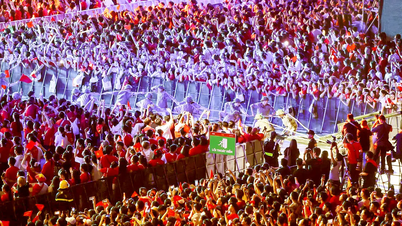
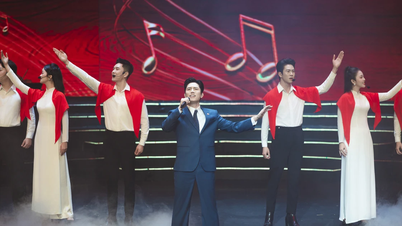
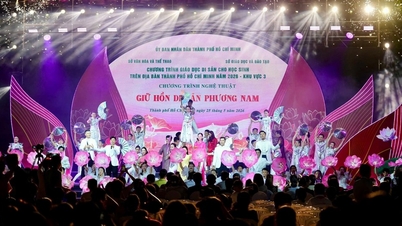
On August 10th, during the "Homeland in My Heart" concert , the image of over 50,000 people singing "Tien Quan Ca" (Marching Song) evoked strong emotions in the audience. In August 2023, during the 100th anniversary of composer Van Cao's birth, thousands of artists and audience members also sang the song in the August Revolution Square. The performance recreated the moment the national anthem ( Tien Quan Ca ) was first performed during a rally in Hanoi on August 19, 1945, to show support for the Viet Minh front. In recent years, many different arrangements of the song have emerged, all retaining its majestic and powerful tone.
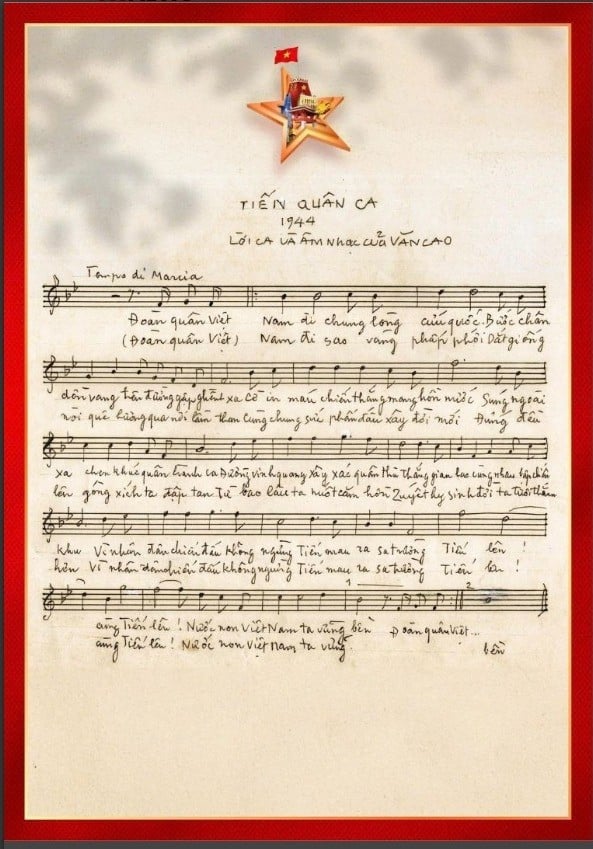
A handwritten copy of "Tiến quân ca" (Marching Song) by composer Văn Cao, printed on the tickets for the "Homeland in My Heart" concert. Photo: Provided by the organizers.
The work was created in the winter of 1944, when composer Van Cao was auditing classes at the Indochina College of Fine Arts, earning a living by selling paintings and writing poetry and short stories. During his time in Hanoi, he stayed with friends. At that time, Hanoians were suffering from hunger, so Van Cao's paintings didn't sell well. Every day, he had to rely on his artist friends for food and help with his work.
He was persuaded to join the revolution by Vu Quy, a Viet Minh cadre. While Van Cao was eager to take up arms and fight, Vu Quy assigned the musician a cultural task: to compose a marching song to boost the morale of the resistance army.
In his memoir, "Why I Wrote the Marching Song," the composer recounts the afternoon after receiving his assignment. He wandered the streets until the streetlights came on. Seeing the impoverished figures, including a child, wandering aimlessly by the roadside, he remembered his three-year-old nephew who had gone missing, and tears welled up in his eyes. That night, he wrote the first notes of the Marching Song .
He wrote the song in the cramped attic of house number 45 Nguyen Thuong Hien, by a window overlooking a two-story house. Here, the musician often heard the sound of ox carts carrying the corpses of those who had died of starvation to Kham Thien.
"I haven't held a gun, I haven't joined any armed unit. I'm just writing a song. I haven't been to the war zone, only the streets of Ga Street, Hang Bong Street, and Hoan Kiem Lake Street that I'm used to walking on. I haven't met our revolutionary soldiers from that first military training course. And I know how they sing. Here, I'm thinking about how to write a simple song that they can sing," the musician wrote.
He wrote and edited the song for days, during the gloomy winter months, with the first lines:
"The Vietnamese army marches on."
United in heart to save the nation.
"Footsteps resound on the long, rugged road."
In the second verse, he imagines the image of the red flag with a yellow star fluttering amidst the green of the mountains and forests:
"The Vietnamese army marches on."
The golden star flutters
"Leading our people and homeland out of suffering."
The composer wanted the song to be not only for the students of the anti-Japanese military training course and the soldiers fighting, but for the entire nation, hence the line "Forward! Let's move forward together." After finishing the song, he entrusted it to officer Vu Quy. That afternoon, the composer also received the task of managing the secret Phan Chu Trinh printing house, designing the newspaper Doc Lap (Independence) and printing documents for the Viet Minh front. Poet Nguyen Dinh Thi was in charge of the newspaper's content. Because the scribe couldn't transcribe the musical score, composer Van Cao had to go directly to the secret printing facility in Bat Trang village to personally write and print the " Marching Song" in the first issue of Doc Lap . The song was then sent to battlefields throughout the country.
In August 1945, the Central Committee of the Party and President Ho Chi Minh convened the National Congress in Tan Trao. Poet Nguyen Dinh Thi presented three songs: " Destroy Fascism," which he composed himself, along with " Viet Minh Soldier" and "Marching Song" by Van Cao. President Ho Chi Minh decided to choose "Marching Song" as the national anthem.
On August 19, 1945, before the people of Hanoi marched to seize power at the Northern Government House, composer Van Cao conducted the Young Pioneers Choir to perform a song in the August Revolution Square.
On September 2, 1945, at Ba Dinh Square, tens of thousands of people sang songs and listened as President Ho Chi Minh read the Declaration of Independence, giving birth to the Democratic Republic of Vietnam.
Composer Văn Cao wrote in his memoirs: "When I heard the voices of tens of thousands of people singing, I was deeply moved and tears welled up in my eyes. And I understood that the national anthem, or 'Marching Song,' was no longer mine; it now belonged to the people."
On March 2, 1946, the National Assembly held its first plenary session at the Grand Theatre, electing a new government with President Ho Chi Minh as its chairman. During the session discussing the national anthem , some delegates suggested Hung Lan's " Vietnam, the Pearl of the Eastern Sky" as a replacement. Composer Nguyen Dinh Thi immediately stood up and led the singing of "Tien Quan Ca" (Marching Song) , and the entire hall joined in. No one mentioned changing the national anthem again.
In 1981, a massive campaign was launched to compose a replacement for the national anthem , but ultimately, the National Assembly decided to retain " Tien Quan Ca" ( Marching Song). For the past 80 years, the work has been intertwined with the nation's history, creating deep memories for many generations of Vietnamese people.
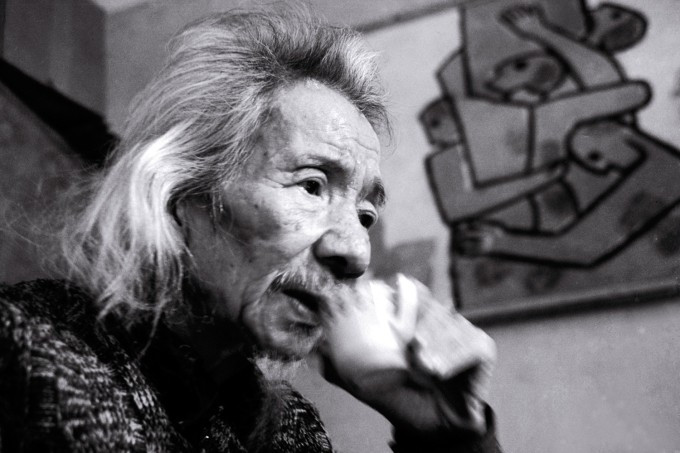
Composer Văn Cao. Photo: Photographer Nguyễn Đình Toán
Composer An Hieu – son of composer An Thuyen – believes the song has become a symbol of the nation's vitality and the character of the Vietnamese people. "The lyrics are simple yet profound, affirming patriotism. The melody is easy to remember, easy to learn, and relatable to the masses. The song's structure is tight. I always feel a lot of emotion when I listen to this song," the composer said.
In accordance with the composer's wishes, in 2016, his wife and children donated the "Marching Song" to the State.
Composer Văn Cao was born on November 15, 1923, in Hai Phong and passed away on July 10, 1995. He was an influential artist in Vietnamese modern music and is considered a model of genius in the history of culture and arts. Although not formally trained in music, he showed his talent before the age of 20 with romantic lyrical songs such as "Bến xuân," "Suối mơ," "Thiên Thai," and "Trương Chi."
After joining the revolutionary movement at the age of 21, he composed many heroic songs such as " Marching Song , " "Epic of the Lo River ," "Marching Towards Hanoi," and "My Village." Besides composing music, he also wrote poetry, painted, and wrote for newspapers. Composer Van Cao was posthumously awarded the Ho Chi Minh Prize for Literature and Arts in 1996.
Source: https://baohatinh.vn/tien-quan-ca-bai-hat-gan-voi-lich-su-dan-toc-post294888.html


![[Photo] The heat at the fireworks display site on the opening night of the Da Nang International Fireworks Festival 2026](https://vphoto.vietnam.vn/thumb/1200x675/vietnam/resource/IMAGE/2026/05/27/1779889741485_ndo_br_z7872039145157-fecaba5112f39e8352544099d7ef4738-5140-jpg.webp)

![[Photo] The courage of new recruits of Brigade 144 on the training ground.](https://vphoto.vietnam.vn/thumb/1200x675/vietnam/resource/IMAGE/2026/05/27/1779881651341_anh-man-hinh-2026-05-27-luc-18-32-52.png)




















































![[Photo] The courage of new recruits of Brigade 144 on the training ground.](https://vphoto.vietnam.vn/thumb/402x226/vietnam/resource/IMAGE/2026/05/27/1779881651341_anh-man-hinh-2026-05-27-luc-18-32-52.png)



























Comment (0)