

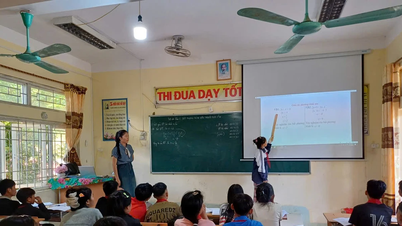
100% of schools organize compulsory foreign language 1 instruction starting from grade 3.
Regarding the report on improving the quality of foreign language teaching and learning, especially English, the Ministry of Education and Training stated that it has issued a directive to improve the quality of foreign language teaching and learning, particularly English, at all levels of education and training. It is researching and developing projects and plans to gradually make English the second language in schools; identifying this as one of the key tasks for the 2024-2025 academic year.
At the same time, the Ministry of Education and Training has conducted research and developed the Project "Making English the second language in schools in the period 2025-2035, with a vision to 2045," which is currently being submitted to the Prime Minister for promulgation.
At the primary school level, following the directives of the Ministry of Education and Training, localities are actively implementing a comprehensive set of solutions to improve the quality of foreign language teaching and learning.
However, the number of students studying English in grades 1 and 2 decreased slightly compared to the 2023-2024 school year because the compulsory English program is being implemented in grades 3, 4, and 5, so schools prioritize teachers to implement the compulsory program.
Local authorities have been actively implementing the mandatory foreign language teaching for grades 3, 4, and 5 according to the 2018 General Education Program. As a result, 100% of schools have organized the teaching of a mandatory first foreign language in grades 3, 4, and 5, with English being the majority. The percentage of students learning other foreign languages (French, Chinese, Korean, Japanese) is only 0.2%.
For lower secondary and upper secondary levels, continue to vigorously innovate and improve the quality of English teaching and learning, encouraging the teaching and learning of other subjects in English to enhance language application in academic and practical contexts. Ensure that English teaching and learning, as well as teaching and learning in English, are designed in a synchronized, interconnected, and consistent manner from primary school.
English is being used increasingly widely, naturally, and effectively in teaching, education, and communication activities within schools.
Although it is no longer a compulsory subject in the 2024-2025 high school graduation exam, more than 352,000 out of over 1,132,000 candidates still take the exam, ranking third among the optional subjects.
This reflects the role of English and the awareness of society, students, and parents regarding the importance of English in academics and careers after students leave high school.
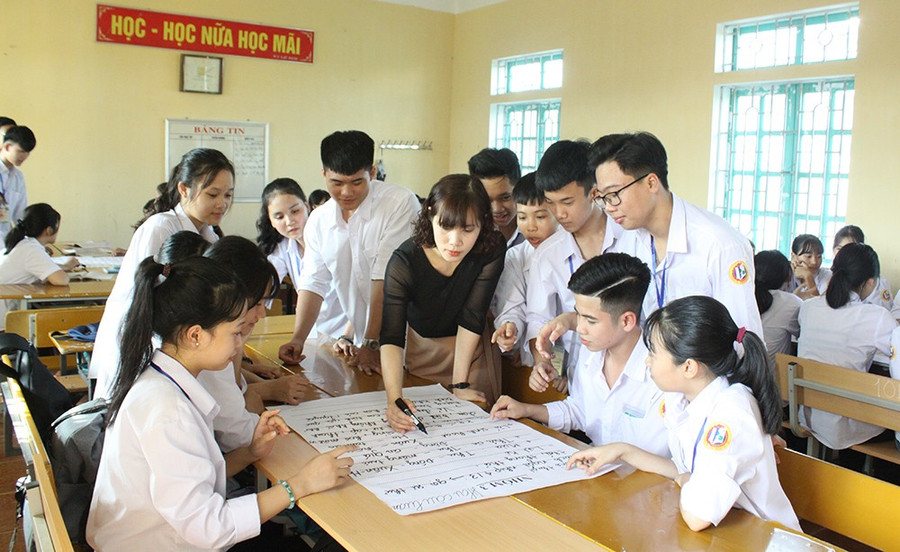
Applying various learning methods flexibly.
According to the Ministry of Education and Training, in general, educational institutions have flexibly applied various learning methods based on the shortage of teachers to implement the program.
Some solutions include: utilizing online lecture repositories and electronic learning materials for English to organize online learning for students with the support of school teachers; implementing online teaching and in-person learning through virtual classrooms, equipping teachers with the technological conditions to teach more than one class at a time in different geographical locations; and strengthening the organization of teaching through television interspersed with other forms of learning.
The Ministry of Education and Training also stated that localities are currently continuing to recruit, transfer, and train staff to ensure the organization of foreign language teaching for students in accordance with the 2018 General Education Program.
The infrastructure for teaching and learning has been improved, and now it is basically ensured for nearly 100% of schools; the remaining deficiencies that need to be addressed are generally within the investment capacity of the localities without encountering too many difficulties.
Despite the achievements, English language teaching in schools still faces challenges. Specifically, for English teaching at the primary school level: there is a shortage of teachers nationwide. Primary schools in remote and rural areas often have multiple campuses and scattered locations, making it difficult to allocate teachers. The English proficiency of teachers is uneven, with some teachers in remote areas not meeting the required training standards.
Regarding English language teaching at the lower and upper secondary levels: there are still regional disparities in teacher quality. Attracting qualified teachers remains challenging due to inconsistent policies that are not attractive enough to encourage teachers to work in disadvantaged areas.
Source: https://giaoducthoidai.vn/tieng-anh-duoc-su-dung-hieu-qua-trong-hoat-dong-day-hoc-post742115.html

![[Photo] Prime Minister Pham Minh Chinh presides over the conference announcing the establishment of the International Finance Centre in Vietnam.](/_next/image?url=https%3A%2F%2Fvphoto.vietnam.vn%2Fthumb%2F1200x675%2Fvietnam%2Fresource%2FIMAGE%2F2025%2F12%2F21%2F1766309817714_ndo_br_dsc-3400-jpg.webp&w=3840&q=75)
![[Photo] Prime Minister Pham Minh Chinh presides over a meeting on private sector economic development.](/_next/image?url=https%3A%2F%2Fvphoto.vietnam.vn%2Fthumb%2F1200x675%2Fvietnam%2Fresource%2FIMAGE%2F2025%2F12%2F20%2F1766237501876_thiet-ke-chua-co-ten-40-png.webp&w=3840&q=75)
























































































Comment (0)