The friendship between Vietnam and the Soviet Union (Viet-Soviet) was a comradeship, a noble and pure proletarian international friendship, stemming from the ideals of fighting for national liberation and advancing towards socialism.
That sentiment stemmed from the process of searching for a way to save the country, which Nguyen Ai Quoc encountered and formed through the absorption of Marxism-Leninism and the practical experience of the Russian October Revolution. From within the long night of slavery, Vietnam found its revolutionary path: "To carry out a bourgeois democratic revolution and an agrarian revolution to advance towards a communist society."
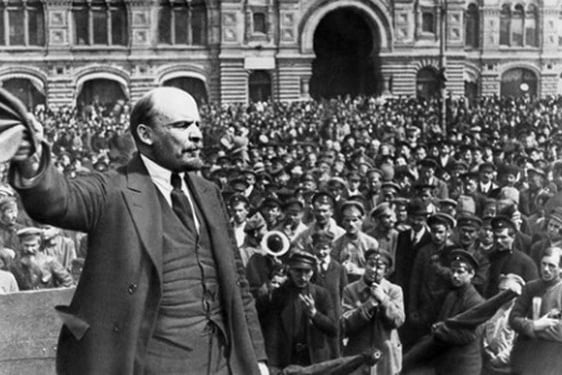
Lenin speaking to the people in Petrograd in 1917 (archival photo).
The October Revolution in Russia shattered a crucial link in the chain of capitalism, ushering in a new era for humanity: the era of socialism. Therefore, after the birth of the worker-peasant state, internal enemies, in collusion with foreign invaders, attempted to stifle the revolutionary government in its infancy. However, under the leadership of the Bolshevik Communist Party and the brilliant leader V.I. Lenin, the Russian Soviet state not only stood firm but, in 1922, expanded to include 16 republics, forming the Union of Soviet Socialist Republics (USSR).
Rising from a poor, multi-ethnic capitalist country, the Soviet Union became a powerful socialist state, a world power that defeated fascism in World War II. This great victory opened up a new world order, giving rise to the socialist system and creating opportunities for many countries to rise up and gain national independence, including Vietnam.
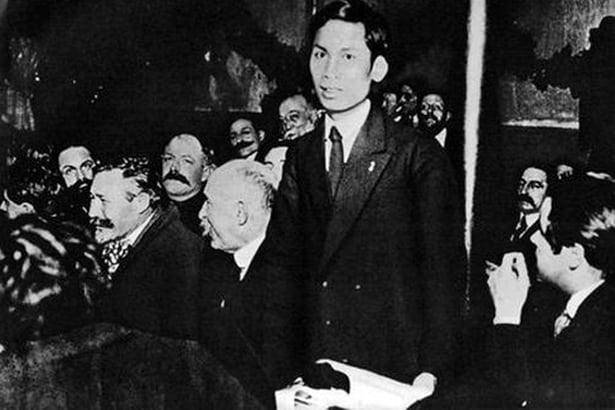
Leader Nguyen Ai Quoc at the National Congress of the French Socialist Party in Tours (France), December 1920. Archival photo.
With his vision for the times, Nguyen Ai Quoc - Ho Chi Minh sought to transform the banner of the Russian October Revolution into an ideal that called upon the entire nation to rise up. Immediately after its founding, the Communist Party of Vietnam launched a revolutionary movement with the goal of establishing a worker-peasant government modeled after the Soviet Union, culminating in the Nghe An - Thinh Hoa Soviet.
Although victory was not achieved, this was a rehearsal to prepare forces in all aspects, seizing the opportunity to rise up and seize power. When the Soviet Union defeated Nazi Germany, and at the same time that the Japanese fascists in Indochina surrendered, before the Allied forces could disarm them, the Viet Minh Front launched a successful general uprising; boldly declaring to the world the birth of the Democratic Republic of Vietnam. The August Revolution was a brilliant combination of preparing forces domestically and seizing the opportunity when the Soviet Union defeated Nazi Germany in World War II.
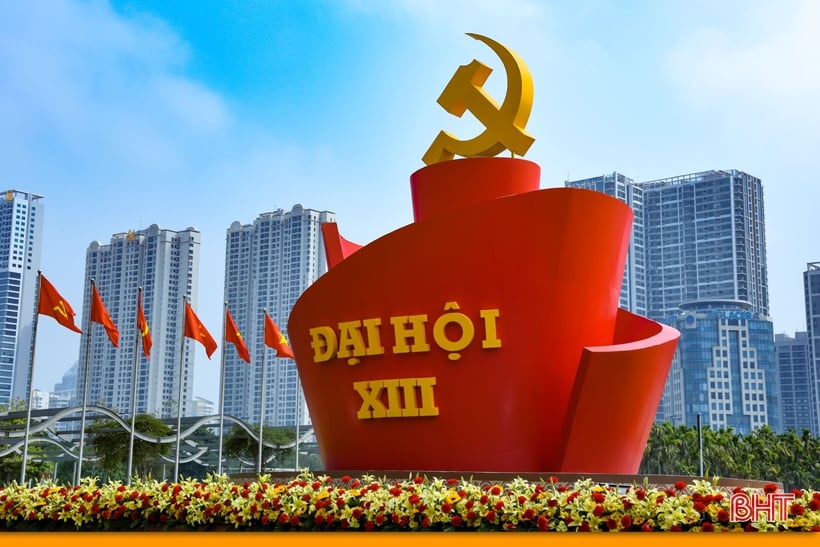
Under the leadership of the Communist Party of Vietnam and President Ho Chi Minh , the Vietnamese revolutionary cause achieved great victories of historical significance (illustrative image).
During the two wars of resistance against French colonialism and American imperialism, the Soviet Union wholeheartedly and selflessly assisted Vietnam in all fields. Every year, the Soviet Union provided Vietnam with a large quantity of weapons and ammunition. Three-quarters of the weapons used by Vietnam, including aircraft, missiles, tanks, armored vehicles, ammunition, and modern equipment, were from the Soviet Union. In addition, the Soviet Union trained over 50,000 scientific and technical personnel in all fields (of which more than 30,000 had university and postgraduate degrees), many of whom became leaders, managers, and scientists of the country.
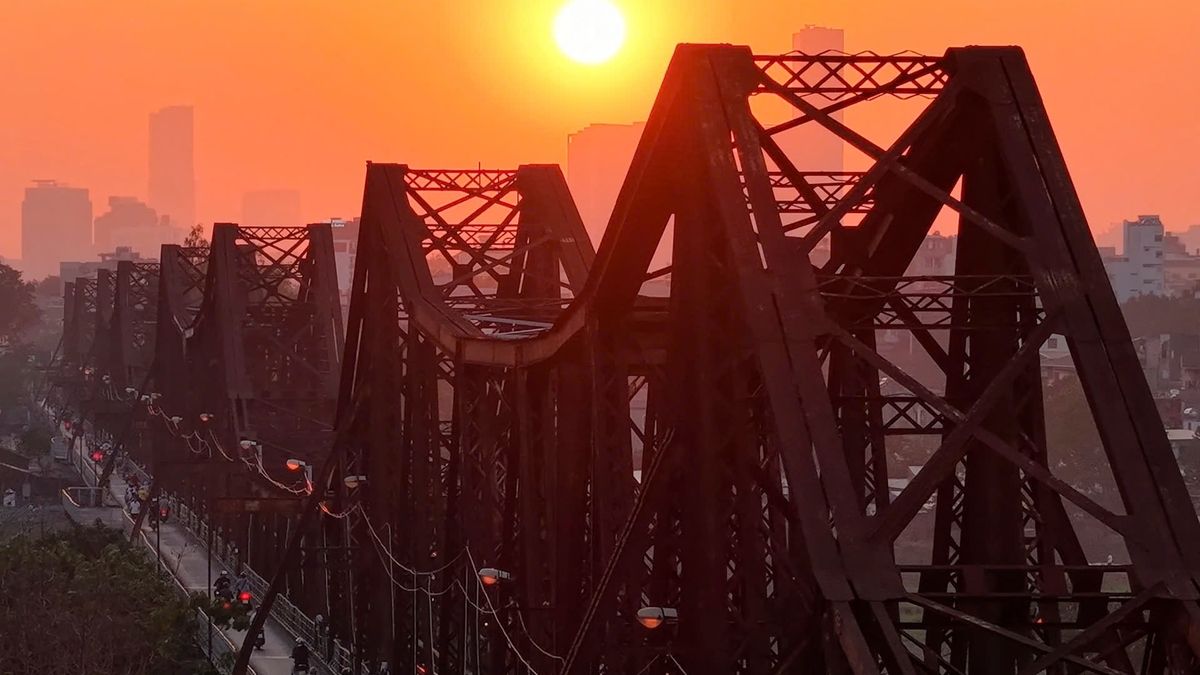
Economically, the Soviet Union provided Vietnam with loans and aid totaling over 55 billion USD; generously assisted Vietnam in oil and gas exploration and exploitation with modern technology and a skilled workforce of managers, scientists, and technicians; and directly aided in the construction of major projects such as the Song Da hydroelectric power plant, Thang Long bridge, Hanoi University of Technology, Vietnam-Soviet Friendship Hospital, etc.
In particular, while Vietnam was helping Cambodia fight against the Pol Pot regime, and was virtually isolated and sanctioned by the world, at that time (1978), the Soviet Union signed the Vietnam-Soviet Friendship Treaty. During the process of "reform," due to the emergence of opportunism and abandonment of Marxism-Leninism among high-ranking officials, and being exploited by the enemy to undermine the country, the Soviet Union collapsed. Vietnam implemented a policy of reform while maintaining the principle of national independence and advancing towards socialism on the basis of creatively applying Marxism-Leninism and Ho Chi Minh Thought.
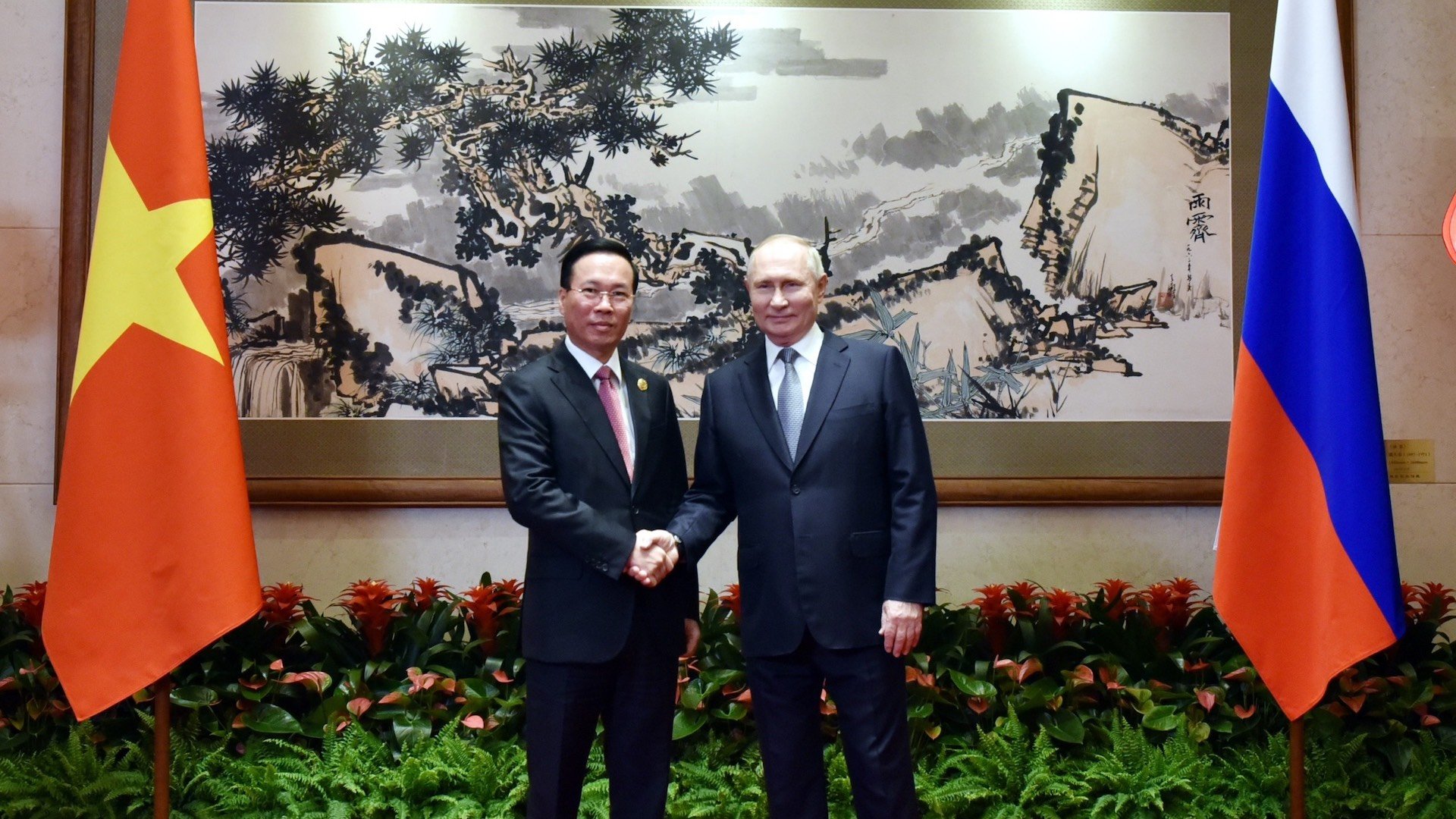
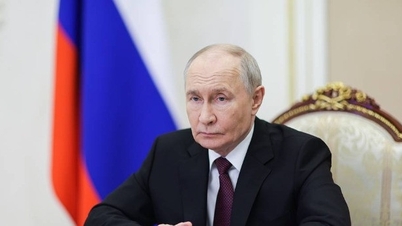
President of the Socialist Republic of Vietnam Vo Van Thuong meets with President of the Russian Federation Vladimir Putin, October 17, 2023. (Photo: VNA).


Despite the collapse of the Soviet Union, relations between Vietnam and the Russian Federation have been maintained and developed under new conditions. President Vladimir Putin and other Russian leaders still consider Vietnam a comrade, and the two countries have upgraded their relationship to a comprehensive strategic partnership. Russia sells approximately 70% of its modern weapons to Vietnam; continues to expand cooperation in oil and gas exploration; and has announced the cancellation of Vietnam's debt (nearly $11 billion). During the COVID-19 pandemic, Russia provided Vietnam with tens of millions of doses of vaccines, medicines, and coordinated treatment protocols. Although there is an ongoing military conflict between Russia and Ukraine, cooperation between Russia and Vietnam remains strong and based on mutual trust. The two countries continuously send high-level delegations to visit each other, exchange views, and sign cooperation agreements in various fields in the new context.
We believe that the precious and enduring friendship between Vietnam and the Soviet Union in the past, and between Vietnam and Russia today, which originated from the Russian October Revolution, will continue to flourish throughout history, remaining an invaluable asset of both nations that will forever shine brightly. Vietnam and the Russian Federation will always stand side by side with unwavering loyalty and devotion, fighting together to defend the independence and freedom of each country, and are making important contributions to the goal of forming a multipolar world for the legitimate interests of all nations, in line with the progress of the times and of progressive humanity.
Dr. Dang Duy Bau
Dr. Dang Duy Bau
Source


![[Photo] Prime Minister Le Minh Hung presides over the thematic session on promoting science and technology development and innovation.](https://vphoto.vietnam.vn/thumb/1200x675/vietnam/resource/IMAGE/2026/06/23/1782207872934_ndo_br_dsc-1724-jpg.webp)