

Amidst electricity supply constraints, the National Power System and Market Operator (NSMO) has proposed implementing a new peak, off-peak, and normal timeframe starting in June 2026 to regulate electricity demand away from peak hours between 5:30 PM and 10:30 PM.
Production should be shifted to off-peak hours.
According to the National Power Grid Management Authority (NSMO), given that the national power grid's electricity consumption on May 25th could reach 1.136 billion kWh and the peak power of the national power grid at 9:30 PM reached 53,503 MW, the NSMO ordered the start-up of expensive oil-fired generating units including S1 and S2 O Mon I (using fuel oil) to ensure availability for the national power grid and to connect to the grid before 7:00 AM on May 25th to meet peak demand. The remaining oil-fired generating units, including S1-3, GT4-5 Thu Duc (DO), S4 Can Tho (FO), and GT1-4 Can Tho (DO), will continue to be mobilized as needed.
Previously, at the end of April, the Ministry of Industry and Trade issued Decision 963/QD-BCT stipulating that peak hours during the day would be concentrated in the evening, from 5:30 PM to 10:30 PM. Meanwhile, off-peak hours would be applied from 0:00 AM to 6:00 AM.
Mr. Bui Trung Kien, Deputy General Director of Ho Chi Minh City Power Corporation (EVNHCMC), said that adjusting the peak hours does not change the total application time (approximately 5 hours/day), but only shifts it from daytime to evening.
This change has a positive impact on the manufacturing and business sector. Previously, peak hours from 9:30 AM to 11:30 PM coincided with continuous production. By shifting to evening hours, businesses can proactively adjust shifts to avoid peak hours, thereby reducing electricity cost pressure. For businesses with stable 24/7 electricity demand, this change will hardly make a significant difference.
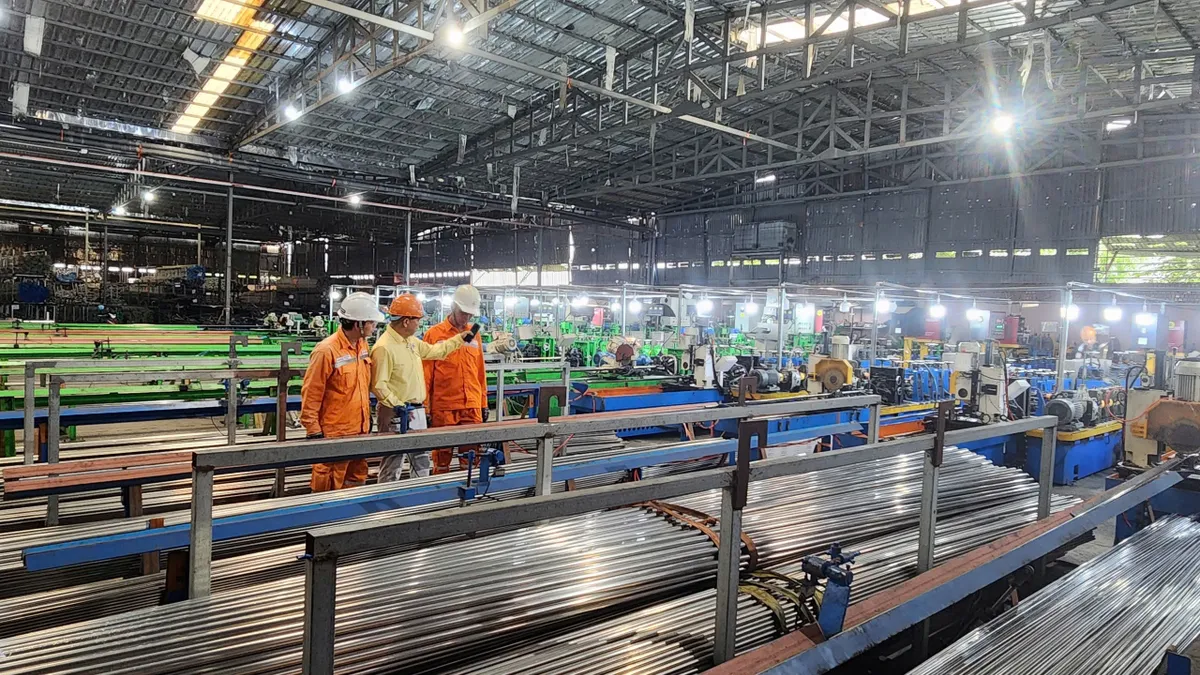
The electricity sector is supporting manufacturing and business enterprises in planning to adapt to the new peak hours expected to be implemented from June 2026. Photo: LE TINH
Mr. Kien also noted that because the new regulations have just been issued and have not yet been officially applied, businesses still have time to proactively develop more suitable operating plans than before. However, the group more clearly affected are service establishments such as restaurants, hotels, bars, karaoke venues, etc., because their electricity consumption is concentrated in the evening, coinciding with the new peak hours. Nevertheless, this is not a negative impact but rather an incentive for these establishments to adjust their operations and invest in appropriate solutions.
Mr. Kien advised businesses and households using electricity for commercial and production purposes to shift high-power consumption activities to off-peak hours and limit the operation of high-power machinery during peak hours. This would also contribute to promoting the trend of using solar power combined with energy storage systems. Currently, the power system has received a large proportion of solar power, creating conditions to reduce pressure during peak daytime hours.
Therefore, businesses, especially in the service sector, can utilize solar power during the day, store it, and use it at night to save costs. "This solution not only helps businesses proactively secure their electricity supply and reduce costs but also contributes to easing the burden on the national power grid. Overall, the manufacturing sector is largely unaffected, while the service sector is encouraged to adapt and invest in more efficient electricity use," Mr. Kien shared.
There are plans to adapt.
From the perspective of businesses using electricity for production and business, Mr. THP, the owner of an ice factory in Ho Chi Minh City, expressed concern that if the peak hour calculation method changes from June 1st, his factory will certainly see an increase in electricity costs due to the current peak hot season, requiring maximum capacity operation. This will narrow the profit margin of the business because it will be difficult to adjust selling prices in a highly competitive environment, and many contracts have already been finalized at the beginning of the year.
To mitigate the impact, Mr. P. said he is reviewing the entire operational process, temporarily shutting down non-essential equipment during peak hours, and rearranging employee shifts to optimize electricity consumption. He also hopes that any future changes related to electricity prices or pricing schedules will be announced earlier so that businesses can proactively prepare.
Additionally, Mr. P. is considering installing solar power but is hesitant due to the small size of his workshop and concerns about monthly maintenance, which could affect security control at the workshop.
In the food sector, Mr. Truong Chi Thien, General Director of Vinh Thanh Dat Food Joint Stock Company, said that the company mainly produces during the day, so the impact is not too significant. The company is planning to shift work shifts earlier by 30 minutes to 1 hour to complete most operations before 5:30 PM - the start time of the new peak hour.
According to Mr. Thien, this solution is quite feasible because most workers are renting accommodation near the factory. At the same time, the company also hopes that the procedures for investing in solar power for businesses will continue to be simplified so that a system suitable for existing production conditions can be deployed soon.
In the wood processing industry, Mr. Dang Minh Lanh, Director of New GBI Furniture Co., Ltd., said that many export orders require tight deadlines, so businesses often have to organize continuous production day and night. For orders with more flexible timelines, the company prioritizes scheduling machine-intensive processes during off-peak hours, while only manual tasks requiring less electricity are performed during peak hours. The company is also implementing a plan to install solar power to reduce energy costs and proactively secure a power source for production. "I hope the management agency will study a policy of preferential electricity prices for businesses that actively shift their load to off-peak hours," Mr. Lanh expressed.
Similarly, Mr. Hoang Van Thuy, Chairman of the Board of Directors of Dai Hoang Thuy Coffee Group, said that high-capacity equipment will be prioritized for operation outside of peak hours to reduce costs.
According to Mr. Thuy, the group has just invested over $25 million to build its third factory in Tan Thoi Hiep Industrial Park (Ho Chi Minh City), with a designed capacity of 25,000 tons per year. The production lines, imported from Germany and Japan, have high efficiency, and combined with a rooftop solar power system, significantly reduce electricity consumption.
However, according to Mr. Thuy, the current pressure comes not only from electricity costs but also from the sharp increase in the price of raw materials, packaging, and imported supplies, with some items increasing by up to 60%. Meanwhile, businesses find it difficult to raise selling prices accordingly for fear of affecting their competitiveness. Therefore, he suggested that solutions to stabilize raw material prices and appropriate tax policies are needed to support businesses in maintaining production and expanding their markets.
Addressing concerns from electricity users regarding the new peak-hour pricing scheme, Mr. Bui Trung Kien affirmed that the time-based electricity pricing only applies to non-residential customers such as those engaged in production and business activities who have installed three-tiered electricity meters.
Furthermore, residential electricity prices are not calculated based on peak hours but on a tiered system, depending on the electricity consumption of the customer. Therefore, families and individuals using electricity for residential purposes pay the same price for both day and night. However, people should still use electricity economically to avoid being charged at higher tiers, which can lead to higher electricity bills during the hot season.
Mr. Nguyen Le Nhat Chi Chung, Director of U-Solar Solutions Trading Company Limited, stated that in the context of continuously increasing electricity demand, combining solar power systems with battery energy storage systems (BESS) is considered an effective solution to reduce pressure on the power grid and optimize electricity costs.
According to Mr. Chung, restaurants and hotels are considered the biggest beneficiaries of investing in BESS systems because the payback period is only about two years. Even without solar power, businesses can still take advantage of the hourly electricity pricing mechanism by charging batteries during off-peak hours and discharging electricity during peak hours. Calculations show that this option can recoup its investment after approximately 4-4.5 years of operation.
The trend of investing in BESS systems is also increasingly appearing in factories that operate at night. Currently, the investment cost for BESS in the industrial sector ranges from approximately 140 to 200 USD/kWh, equivalent to 3.6 to 5.2 million VND/kWh, depending on the technology and brand. "Although the initial cost is still quite high, the demand for investment is clearly increasing," Mr. Chung said.
Source: https://money.vtv.vn/tinh-toan-ne-gio-cao-diem-su-dung-dien-109260526131901995.htm

![[Photo] The heat at the fireworks display site on the opening night of the Da Nang International Fireworks Festival 2026](https://vphoto.vietnam.vn/thumb/1200x675/vietnam/resource/IMAGE/2026/05/27/1779889741485_ndo_br_z7872039145157-fecaba5112f39e8352544099d7ef4738-5140-jpg.webp)


![[Photo] The courage of new recruits of Brigade 144 on the training ground.](https://vphoto.vietnam.vn/thumb/1200x675/vietnam/resource/IMAGE/2026/05/27/1779881651341_anh-man-hinh-2026-05-27-luc-18-32-52.png)






















































![[Photo] The courage of new recruits of Brigade 144 on the training ground.](https://vphoto.vietnam.vn/thumb/402x226/vietnam/resource/IMAGE/2026/05/27/1779881651341_anh-man-hinh-2026-05-27-luc-18-32-52.png)
































Comment (0)