


Dong Hoa has become the first new rural commune in An Giang province to have a shrimp farming area that has received international ASC certification.
Standing beside his family's shrimp pond, Mr. Nguyen Van Khanh, Chairman of the Board of Directors and Director of the Thanh An Shrimp-Rice Cooperative in Dong Hoa commune, was inspecting the water channels leading into the pond while slowly recounting the story of producing shrimp that meet international standards, in the voice of someone who has spent almost his entire life farming. "In the past, who would have thought that shrimp from this region could be exported abroad?" Mr. Khanh said.
The 60-year-old man grew up alongside rice cultivation. As a child, he followed his parents to the rice fields, and later switched to growing two rice crops a year, like many others in the U Minh Thuong region. However, the soil in Dong Hoa at that time was heavily acidic, and the salinity of the water fluctuated erratically, making any farming uncertain. Around 2007, Mr. Khanh was one of the pioneering households to introduce shrimp farming to the rice paddies, creating a unique model of six months of saltwater shrimp farming and six months of freshwater rice cultivation.
"It was very difficult at first. The soil was acidic, so many people failed at shrimp farming. Some even sold their land and left. Those who persevered prospered, but it still took them two or three years of hard work with shrimp," Mr. Khanh recalled.
Mr. Khanh's 3-hectare shrimp pond now raises tiger shrimp and freshwater prawns together, sometimes adding whiteleg shrimp. On average, the shrimp-rice farming model brings in a profit of about 90-100 million VND/hectare per year. However, the crabs raised alongside the shrimp ponds are the most significant source of income. At times, the price of female crabs with roe reaches 600,000-800,000 VND/kg, and during holidays, it even surpasses one million VND.
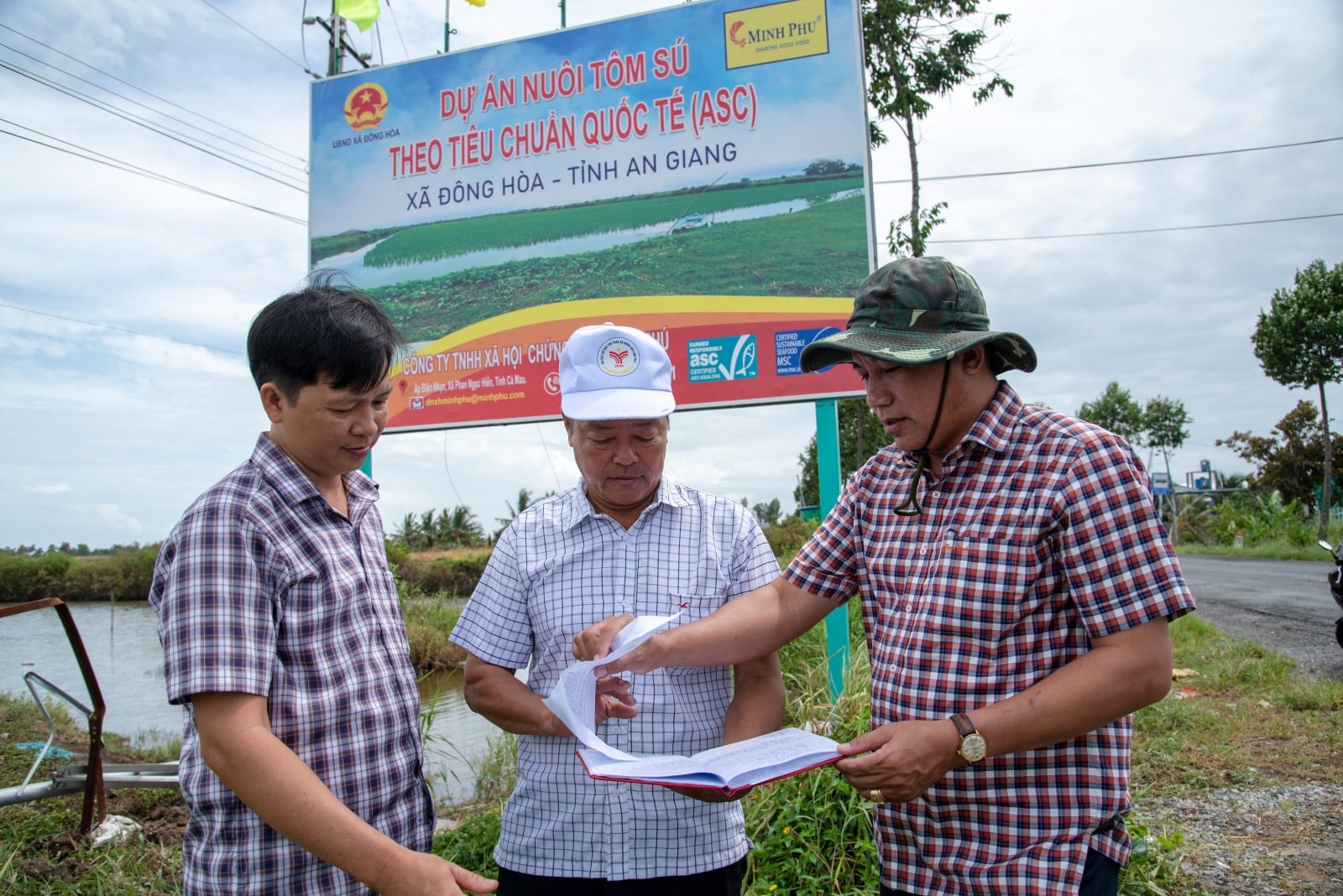
Dong Hoa shrimp has achieved ASC certification after years of efforts to change the farming practices of local people.
But what has troubled Mr. Khanh for many years is that his extensively farmed shrimp, which use almost no chemicals, are still treated the same as market shrimp. Traders buy and sell at whatever price they find, resulting in unstable prices. This worry is not unique to Mr. Khanh. It's also a long-standing issue in the Dong Hoa shrimp-rice farming region for many years; even though the shrimp are clean, there's no way to prove their cleanliness to the market.
When the local authorities started campaigning to build ASC-certified aquaculture zones, many people were discouraged. "Just hearing about international standards scared the farmers. Some said that one failed crop would leave them poor for three years, so they shouldn't do it," Mr. Khanh recounted.
The most difficult part isn't the technique, but the change in habits. From the habit of spraying herbicides to treating algae, they now have to use microorganisms. Even with abundant algae, they can't use chemicals as before; they have to remove it manually, even draining the pond and letting it dry. On the shore, they no longer use herbicides. The broodstock must have disease-free certificates and a clear origin. Most importantly, everything must be meticulously documented.
In the early days, technical staff went directly to the shrimp farms to provide hands-on guidance. Minh Phu Certified Shrimp Company Limited also supported households that followed the ASC process correctly, so that farmers could confidently follow the model. Some people wanted to give up halfway through, and some households found the process cumbersome and considered giving up. But then the first shrimp farms showed results, causing many to change their minds.
At the beginning of the 2026 shrimp farming season, prolonged heatwaves and large temperature differences between day and night caused significant losses in many farming areas. Many shrimp ponds outside the model suffered heavy losses. Mr. Khanh's pond, however, managed to maintain its stock. According to him, farming costs also decreased significantly thanks to replacing chemicals with probiotics. From approximately 20 million VND/hectare, it is now around 12 million VND.
Mr. Khanh said: “I just harvested the first batch, nearly 900kg. The shrimp are growing much faster than before. In the past, it took 5 months to see them grow, but now they reach 30 shrimp per kilogram in 2.5 months. Seeing the effectiveness, more people are registering. This year, the cooperative has 42 participating households, covering an area of nearly 100 hectares.”
Mr. Khanh spoke about achieving ASC certification for shrimp farming as if he were recounting a personal triumph. Initially, hearing about international farming methods, he and the cooperative members were worried about many things, but after doing it for a while, they realized it wasn't the technique that was difficult, but rather breaking old habits. From pond preparation to harvesting, he followed the process meticulously, using disease-free shrimp fry as recommended. Lime and probiotics were all on the permitted list. He no longer applied pesticides whenever he saw algae, as he did before.

People in Dong Hoa are harvesting whiteleg shrimp.
Not far from Mr. Khanh's shrimp farm, Mr. Pham Hoang Tuoc in Thanh An hamlet is also preparing to release a new batch of shrimp fry. This farmer, who owns 1.5 hectares of shrimp ponds, said that he used to think ASC (Aquaculture Stewardship Council) practices were only for large businesses. Now that he's done it, he realizes it's mainly about being willing to change. Mr. Tuoc recounted that before, he raised shrimp based on experience, treating the water quality haphazardly. Now, technical staff come down to guide him through each step, from creating the right water color to treating the microorganisms. "The shrimp are healthier now, with less loss. In just over two months, they've reached 25-30 shrimp per kilogram. We couldn't have achieved that with the old farming methods," Mr. Tuoc said.
The most noticeable change in Dong Hoa now is that shrimp farmers are becoming accustomed to keeping production logs, to saying no to banned antibiotics, and to understanding that clean shrimp is not only for selling at a higher price, but also for more sustainable farming, protecting public health and the ecological environment.
These changes didn't happen overnight. Throughout the project's implementation, households received regular training and guidance on each stage of farming from the commune's economic and technical team, Minh Phu project staff, and input suppliers. From selecting disease-free seeds and treating the water environment to using microorganisms instead of chemicals, everything was taught step-by-step.
According to Nguyen Van Truong, Head of the Economic Department of Dong Hoa Commune: “Thanks to the change in approach, the effectiveness of the model is beginning to be clearly seen with concrete figures. Previously, the yield of extensive shrimp farming only fluctuated around 250-300 kg/ha/season, but now many households achieve 350-450 kg/ha/season. Not only has production increased, but production costs have also decreased due to reduced use of chemical pesticides and a more stable pond environment.”

Nguyen Van Truong (left), Head of the Economic Department of Dong Hoa commune, visits the ASC-certified shrimp farm of Thanh An Shrimp-Rice Cooperative.
In addition to technical support, participating households in the model also receive 1 million VND/hectare/year from Minh Phu Certified Shrimp Social Company Limited, which covers all annual ASC certification maintenance costs. As a result, many previously hesitant households have now confidently registered to participate.
Since 2023, Minh Phu Certified Shrimp Co., Ltd. has collaborated with local authorities to develop internationally certified shrimp farming areas in shrimp-rice cooperatives in Dong Hoa. After numerous training sessions, internal assessments, and independent inspections, by January 2025, the shrimp-rice farming area officially achieved ASC certification, covering over 824 hectares belonging to 259 households.
According to Le Minh Nho, Vice Chairman of the People's Committee of Dong Hoa commune: "The biggest benefit of ASC certification is the change in farmers' production mindset. From raising livestock out of habit to raising them responsibly towards the environment and society. This is very important if we want to succeed in the long run."
In early 2026, the Control Union organization conducted a periodic monitoring assessment for 2025. The results showed that 817.7 hectares with 254 households in Dong Hoa continued to maintain good shrimp farming practices that meet the international ASC certification – a figure that demonstrates the model is no longer an initial experiment, but is gradually becoming a sustainable direction for the shrimp-rice farming region of U Minh Thuong.
Mr. Lam Thai Xuyen, Director of Minh Phu Certified Shrimp Company Limited, believes that the most valuable thing is that the farmers of Dong Hoa have been able to tell their own shrimp story to the world market. “To go far, we must cooperate. From the people, cooperatives, input suppliers to processing plants, everyone must work together.”
According to Mr. Xuyen, the shrimp-rice farming model in Dong Hoa has many natural advantages for sustainable development. Not only does it reduce disease risks, but it also helps improve water quality and produce cleaner products.
Currently, Dong Hoa commune has approximately 15,000 hectares of shrimp-rice farming. According to the Resolution of the Commune Party Congress for the period 2025-2030, the locality aims to have 4,500 hectares of shrimp farming certified under the ASC standard.
To achieve this goal, Dong Hoa commune is focusing on promoting the role of the Party committee, government, and mass organizations in mobilizing people to change their production mindset and expand the area of clean shrimp farming associated with international standards such as ASC, BAP, and organic shrimp.
The locality also aims to reorganize production towards close linkages between cooperatives and businesses supplying inputs and guaranteeing outputs, forming concentrated farming areas to serve processing and export. Simultaneously, it will strengthen the application of science and technology, introducing advanced management methods into improved extensive farming areas to create clean, traceable products.
In this development story, what local leaders expect is not just a few thousand more hectares to achieve international certification, but to preserve the long-term livelihoods of the people of Dong Hoa in the context of increasingly severe climate change.
Text and photos: DANG LINH
Source: https://baoangiang.com.vn/tom-dong-hoa-dat-chuan-asc-chuyen-bay-gio-moi-ke-a486254.html
![[Image] Close-up view of the interchange connecting the two expressways and Long Thanh Airport.](https://vphoto.vietnam.vn/thumb/1200x675/vietnam/resource/IMAGE/2026/05/25/1779703378210_ndo_br_z7863716673926-224453a31600126cce10622af6290afd-4549-jpg.webp)
![[Image] Hanoi's urban life under the challenge of a "scorching hot" environment](https://vphoto.vietnam.vn/thumb/1200x675/vietnam/resource/IMAGE/2026/05/25/1779706979265_nang-nong-t5-2026-minh-duy-7-4636-jpg.webp)











































































Comment (0)