


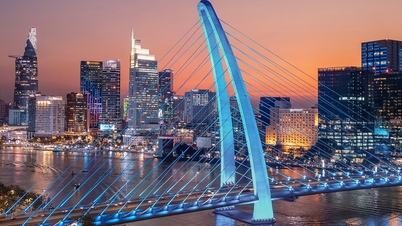
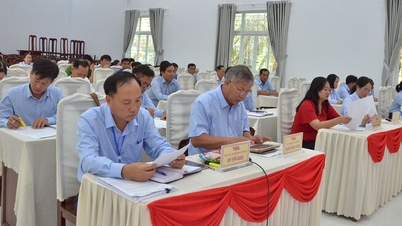
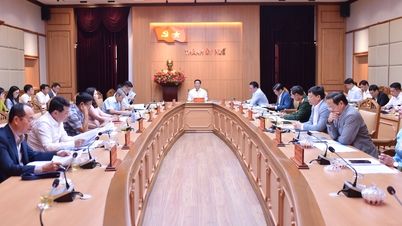
In her opening remarks, Ms. Nguyen Thi Le, Chairwoman of the Ho Chi Minh City People's Council, stated that the report on the planning of Ho Chi Minh City for the period 2021-2030, with a vision to 2050, is an important content, serving as a basis for reviewing, adjusting, supplementing, and developing other plans, and providing direction for managing and operating the city's development process.
"Urban planning is a key factor in guiding development, creating favorable conditions for socio -economic and cultural development, protecting the environment, and improving the quality of life for the people. This planning contributes to laying the groundwork for Ho Chi Minh City to become the economic, financial, commercial, and science and technology center of the country and the region, meeting the requirements of international integration," Ms. Le stated.
Approximately $360 billion is needed to implement 199 projects.
Reporting at the session, Ms. Le Thi Huynh Mai, Director of the Department of Planning and Investment of Ho Chi Minh City, stated that this plan aims for Ho Chi Minh City to become a global, civilized, modern, compassionate, dynamic, and innovative city by 2030.
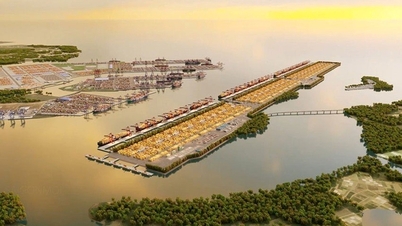
Regarding the development of functional zones, the Director of the Department of Planning and Investment stated that the economic zone will form a free trade zone (FTZ) connected to the Can Gio international transshipment port and Ganh Rai Bay, with a scale of approximately 1,000 - 2,000 hectares; industrial parks, export processing zones, and industrial clusters including 37 industrial parks, 3 export processing zones, and 7 industrial clusters with a total area of over 10,461 hectares; 4 high-tech zones with a total area of approximately 1,331 hectares; and high-tech agricultural zones with a total area of approximately 1,251 hectares.
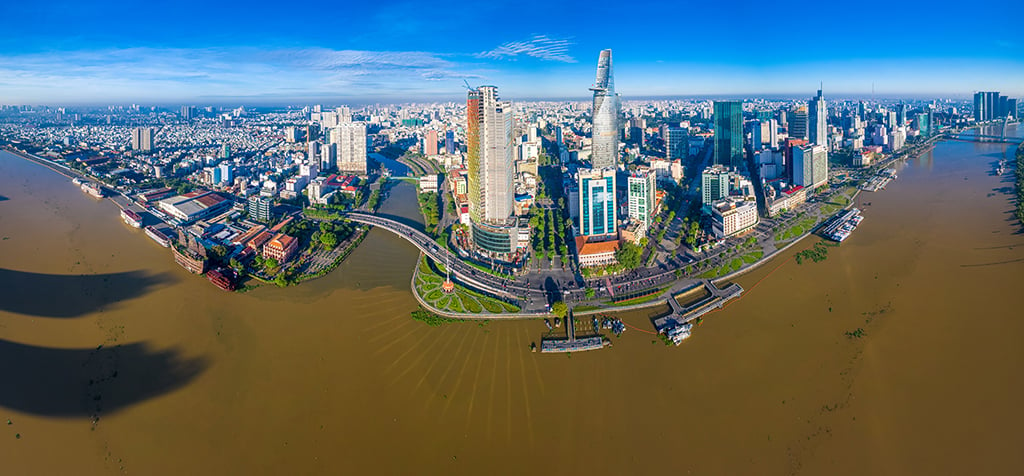
According to the plan, Ho Chi Minh City will become the economic, financial, commercial, and science-technology center of the country and the region, meeting the requirements of international integration.
In addition, there are other functional zones including 14 tourist zones; 3 research and training zones; 8 sports zones; 11 cultural zones; 1 international financial center; concentrated agricultural production areas; areas requiring preservation, restoration, and rational exploitation (Can Gio mangrove forest biosphere reserve); reclaimed land areas in Can Gio and military and security zones; and areas with a driving role linked to the above functional zones, including the central urban area; Thu Duc City; the southern area (District 7 and Nha Be District); Can Gio District; Binh Chanh District, Hoc Mon District, and Cu Chi District.
According to the Ho Chi Minh City master plan, approximately 199 projects are expected to be implemented, including 72 key projects with special investment priority, totaling about 360 billion USD.
After hearing the report, the delegates also raised the issue of needing to specify certain targets and clearly identify key areas to help Ho Chi Minh City grow, such as education, healthcare, and land development.
The goal is to achieve double-digit growth after 2030.
At the meeting, Chairman of the Ho Chi Minh City People's Committee Phan Van Mai acknowledged the delegates' opinions to further refine the city's planning document for submission to the State Appraisal Council for consideration before finalizing and submitting it to the Prime Minister for approval.
Regarding the planning documents, Mr. Mai stated that the Ho Chi Minh City People's Committee is directing relevant units to clarify 149 contents in the planning documents and 18 contents of the strategic environmental assessment to complete the documents urgently and on time, while also making every effort to obtain the best possible plan.
According to the Chairman of the People's Committee of Ho Chi Minh City, the goal is to ensure that this plan is as integrated as possible, meeting requirements and being consistent with other plans: national specialized plans, national strategic plans, regional plans, and city plans…
"The city planning is a strategic development orientation plan, which will then be further specified in the overall plan of Ho Chi Minh City and will be more detailed in subsequent projects, programs, and initiatives of the city. Specific opinions from delegates regarding functional zones, the proportion of agricultural land in the total land area of the city, land use planning issues, the development of implementation plans, management, and execution of plans, or other specific issues will be thoroughly studied in accordance with the law and the practical realities of Ho Chi Minh City," Mr. Mai stated.
Regarding the issue of land allocation for the development of religious facilities, Mr. Mai stated that the extent to which religious facilities can be built in each plan is carried out according to regulations.
Similarly, other functional areas will continue to be thoroughly reviewed and studied to ensure the best possible conditions for development.
Regarding growth targets and GDP per capita, Chairman of the Ho Chi Minh City People's Committee Phan Van Mai stated that, during the planning period of 2021-2030, Ho Chi Minh City aims for an annual growth rate of 8.5-9%. This is a very challenging growth rate for Ho Chi Minh City, but it requires careful planning, strategies, solutions, and investment to achieve it by 2030; and after 2030, the city's growth should exceed double digits (over 10%).
"Therefore, Ho Chi Minh City will have a very specific plan, which will identify key investment projects, have breakthrough solutions, and allocate appropriate resources for implementation. This will be accompanied by amendments to institutions, mechanisms, and policies so that the city can mobilize resources for investment and development. Once bottlenecks are removed, we have the potential to achieve this growth," said a leader of Ho Chi Minh City.
Furthermore, Ho Chi Minh City will maintain its four key industrial sectors and nine main service sectors, but will select segments that generate high added value and are suitable for the city's situation for development. The remaining segments will be developed in other areas through regional linkages.
Regarding urban development and functional zones, Ho Chi Minh City will conduct a thorough review to integrate this plan into the overall Ho Chi Minh City master plan.
"From now until 2030, we will maintain the current administrative and urban structure, which includes the central urban area, Thu Duc City, 16 districts, and 5 counties. We will strengthen the internal capacity of all these urban areas and administrative units, while also striving to clearly define a 'city within a city' for Thu Duc. As for the 5 counties, we will implement projects to build technical infrastructure to achieve urban standards. Whether these 5 counties of Ho Chi Minh City will be upgraded to districts or cities still needs to be reconsidered, but at least they must meet the standards of a type 3 urban area," Mr. Mai said.
In addition, Ho Chi Minh City will continue to implement the Prime Minister's suggestion on the "city within a village, village within a city" model.
"I think with this mindset, each urban area must have ecological elements, and more broadly at the level of Ho Chi Minh City, we are a special urban area but also have buffer zones, rural areas, and reserve land. Thus, the 'city within a village, village within a city' concept will continue to be studied and concretized in this planning as well as the overall planning of Ho Chi Minh City," Mr. Phan Van Mai concluded.
Establish security and order protection teams in neighborhoods and hamlets.
Also at this session, the Ho Chi Minh City People's Council passed a Resolution stipulating the criteria for establishing security and order protection teams; criteria for the number of members of security and order protection teams; and the level of support, allowances, and expenditure for forces participating in security and order protection at the grassroots level in Ho Chi Minh City.
Accordingly, each neighborhood or hamlet will establish a security and order protection team. The number of team members will be allocated according to the population size of each neighborhood or hamlet. Neighborhoods or hamlets with a population of up to 2,700 will have 3 members: 1 team leader, 1 deputy team leader, and 1 team member. Neighborhoods or hamlets with between 2,700 and 3,600 inhabitants will have an additional team member; and for every additional 900 inhabitants, an additional team member will be added.
The regular monthly allowance for the team leader is 6.5 million VND; for the deputy team leader, 6.3 million VND; and for team members, 6 million VND.
Those participating in local security and order protection forces receive 100% support for voluntary social insurance contributions based on the regular monthly support level and 100% support for annual health insurance contributions.
Source: https://thanhnien.vn/tphcm-phan-dau-tro-thanh-do-thi-toan-cau-185240622203253758.htm
![[Photo] Nhan Dan Newspaper's New Year's gathering in the year of the Horse 2026](https://vphoto.vietnam.vn/thumb/1200x675/vietnam/resource/IMAGE/2026/02/23/1771825639110_gap-mat-dau-xuan1-8272-jpg.webp)

![[Photo] General Secretary To Lam meets with and extends New Year greetings to the Central Party Office.](https://vphoto.vietnam.vn/thumb/1200x675/vietnam/resource/IMAGE/2026/02/23/1771822040571_a1-bnd-6844-9653-jpg.webp)



















































Comment (0)