

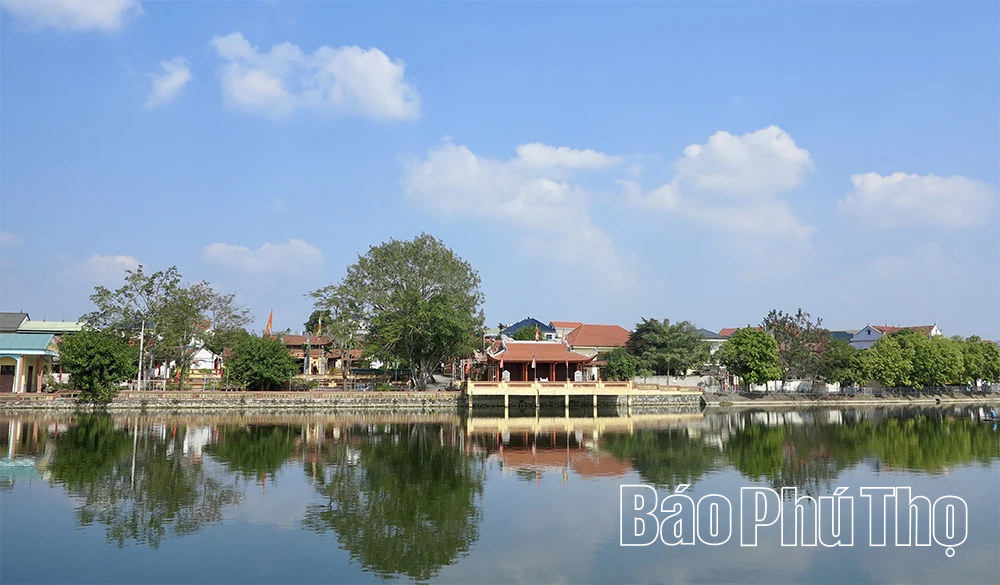
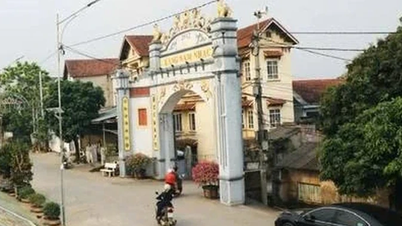
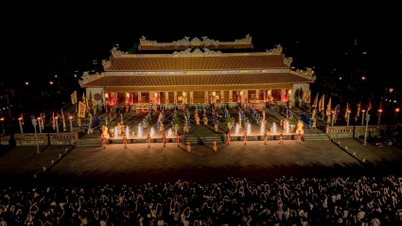
A view of the Son Vi communal house complex in Phung Nguyen commune.
Traces of ancient land
These days, the countryside of Phung Nguyen is more vibrant than ever. The inter-village roads are neatly maintained, and the bright red and yellow flags of the Vietnamese flag stand out against the spring sunshine and breeze; the atmosphere of preparing for the traditional Lunar New Year permeates every house and alleyway. In this rhythm of life, the historical depth of this ancient land remains present, becoming a spiritual anchor for its development today.
Phung Nguyen is a rare and exemplary locality that brings together three major archaeological cultures: Son Vi, Phung Nguyen, and Go Mun, reflecting the continuous development of ancient Vietnamese people from the Paleolithic to the Metal Age. This is vivid evidence affirming that Phung Nguyen is one of the important cradles of ancient Vietnamese civilization, associated with the pre-Hung Vuong period and the Hung Vuong period of nation-building. The first stop is Son Vi village in the days leading up to Tet (Lunar New Year), where one can easily feel the harmony between the past and the present. The village is located on a fertile low hill, carrying within it a rich history of thousands of years. Son Vi, the name given to the Son Vi Culture, still preserves many ancient customs and village traditions, cherished and passed down through generations by its people.
Phung Nguyen commune currently has 44 historical and cultural relics, including 12 national-level relics and 11 provincial-level relics. The system of communal houses, temples, pagodas, and shrines is widely distributed, dedicated to generals of the Hung King era, village tutelary deities, human deities, and nature deities, creating a rich spiritual space closely intertwined with community life. A prime example is Do Nghia communal house – a national-level historical relic, built on a land "resting on mountains, facing water," dedicated to the Water God Dai Hai Cong. The communal house not only possesses architectural and historical value but also serves as a center for cultural and religious activities, connecting the community and fostering the principle of "drinking water, remembering the source." Besides its tangible heritage, Phung Nguyen is also notable for its 20 traditional festivals maintained annually, mainly concentrated in the spring. In particular, the Tro Tram festival – a unique folk religious activity – has been recognized as a National Intangible Cultural Heritage, becoming a great source of pride for the local people and contributing to enriching the cultural identity of the ancestral land.
Speaking with us, Ms. Nguyen Thi Thuy Linh, Vice Chairman of the People's Committee of Phung Nguyen commune, said: "Phung Nguyen clearly defines its responsibility to preserve and promote the value of tangible and intangible cultural heritage, considering this an important spiritual foundation in the development process. Culture is the intrinsic strength for sustainable local development."
A lively atmosphere to welcome the Lunar New Year.
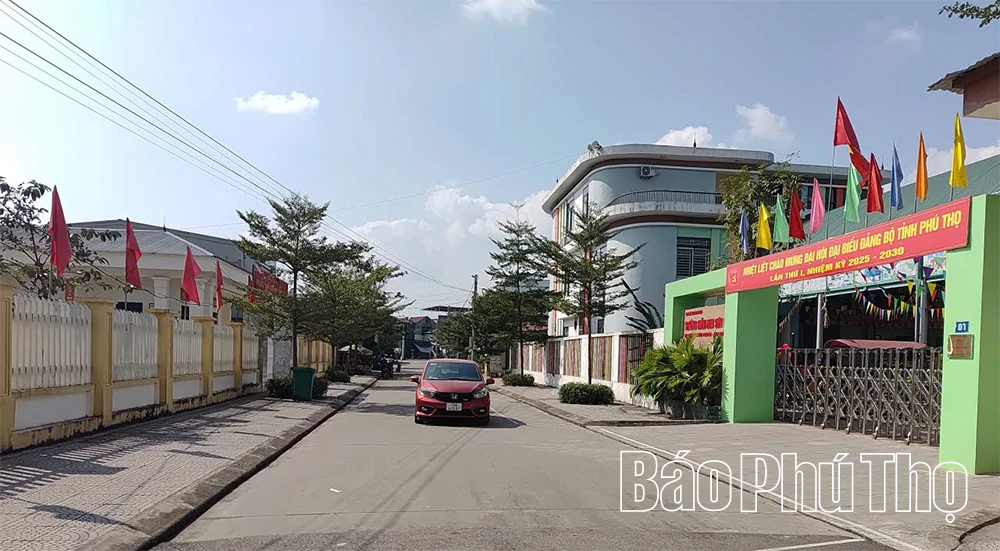
The roads and infrastructure have been built solidly, making Phung Nguyen increasingly modern and civilized.
The arrival of the new spring also marks a time to reflect on a year of hard work and significant development for Phung Nguyen commune after its merger. In the context of a large geographical area and varying development conditions across different regions, the commune's Party Committee has effectively exercised comprehensive leadership, promptly consolidating its organization, unifying its thinking, and developing and implementing resolutions that are practical and relevant to real life. This has resulted in concrete and effective programs and plans that translate the Party's resolutions into reality.
Agriculture continues to be identified as a crucial foundation, developing towards commodity production, near-urban areas, and increasing value per unit area. High-quality rice production areas are maintained stably; the area of advantageous crops such as safe vegetables and bananas is expanded, with a focus on improving product quality and value. Aquaculture continues to develop in an intensive direction, contributing to stabilizing people's income. The One Commune One Product (OCOP) program is actively implemented, gradually forming distinctive local products. Along with agriculture, industry, handicrafts, and private sector development are identified as important drivers of growth. Industrial clusters and craft villages are managed and exploited effectively; Industrial and small-scale manufacturing activities remain stable with key products such as packaging, building materials, and carpentry. The Hop Hai - Kinh Ke Industrial Cluster and the Son Vi Craft Village have created jobs for thousands of local workers, contributing to the shift in labor structure and improving the lives of the people.
In 2025, total state budget revenue in the area reached nearly 303 billion VND, achieving 452.9% of the target set in the resolution. The commune has 156 operating businesses, exceeding 106% of the target set in the resolution, clearly reflecting the flourishing investment and business environment and the increasingly prominent role of the private sector in local economic development. The socio-cultural sector continues to receive comprehensive attention. The poverty rate has decreased to 0.92%; the movement to build a cultured way of life is effectively maintained. The new rural development program continues to improve in quality; to date, the commune has 30 out of 43 model new rural residential areas and 7 out of 43 smart new rural residential areas, creating an increasingly modern and civilized rural landscape.
Sharing his vision for development, Comrade Cao Van Thang, Secretary of the Party Committee and Chairman of the People's Council of the commune, emphasized: "After the merger, the commune's Party Committee identified its central task as promoting the tradition of unity and solidarity, while focusing on leading economic development and improving the people's lives. The overarching goal is rapid but sustainable development, with the people at the center and culture as the foundation."
The Spring of the Year of the Horse is present in every village of Phung Nguyen. Amidst the spreading spring colors, this ancient land emerges with renewed hope and spirit. The economy continues to flourish, the material and spiritual lives of the people are constantly improving; traditional cultural values are preserved and promoted. All these elements blend together, creating a picture of Phung Nguyen that is both rich in local identity and steadfast on its path of development in this new era.
Anh Tho
Source: https://baophutho.vn/dat-lang-phung-nguyen-247939.htm



![[Image] Nearly 125,000 Hanoi students completed the Literature exam for the 10th grade entrance exam.](https://vphoto.vietnam.vn/thumb/1200x675/vietnam/resource/IMAGE/2026/05/30/1780117233041_ndo_br_thiet-ke-chua-co-ten-2-png.webp)































































Comment (0)