

Pressure from the numbers
Ho Chi Minh City and Hanoi are the two localities with the largest number of students in the country. The high rate of population growth due to migration has led to a constant shortage of school places in public high schools.
In Hanoi, statistics from the Department of Education and Training show that this year the city has approximately 147,000 students graduating from junior high school, an increase of about 20,000 students compared to last year. Meanwhile, the total enrollment quota for public high schools is only over 78,300, equivalent to 55% of students having the opportunity to enter public high schools.
In Ho Chi Minh City, every year, the Department of Education and Training has to organize an exam for tens of thousands of candidates to select students for public schools, a process that is considered very limited in terms of available places.
The Ho Chi Minh City Department of Education and Training announced that the education sector is gradually researching a new enrollment model suitable to the conditions of each locality. Accordingly, from the next school year, areas with sufficient facilities and educational resources may apply a selection process for grade 10 admissions instead of the current centralized entrance exam. In the 2025-2026 school year, Ho Chi Minh City will have nearly 170,000 students completing the lower secondary education program. Of these, over 150,000 will register to take the entrance exam for public grade 10, while more than 17,000 students will have to choose other paths.
For many years, Ho Chi Minh City has issued a temporary set of standards for universal secondary education, including lower secondary and upper secondary education, aiming to achieve universal upper secondary education in accordance with the Party and State's policy. Following this direction, when the system of various types of schools is developed synchronously, including public and private upper secondary schools, vocational schools, and vocational education and continuing education centers, students will have more opportunities to choose a learning model that suits their abilities, family circumstances, and career aspirations.
This locality also aims to gradually reduce the mass entrance exam for 10th grade, moving towards applying a selection method with criteria that ensure fairness, suitability to students' abilities and aspirations, and prioritize schools near their place of residence.
According to the Ho Chi Minh City Department of Education and Training, this year, the first year of 10th grade enrollment after the merger, Thanh An island commune and Con Dao special zone have implemented a selection process for 10th grade. In the coming years, the education sector will continue to research expanding this to areas with sufficient facilities and student numbers.
Comprehensive solutions are needed.
To realize the roadmap for reducing enrollment pressure, the most important issue currently is infrastructure. Ho Chi Minh City is implementing a "150-Day Campaign" to complete approximately 1,000 new classrooms for the 2026-2027 school year.
In addition, more than 100 school projects are being reviewed and accelerated. The city aims to achieve a ratio of 300 classrooms per 10,000 people of school age, thereby expanding enrollment and reducing the long-standing overcrowding problem.
Experts believe that the 10th-grade entrance exam is not just a matter of whether or not to take it, but reflects the entire educational structure and social psychology. If the exam is abolished without addressing the shortage of schools, the pressure will immediately shift to a race to obtain residency permits, school records, or other even more complex forms of covert competition. To truly reduce pressure, the education system must address the root causes of the problem.
To achieve the goal of reducing the burden on public high schools, the most crucial and fundamental challenge is to improve the learning capacity of the public high school system. When the majority of students have suitable places to study, the role of the exam will naturally diminish.
In Hanoi, the city plans to build approximately 90 more high schools by 2030. Specifically for the 2026-2027 school year, four new schools are expected to open: Hoang Quan Chi High School (Yen Hoa), Viet Hung High School (Dong Anh), Xuan Khanh High School (Son Tay), and Vinh Hung High School (Vinh Hung).
Despite the trend of abolishing mass entrance exams for 10th grade, many education administrators still express concerns about fairness, the pursuit of excessive academic achievement, and the risk of "falsifying report cards" if the transition is too rapid.
A literature teacher at a high school in Thu Duc District, Ho Chi Minh City, frankly shared that maintaining entrance exams for top-tier schools is necessary because the city needs high-quality human resources. Without exams, some students might lose motivation to study, leading to the dangerous consequence of students progressing to the next grade without studying. In particular, evaluating academic transcripts is prone to corruption because the assessment criteria of each junior high school lack consistent reliability.
In fact, in the past, Hanoi and Ho Chi Minh City used to conduct entrance exams for 10th grade. However, this practice was discontinued after a short time due to numerous problems and shortcomings.
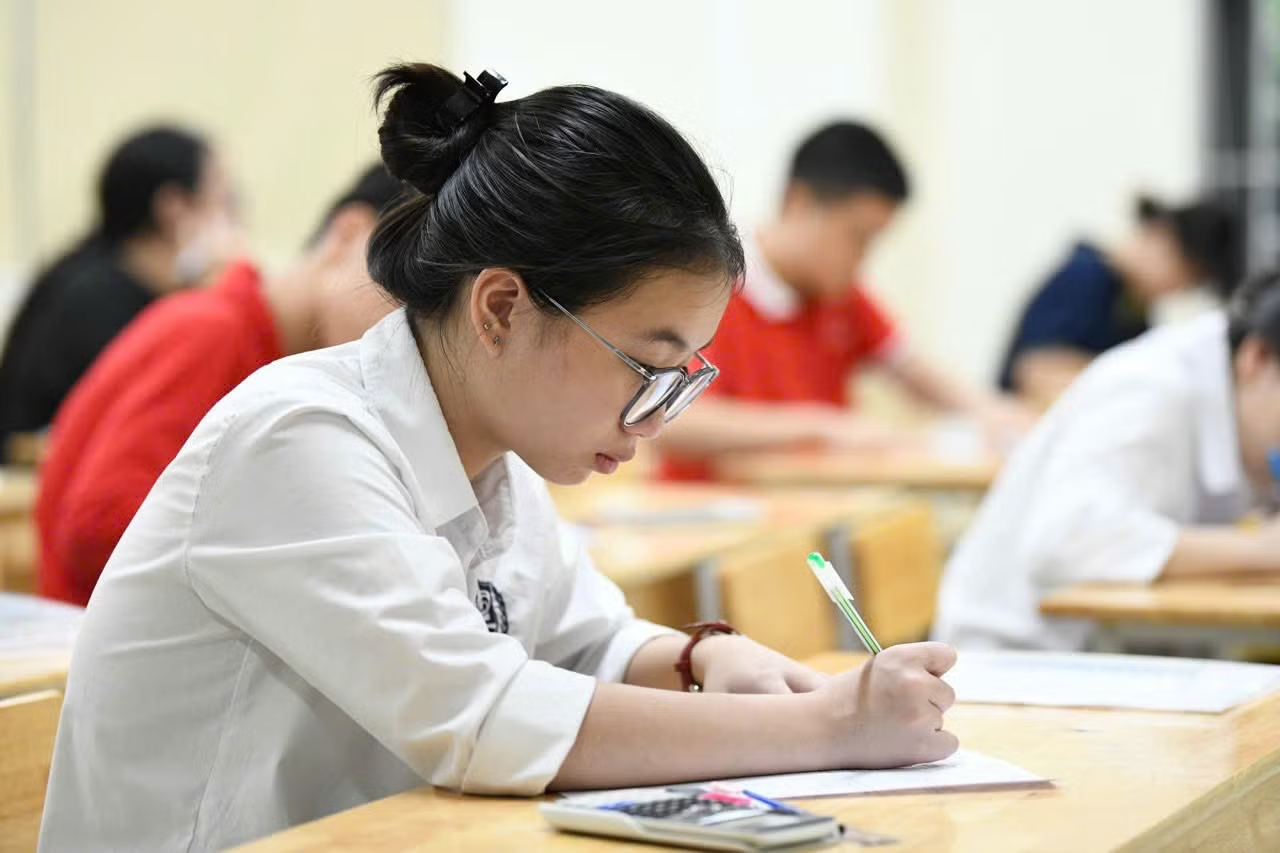
Discussing the intense pressure of the 10th grade entrance exam in Hanoi, Ms. Nguyen Thi Van Hong, Principal of Chuong Duong Secondary School (Hanoi), stated that to truly alleviate the pressure on students, a comprehensive solution is needed, considering all three aspects: family, school, and society. This is because the current pressure stems not only from the exam structure but largely from the "must get into a top school" mentality of parents and students.
From a management perspective and with direct support for graduating students, the Principal of Chuong Duong Secondary School has proposed five core solutions. Firstly, changing the perception of success. Many parents still assume that getting into a top-tier public school is the only path. In reality, students have many suitable options such as high-quality private schools, vocational schools, dual-degree programs, etc. When parents reduce their pressure and stop comparing their children to others, students will have less psychological burden and be able to best develop their inherent abilities.
The race to get into 10th grade can only cool down when society becomes less dependent on it. A decisive expansion of schools combined with flexible streaming will help resolve this bottleneck and restore the true value to students' development.
Next, review early but avoid overwhelming students. What exhausts students is prolonged stress throughout the school year. Schools need to organize differentiated review sessions based on ability, increase mock exams moderately, and focus on helping students systematize key knowledge, avoiding endless practice tests.
Thirdly, psychological support goes hand in hand with academic counseling. This helps students manage their time and relieve exam stress, preventing them from studying well but losing their composure during the test.
Next, don't turn exam season into a "family battle." Instead of constantly reminding students about grades, which can be suffocating, what students need most during this crucial period is a relaxed living environment and the reassurance that their parents are always there to support them.
Finally, at the macro level, in the long term, Hanoi needs to invest in infrastructure, increase the number of public schools in densely populated areas, standardize quality among schools, and promote career guidance after lower secondary school. At the same time, it needs to provide clear admissions information so that parents have a more realistic perspective.
Source: https://tienphong.vn/tphcm-se-to-chuc-xet-tuyen-lop-10-post1844682.tpo


![[Image] Hanoi's urban life under the challenge of a "scorching hot" environment](https://vphoto.vietnam.vn/thumb/1200x675/vietnam/resource/IMAGE/2026/05/25/1779706979265_nang-nong-t5-2026-minh-duy-7-4636-jpg.webp)
![[Image] Close-up view of the interchange connecting the two expressways and Long Thanh Airport.](https://vphoto.vietnam.vn/thumb/1200x675/vietnam/resource/IMAGE/2026/05/25/1779703378210_ndo_br_z7863716673926-224453a31600126cce10622af6290afd-4549-jpg.webp)
















































































Comment (0)