

(NLĐO) - This area of Mongolia was once an ocean for 115 million years, after boiling rocks from the Earth's crust rose up, tearing apart a vast region.
According to Live Science, a new study has found evidence that the desert country of Mongolia today was once an ocean. Even more astonishing, it was an unusual ocean, created when a sudden mantle burst ripped through the Earth's crust.
Previously, the authors were fascinated by volcanic rocks in northwestern Mongolia from the Devonian period (419 million to 359 million years ago).
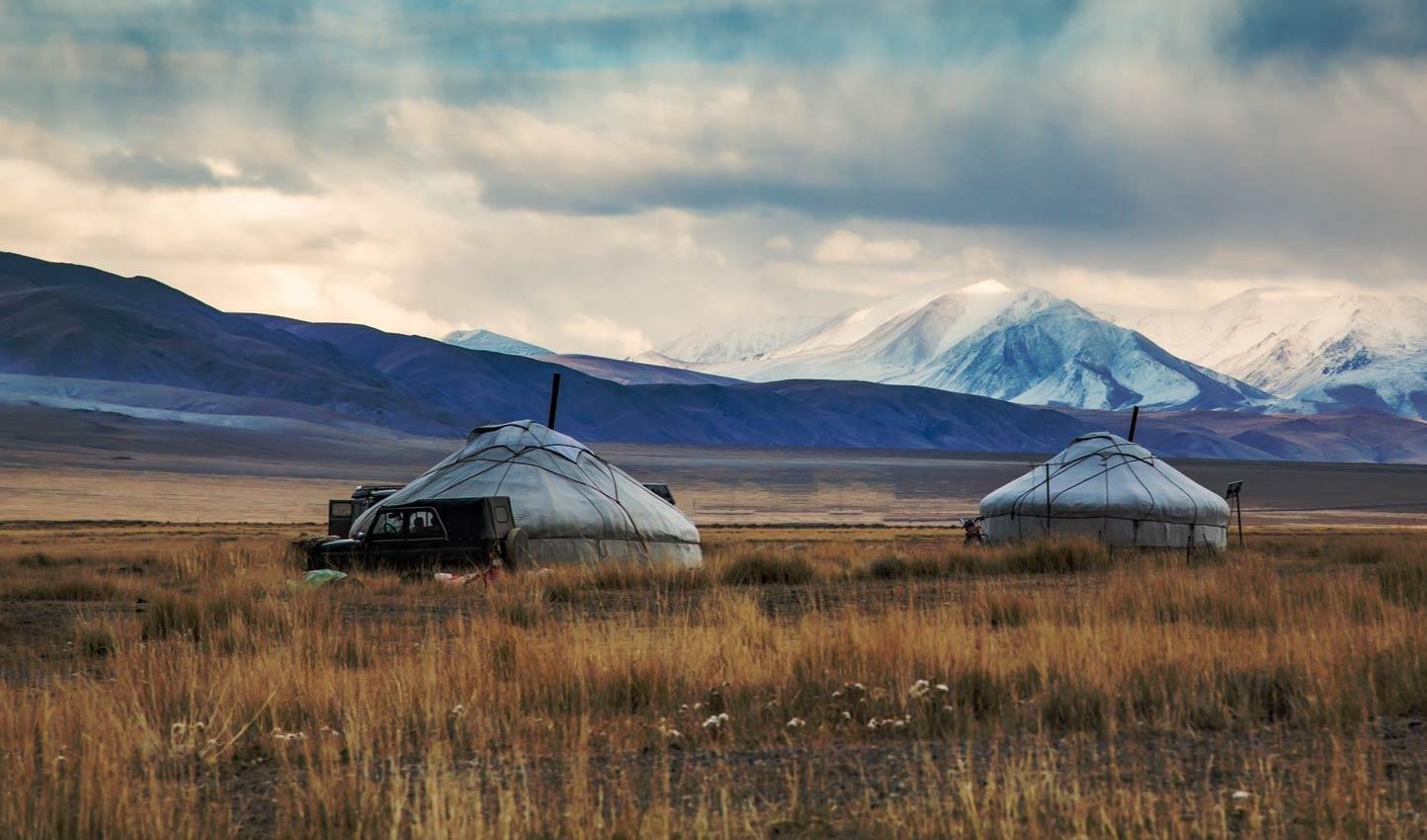
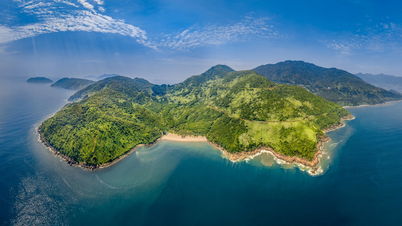
The desert region of northwestern Mongolia today was once home to the Mongol-Okhotsk Ocean, formed by the tearing apart of the Earth's crust - Photo: ESCAPE TO MONGOLIA
The Devonian period is also known as the "age of fish," when fish species unexpectedly diversified and increased dramatically in number in the oceans, while vegetation began to cover the land.
At that time, Earth had only two supercontinents, Laurasia and Gondwana, along with a long chain of subcontinents that would eventually become present-day Asia. These subcontinents gradually collided and merged in a process called accretion.
The research team conducted field surveys in northwestern Mongolia, where rocks from the collisions that formed the continent are exposed on the surface.
They discovered that between approximately 410 million and 415 million years ago, an ocean called the Mongol-Okhotsk Ocean opened up in the region.
The chemical composition of the volcanic rocks associated with this fissure has revealed the presence of a seething mantle, which tore through the Earth's crust to create the aforementioned ocean.
Mantle plumes are unusually hot columns of material rising from deep within the Earth's mantle.
Professor Mingshuai Zhu from the Chinese Academy of Sciences explained: “Mantle plumes are often involved in the first phase of the Wilson cycle, marking the breakup of continents and the opening of oceans, such as the Atlantic.”
In many cases, this happens right in the middle of a solid landmass, tearing it apart.
The geological factors in the case of Mongolia are particularly complex, as this mantle flow tore apart the previously formed crust that had just reassembled through deposition.
According to Professor Zhu, this could be due to the newly formed continent having weak points, which the mantle currents have exploited.
However, this ocean only existed for 115 million years before being closed off by the Earth once again, so today we see Mongolia situated in a vast desert.
The formation of these ancient oceans was very slow, with land expanding only a few centimeters each year. Similar mantle events may be occurring in other parts of the Earth today.
A prime example is the Red Sea, with its shores gradually expanding by about 1 cm per year.
The rift in the Red Sea is even larger than what existed in Mongolia in the past. Therefore, in the next tens of millions of years, the narrow Red Sea of today could transform into a vast new ocean in East Africa.
Source: https://nld.com.vn/trai-dat-tung-rach-toac-o-mong-co-dai-duong-moi-ra-doi-196240628111114712.htm

![[Photo] Prime Minister Pham Minh Chinh presides over the conference announcing the establishment of the International Finance Centre in Vietnam.](/_next/image?url=https%3A%2F%2Fvphoto.vietnam.vn%2Fthumb%2F1200x675%2Fvietnam%2Fresource%2FIMAGE%2F2025%2F12%2F21%2F1766309817714_ndo_br_dsc-3400-jpg.webp&w=3840&q=75)

![[Photo] Prime Minister Pham Minh Chinh presides over a meeting on private sector economic development.](/_next/image?url=https%3A%2F%2Fvphoto.vietnam.vn%2Fthumb%2F1200x675%2Fvietnam%2Fresource%2FIMAGE%2F2025%2F12%2F20%2F1766237501876_thiet-ke-chua-co-ten-40-png.webp&w=3840&q=75)



















































































Comment (0)